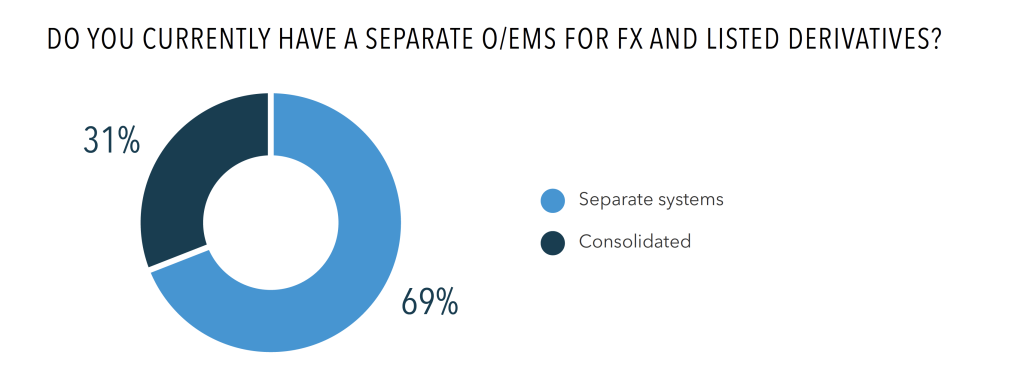
Foreign exchange (FX) occupies a unique place alongside other members of the big four asset classes. It is much less likely to be traded for alpha generation than equity, credit or rates. Instead, many approach the market as a mechanism for access, as investors and proprietary trading firms use it to rotate into non-domestic markets. As such, the FX function has often sat separately from other trading desks. A common setup for listed derivatives desks, for example, has been to call a separate floor when they need the currency to trade non-domestic equity and fixed income markets.
However, recent trends in buy-side operations and market dynamics have been pushing change in these assumptions. More firms are starting to integrate FX into a multi-asset approach to trading. The motivations for doing so range from the rise of multi-asset trading models at buy-side firms, to more firms seeking alpha in FX itself. For many firms, the move to multi-asset trading is driven by cost efficiency. Firms that previously hired a trader for each asset class are often moving towards a more lightly staffed and centralized trading desk where traders have responsibility for more than one asset class. This consolidation has been supported by the rise of electronic trading protocols.
Whether it is a European hedge fund seeking dollars to access U.S. equity markets or a proprietary trading firm looking to add FX as another asset class to trade, FX is increasingly coming into the fold of other trading desks. This trend is running at the same time as a gathering buy-side wide focus on controlling trading costs, both to fine-tune strategies that rely on fine margins and to boost shareholder returns through an optimized cost structure around functions such as margin. Such efficiencies are not being pursued in the front office. Synergies are much more likely to be sought further along the trade life cycle by consolidating systems and workflows where possible. Any consolidation project of that scale will be a substantial one, however.
In order to better understand the challenges involved, as well as the potential payoffs, Trading Technologies commissioned research company Acuiti to survey 65 trading firms on their current approach to FX and how they view its integration with other asset classes. Firms participating in the survey comprised a roughly even split between hedge funds, proprietary trading firms and asset managers.
Source: Trading Technologies and Acuiti
THE KEY FINDINGS OF THIS REPORT WERE:
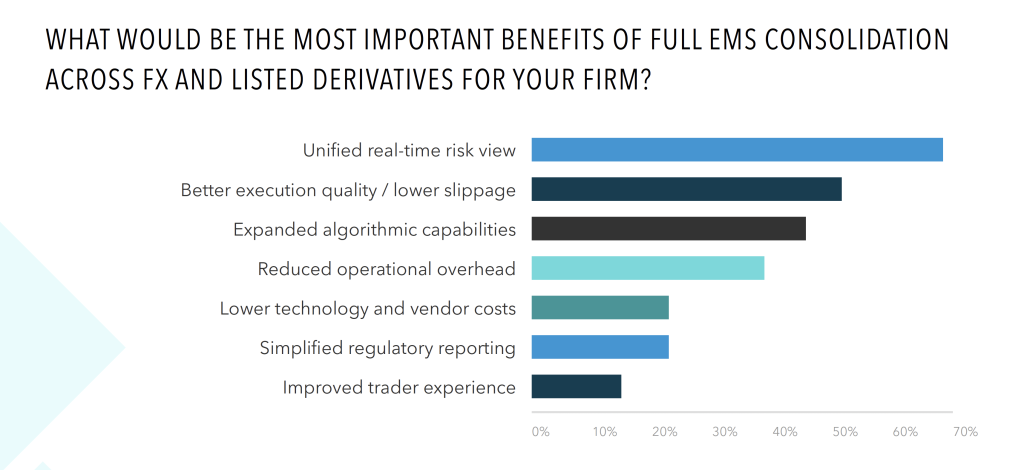
- For 69% of survey respondents, a unified real-time view of risk is the greatest benefit of full execution management system (EMS) consolidation between FX and other asset classes
- Basis trades are at a particular risk of EMS complexity, with leg synchronization across venues proving to be a prominent pain point
- Trade reconciliation across venues as well as position and P&L reporting latency were cited as the two greatest post-trade challenges of running separate systems
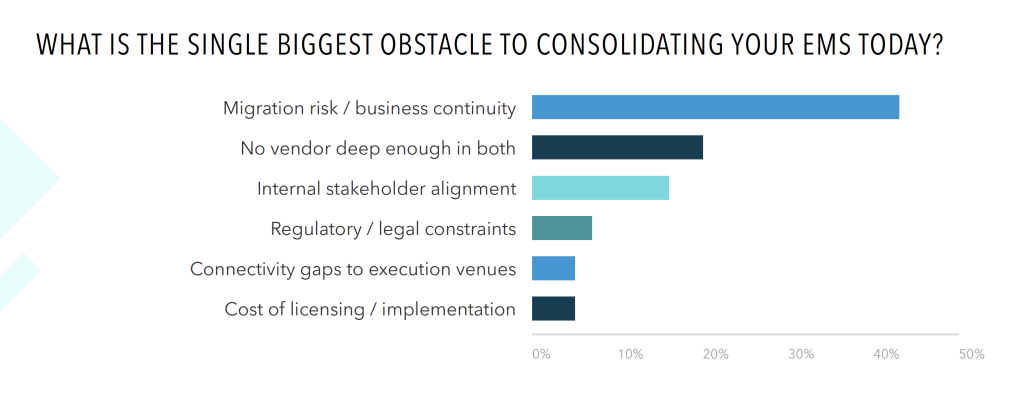
- Migration risk was pointed to by 43% of survey respondents as the biggest single obstacle to EMS consolidation of FX and other asset classes
RESOLVING PAIN POINTS THROUGH CONSOLIDATION
The extra costs of running separate trading systems make consolidation worth exploring for many firms.
Not only does this open the door to potential synergies that can simplify workflows and reduce overall costs, but it can also create room for more auditable, standardized benchmarks that serve as the base for a more streamlined multi-asset trading operation.
A real-time view of risk was the greatest benefit of full EMS consolidation with FX and other systems cited by survey respondents. This focus on cross-asset risk has increased in the wake of several events in equity markets since 2020, including severe losses on dividend linked structured products and the collapse of Archegos Capital.
Those concerns have also dovetailed with an ever-growing focus on margin management. With volatility becoming a more constant feature of markets in the post-quantitative easing era and margin calls concurrently becoming more frequent, demand for real-time monitoring of risk positions has risen. As such, a unified view of risk has become highly desirable, especially one that crosses asset classes to provide the broadest possible oversight of a firm’s trading activity.
Survey respondents also commonly cited better execution quality as a key benefit of EMS consolidation. Here, the ability to create a more unified view of trading positions can reduce timing gaps as well as more consistent order controls and routing logic. Similarly, a trading operation that is able to bring greater standardization across systems also stands to improve algorithmic capabilities across the asset classes they trade.
This is, again, an advantage for firms seeking to improve spreading tools for strategies like the basis trade. Notably, improved trader experience ranked bottom of the list. This highlights the primacy of middle and back-office operational considerations over “pure” front-office improvements at many institutions. Internal signoff on new technology is often much more likely when it is a platform offering durable efficiencies across trading workflows, rather than front-office functionality that gives a trader an edge in the markets.
Any substantial technology investment project is likely to involve considerable scrutiny though, due to its consumption of internal resources. Indeed, migration risk ranked as the single biggest obstacle for firms considering EMS consolidation. The cost of displacement for firms that already trade FX, even if inefficiently, can often result in corporate inertia. Internally, teams are often wary of the resource drain and career cost that a long and onerous transition to another system can entail.