Flavia: It seems to me that nowadays we tend to protect children from fear, but it wasn’t always like that. I think that how we understand the idea of childhood and what we consider important changes the books that we make for children. For instance, around the 1700s it was ok to scare children into salvation by threatening them with going to hell if they misbehaved. Then around the 1800s it was ok to scare them into “good behavior,” for instance in books like Struwwelpeter, or Belloc’s Cautionary Tales. And now scary books are perhaps more ambiguous and less overtly moralistic.
I also suspect this trend is also partly motivated by economic interest. For instance, Pinocchio was supposed to die to show that bad behavior has dreadful consequences, but pressured by the public and by his publisher, Collodi resurrected the puppet and gave him a happy ending. The interviews I did, and my own experiences tell me that there are always considerations on whether people will buy a book which simply has scary elements in it. Now imagine making a scary book for kids – crazy idea!
Ryan: Whether we’re still talking about spookiness or not, do you think there’s a significant difference between the types of children’s books published in the US vs other countries?
Flavia: There are fabulous books and publishers in the U.S., but I have found that in France, Italy and in some Scandinavian countries, there are picture books which would be classified as “too sophisticated, scary or unsuitable” for children in other countries like the UK or USA. It seems to me that, in these countries, smaller publishers might allow more freedom, and I speculate that this is particularly true of publishers which are not looking to publish 20 co-editions and have to appeal to a global market – if that makes sense.
Ryan: It’s been 4 years now since Gustavo the Shy Ghost came out, and it’s truly an instant classic for the Halloween season. Could you tell us a little bit about the history of its creation? How long ago did you write it? Is it a story you used to launch your career while you were looking for an agent? Did you have publishers fighting over our favorite shy ghost?
Flavia: Around 2015-2016 – before it became a hellish place – I used Twitter a lot! One day I was randomly thinking about the reason why ghosts wear sheets. “It must be because they are shy,” I thought. I wrote a tweet about it and thought it could make a fun picture book.
Later, in 2018, I finished the MA in Children’s Picture Books at ARU in Cambridge, I didn’t have an agent, but Deirdre McDermott at Walker Books liked my work from the graduation show and asked me to go and have a chat with them. I really, really, really wanted to impress them, but they were not really keen on any of the ideas I had in my portfolio – or they already had similar books – so when they asked me if I had more ideas, I told them that I wanted to make a picture book about why ghosts wear sheets, which fortunately they thought had potential.
So, no one was fighting for the story because it didn’t exist, Walker Books just gave me a chance to develop it, and ever since, they have been the most wonderful and supportive team to work with!
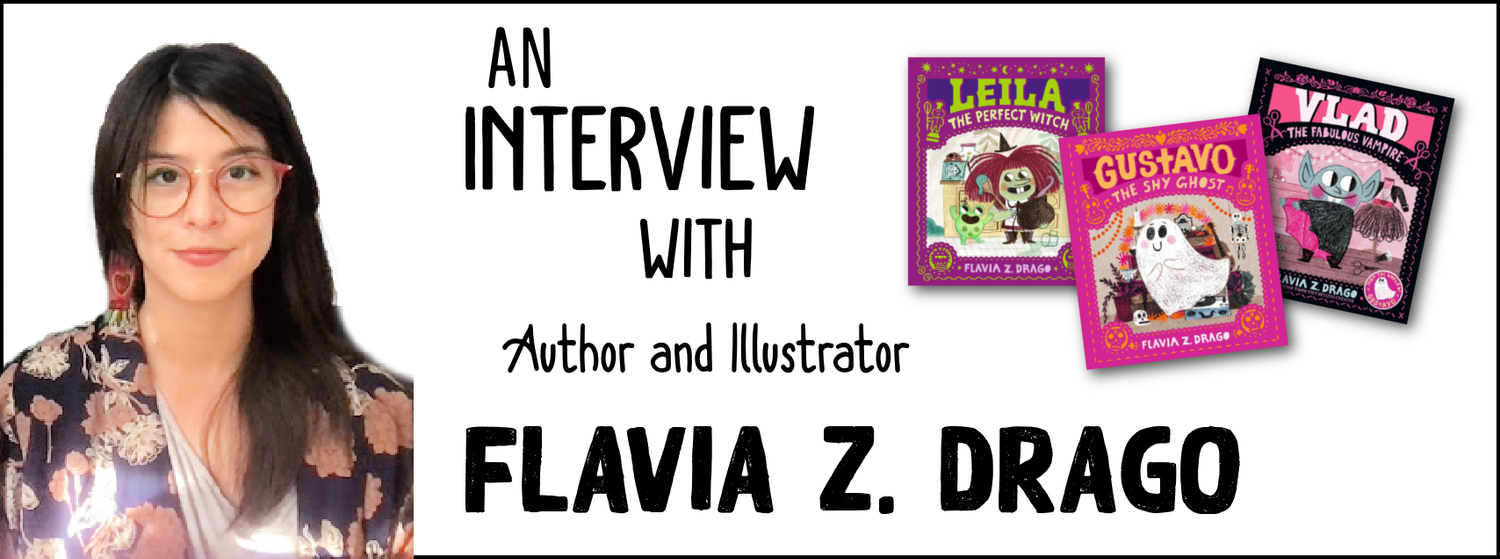
Ryan: The main characters of your friendly monster trilogy (Gustavo, Leila, and Vlad) all teach social/emotional lessons like being yourself and dealing with perfectionism and the importance of community. What was your inspiration in writing specifically about all of these topics for kids?
Flavia: For those books my main inspiration came from childhood memories, my family and my love for the horror genre and fairy tales. I just want to make the books I would have liked to have as a child, and about things I enjoy drawing.
Gustavo and Leila and Vlad are all very friendly and lovable characters right from page 1, and of course that’s what makes them so endearing. They certainly aren’t keeping kids up at night.