Find Your Leadership Clarity: 2026 Guide

Table of Contents
Last Updated: September 29, 2026
What a Leadership Clarity Session Actually Delivers
A leadership clarity session is a focused, time-boxed conversation that turns a leader’s tangled priorities into a written plan of action. Doug Thorpe Group built its practice around this format: 90 minutes with a trained advisor, followed by a 30-Day Clarity Plan the leader executes alone.
Most executives arrive with the same complaint. They know something is stuck, but they cannot name it.
That is the real problem. A stalled priority rarely announces itself. It hides inside a full calendar, a dozen open decisions, and a team waiting for direction. A leadership clarity session forces the issue into the open and produces a next step you can defend.
Why Clarity Beats Generic Coaching Frameworks
Generic coaching frameworks assume every leader has the same problem. They do not.
A founder preparing for a business exit faces different constraints than a new VP of Operations who just inherited a struggling department. A rising leader inside a large corporation fights bureaucracy that a small business owner never sees. When the framework ignores context, the advice sounds reasonable and changes nothing.
Clarity works differently.
Key Takeaway
The test of any leadership conversation is simple: can you name the specific decision you will make differently tomorrow? If not, the session failed regardless of how good it felt.
How to Prepare for a Coaching Session: A Pre-Session Checklist
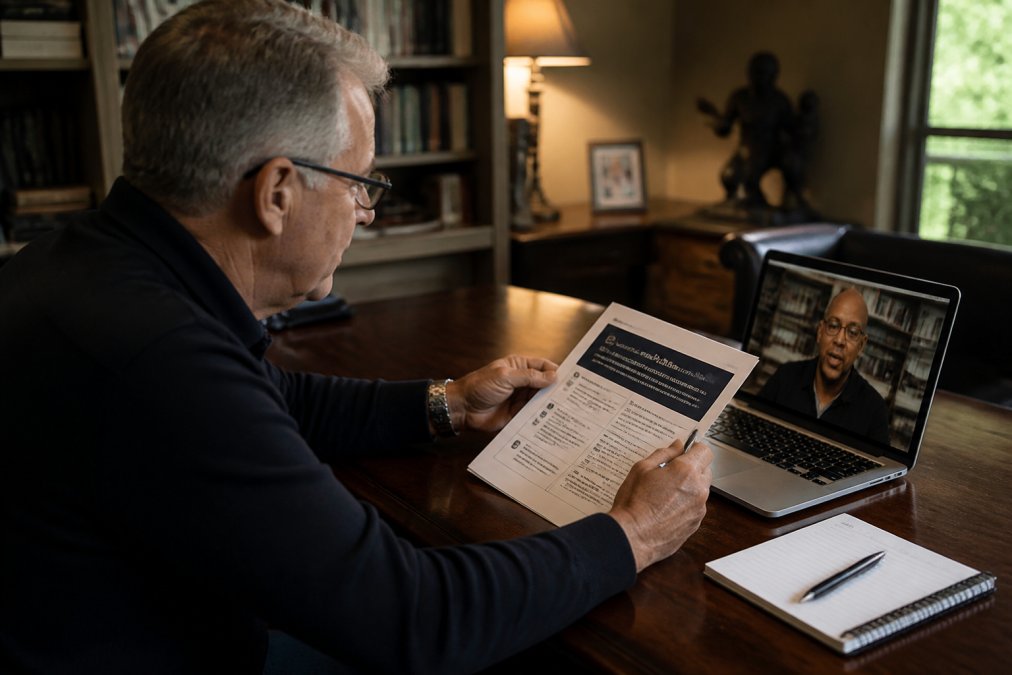
Preparation is where most leaders leave value on the table. Knowing how to prepare for a coaching session separates a useful 90 minutes from an expensive chat. Bring the raw material. Advisors can work with messy input, but they cannot work with nothing.
- Write down the three decisions you have been avoiding for more than 30 days
- List the two people on your team whose performance you have not addressed directly
- Note one priority that has slipped every quarter for the past year
- Bring last quarter’s numbers, even rough ones
- Identify the single outcome that would make the next 90 days a success
- Block 15 minutes after the session to write your own summary while it is fresh
Self-Assessment Tools to Use Before You Book
A short self-assessment tells you whether you need a one-time clarity session or a longer engagement, and it sharpens the conversation before it starts.
- I can name my top three priorities for the next 90 days without checking a document.
- My direct reports can state those same priorities without asking me.
- I make the decisions I am responsible for within a week of the issue surfacing.
- I have had the direct performance conversation I have been putting off.
- My calendar reflects my stated priorities, not just my inbox.
- I know which single number predicts whether this quarter succeeds.
- I have said no to at least one good opportunity in the last 30 days.
- I could describe my team’s biggest constraint in one sentence.
Add your scores.
- 32-40: You have clarity. A session is optional; use one to pressure-test a specific decision.
- 24-31: You have partial clarity. A single 90-minute session is the right format, you need a forcing function, not a long engagement.
- 16-23: You have a pattern, not a moment. One session will help, but expect to need a structured follow-up plan.
- 8-15: The constraint is likely structural, role fit, team composition, or business model. A clarity session can diagnose it, but a longer engagement is the honest recommendation.
Pro Tip
If your score lands in the 24-31 range, bring the completed assessment to the session. Advisors can work faster from a scored diagnostic than from a verbal summary, and it moves the first 20 minutes from discovery to decisions.
The EDGE Framework Leadership Model Explained
The EDGE framework is a diagnostic model that examines a leader’s situation across four dimensions: People, Process, Product, and Performance. Doug Thorpe Group uses it to locate where a business is actually stuck before recommending any action.
People, Process, Product, and Performance in Practice
Each dimension asks a different question.
- People: Do you have the right capability in the right seats, and are you addressing gaps directly?
- Process: Does work move through your organization without constant intervention from you?
- Product: Does what you sell still match what your market is buying?
- Performance: Are you measuring the things that actually predict outcomes, or the things that are easy to count?
The order matters. Fixing Process before People rarely holds. Fixing Product before Process usually creates new bottlenecks.
Pro Tip
When a leader insists the problem is Process, ask what happens when the process is followed perfectly and still produces a bad result. That question usually reveals whether the real constraint sits in People or Product.
Executive Coaching Services: What to Look For and What to Avoid
Not all executive coaching services are built the same way, and the differences show up in the first month. Doug Thorpe Group’s approach reflects a specific philosophy: direct counsel over generic playbooks, and a defined deliverable over open-ended engagement.
Look for these signals.
- A defined session length and a written output you keep
- An advisor who asks about your constraints before describing their method
- Experience outside consulting, ideally in operating roles where decisions had consequences
- A clear answer to “what happens after the session?”
Avoid these patterns.
- Unlimited sessions with no defined outcome per session
- Frameworks presented before your situation is understood
- Advisors who cannot describe a specific result they have produced for a leader like you
- Engagement models that require a long commitment before you have tested the fit
Measuring ROI: Metrics That Prove Leadership Coaching Works
ROI in leadership coaching is measurable, but not with the metrics most providers report. Satisfaction scores tell you whether someone enjoyed the conversation. They tell you nothing about whether the business improved. The gap most providers leave open is the mechanism: how a behavioral change becomes a business result, and how you prove it without a controlled study.
| Metric | What It Measures | How to Capture It | Baseline Window |
|---|---|---|---|
| Decision cycle time | Days from issue raised to decision made | Log dates on your top three recurring decisions | Prior 30 days |
| Stalled priority count | Number of initiatives untouched 30+ days | Review your project list monthly | Current snapshot |
| Accountability gaps closed | Direct conversations you had been avoiding | Keep a simple running list | Prior quarter |
| Delegation depth | Decisions your team makes without you | Count escalations per week | Prior 4 weeks |
| Team alignment | Whether your directs can state the top priority | Ask them, separately, once a quarter | Prior quarter |
| Cycle time to revenue | Days from qualified lead to closed deal | Pull from your CRM | Prior 90 days |
Turning Behavioral Change Into a Business Number
A behavioral metric is not ROI by itself. The chain looks like this:
- Behavior change, decision cycle time drops from, say, 14 days to 6.
- Operational effect, stalled priorities clear faster; the team ships more of what matters.
- Business outcome, revenue, margin, retention, or capacity improves.
A 90-Day Reporting Cadence
Measure at three points, not continuously.
- Day 0: Baseline. Capture every metric in the table above.
- Day 30: Behavioral check. Did decision cycle time and stalled priority count move? This is the earliest honest signal.
- Day 90: Business check. Did the operational effect show up in revenue, margin, or retention? This is where you can claim ROI.
The 30-day check can be useful, as it indicates whether the session produced a behavior change. If nothing moved by day 30, waiting until day 90 to notice may not be efficient.
Watch Out
Do not measure coaching ROI with a single engagement survey. Leaders rate sessions highly even when nothing changes, because the conversation felt valuable. Pair any satisfaction measure with at least one behavioral metric from the table above, and always anchor it to a pre-session baseline.
Key Takeaway
The honest ROI claim is not “coaching paid for itself.” It is “decision cycle time fell from X to Y over 90 days, and here is the operational change that followed.” That sentence survives scrutiny.
Common Mistakes Leaders Make When Booking Online
Booking an online session introduces its own failure modes. Most are avoidable.
Conclusion: Your Next Step Toward Clearer Leadership
The hardest part of leadership is not knowing what to do. It is deciding what to do first when everything feels urgent.
Frequently Asked Questions
What is a leadership clarity session?
A leadership clarity session is a focused 90-minute working session with an executive coach designed to cut through stalled priorities and surface the real decisions blocking progress. Unlike open-ended coaching, it produces a written 30-Day Clarity Plan with specific next steps. Doug Thorpe Group’s session uses the EDGE framework to examine People, Process, Product, and Performance constraints, so you leave with a concrete action plan rather than general reflections.
How do I prepare for a professional coaching clarity call?
Before the call, write down the two or three decisions you have been avoiding, note where accountability breaks down on your team, and identify one metric that has stalled. Bring a recent example of a pressure moment where you fell back into old patterns. This preparation takes 20-30 minutes and lets the coach spend the session on your actual constraints instead of background context.
What should I look for when booking an executive coach online?
Look for a coach who asks about your specific operational context before pitching a package, offers a defined first session with a written deliverable, and can describe how they measure progress. Ask whether their framework adapts to your company size and industry. Avoid providers who only offer unlimited session access without structure, since volume alone rarely changes how a team performs under pressure.
How is a clarity session different from traditional consulting?
Traditional consulting often delivers a report and leaves implementation to you. A clarity session is built around your judgment: the coach works through your constraints with you in real time, then hands you a 30-Day Clarity Plan you own. The goal is improved decision-making under pressure, not a slide deck. This makes it useful for executives who already understand the theory but need help executing differently when things get chaotic.