


You walk into a packed local coffee shop, see the line out the door, and think, “I should open one of these.” That magnetic pull is exactly why this industry is booming. You grab a stress-tested playbook and instant trust from customers who already know what you sell.
But before you drain your savings account, you need to grasp exactly how franchising works. It goes way beyond flipping burgers or fixing roofs. It is a strict, legally binding marriage. You buy a tight system. If you want to change the menu, tweak the logo, or run your own rogue marketing campaigns, this path will make you absolutely miserable.
But if you want a proven blueprint that skips the brutal guesswork of starting from scratch? It might be the smartest move you ever make. I have watched people succeed and fail in this space, and the difference always comes down to understanding the rulebook. Let’s look at the real mechanics, the hidden fees, and the unfiltered reality of buying someone else’s business.
The Basics: What Is a Franchise?
A franchise is simply a legal license. One person builds a successful business, and you pay to copy it down to the exact uniform and color scheme. The 2026 IFA Franchising Economic Outlook projects this sector will generate over $921 billion this year, showcasing a 1.6 percent jump from the previous year.
That is serious money pouring into communities across the country. Two main players run this show. First, you have the franchisor, who is the founder or corporate entity. They made the mistakes, perfected the recipes, and built the software. Now, they sell that specific system to investors. Second, you have the franchisee, which is you.
You buy the rights to open a clone of that business in your town. You do not just buy a famous logo. You buy a comprehensive operating system that touches every part of the daily grind. You pay to skip the painful trial-and-error phase of running a business, stepping right into a machine that already knows how to make money.
|
Feature |
The Franchisor |
The Franchisee (You) |
|
Primary Role |
Creates the rules, brand, and supply chain. |
Executes the system locally and perfectly. |
|
Risk Level |
Low. They use your cash to expand. |
High. You sign the lease and fund the build. |
|
Income Source |
Upfront fees and weekly royalty cuts. |
Whatever profit is left after expenses. |
|
Control |
Total. They dictate how the brand looks and acts. |
Minimal. You manage the daily staff and shifts. |
How Franchising Works: The Financial Mechanics
If you really want to know how franchising works, just follow the money trail. You pay a premium to get in, and you pay a cut of your sales forever to stay. When you sign on the dotted line, you agree to a very specific financial trap. Here is exactly where your cash goes. First, you pay the initial franchise fee. This acts as your cover charge. It buys the legal rights to the name and the operations manual, but it rarely pays for physical real estate or ovens.
Typically, this runs $25,000 to $50,000. Second, you face buildout costs. This is where you spend the real money renting the building, buying equipment, and hiring staff. The good news is that 2026 data shows over 67 percent of new franchise concepts now require less than $500,000 to open entirely.
Third, you pay ongoing royalties. They take a cut of your gross sales, usually weekly. Notice the word gross. Even if you lose money this month, corporate still gets paid. Finally, big brands make you pitch into a national ad fund, which pays for the TV spots that help everyone.
|
Fee Type |
What It Actually Covers |
Typical 2026 Cost Range |
|
Franchise Fee |
The legal license to use the brand and systems. |
$25,000 to $50,000 |
|
Buildout & Launch |
Real estate, construction, and inventory. |
$10,000 (mobile) to $1M+ |
|
Ongoing Royalties |
Continuous corporate support and tech access. |
4 to 8 percent of gross sales |
|
Marketing Fund |
National TV spots and digital ad campaigns. |
1 to 3 percent of gross sales |
The Legal Paperwork: Decoding the FDD
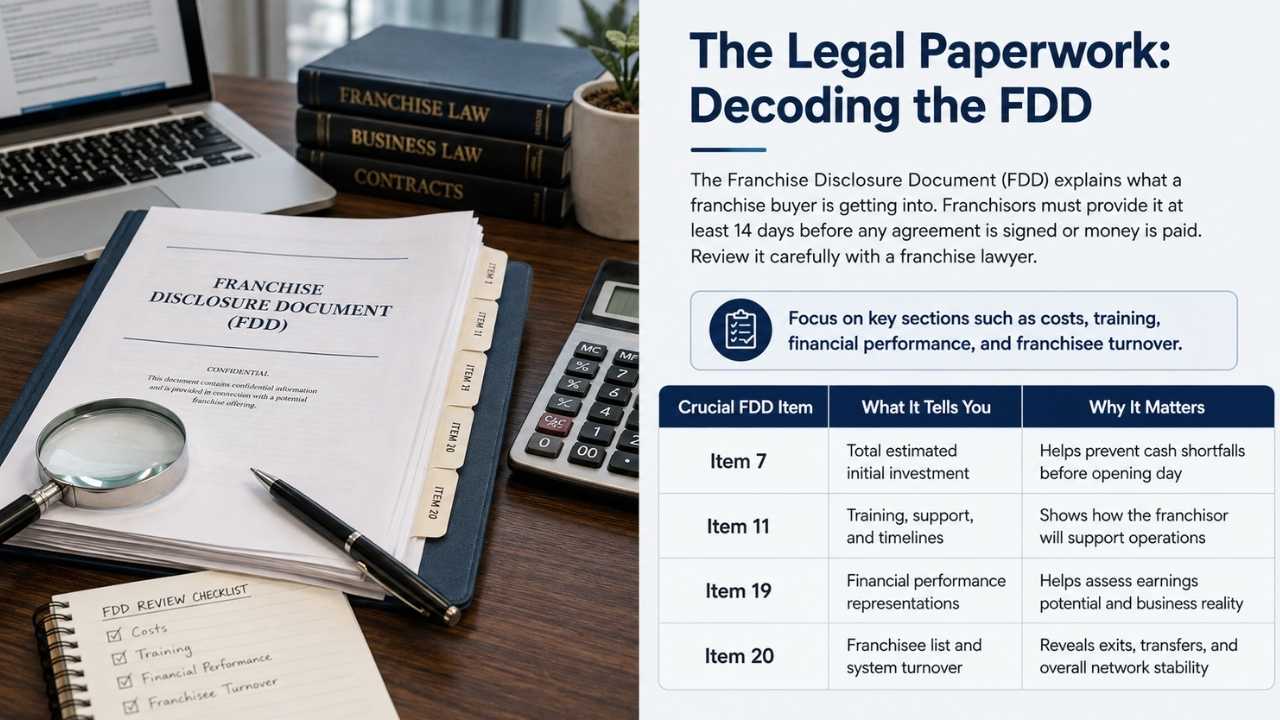
You cannot talk about this business without mentioning the Franchise Disclosure Document, commonly called the FDD. It is a massive, legally binding packet that outlines exactly what you are getting into. The Federal Trade Commission makes franchisors hand this over at least 14 days before you sign anything or pay a dime. But here is the major catch: the government does not verify the facts inside it.
That is entirely your job. You must hire a specialized franchise lawyer and look hard at the 23 items inside. Item 7 shows your estimated total investment, and smart buyers always add 20 percent to their highest estimate because construction delays always happen. Item 11 outlines training and support, and vague promises here mean bad news.
Item 19 shows what current stores actually make, and if they leave this blank, you should run away immediately. Finally, Item 20 lists who quit, sold, or got fired recently. High turnover screams a broken system, so pay close attention to the names listed there.
|
Crucial FDD Item |
What It Tells You |
Why It Matters |
|
Item 7 |
Total estimated initial investment. |
Keeps you from running out of cash before opening day. |
|
Item 11 |
Specific training details and timelines. |
Proves corporate will actually help you survive and grow. |
|
Item 19 |
Actual financial performance numbers. |
Shows if current owners are actually turning a profit today. |
|
Item 20 |
Network turnover and franchisee list. |
Exposes how many people quit the system last year. |
Franchise vs. Independent Startup: True Survival Rates
A massive selling point for this industry is the safety net, but you need to know the real numbers. The most cited statistics suggest independent businesses face a brutal reality, with many failing within the first few years. More conservative research puts the independent five-year survival rate close to 45 to 55 percent. Franchise failure rates sit much lower.
The five-year survival rate for a franchise is often cited between 65 and 85 percent, proving that a proven system fails less often. In fact, FRANdata’s 2026 index shows over 94 percent of tracked franchise units display strong bank-approved survival rates. But you have to remember that “failure” is a tricky word in this space.
Sometimes an owner avoids total bankruptcy by selling their struggling location back to corporate for pennies. The store stays open, meaning the brand survives, but the original owner still lost their shirt. Buying a franchise dramatically lowers your risk of closing the doors, but it definitely does not remove the risk of losing money.
|
Business Type |
Estimated 5-Year Survival Rate |
Biggest Risk Factor |
|
Independent Startup |
45 to 55 percent |
Unproven model and absolutely zero brand trust from day one. |
|
Franchise System |
65 to 85 percent |
High debt burden from initial launch and strict operational limits. |
Top Franchise Industries Right Now
Most people think this space is just fast food drive-thrus and massive hotel chains. In reality, it spans dozens of industries, and the biggest growth is happening far away from deep fryers. The 2026 IFA report shows that Child Services, which includes childcare, tutoring, and youth fitness, is expected to grow at a blistering 3.2 percent clip this year.
Commercial and Residential Services, which covers home maintenance, plumbing, and cleaning, is matching that exact 3.2 percent growth rate. Consumers love recurring, subscription-based services, and investors love the predictable revenue that comes from annual maintenance contracts. You will typically see three main setups.
Business format franchises are the classic turnkey models where you get the exact brand manual. Product distribution models let you act as a local dealer for a manufacturer, like a car dealership. Finally, job or operator models are low-overhead, service businesses where you run a branded van out of your driveway instead of renting a retail space.
|
Franchise Model |
How It Operates |
Fast-Growing 2026 Sectors |
|
Business Format |
Turnkey system using exact brand manuals. |
Child Services, Boutique Fitness, Senior Care. |
|
Product Distribution |
Exclusive local dealer for manufactured goods. |
Automotive dealerships, beverage distribution. |
|
Job / Operator |
Mobile, low-overhead services without retail rent. |
Home Services, Commercial Cleaning, HVAC. |
Scaling Up: Single vs. Multi-Unit Ownership
To grasp the big picture of how franchising works, you have to look at how owners actually scale their wealth. Very few rich operators stop at just one store. Actually, 2026 data reveals that just 19.3 percent of franchisees control nearly 59 percent of all U.S. franchise locations today. You usually start as a single-unit operator.
You grind every single day, hire the staff, run the register, and cover the shifts when people call in sick. Once you prove yourself, corporate pushes you toward multi-unit ownership. You sign a deal to open three, five, or ten locations over a few years. At this point, you stop running registers and start running a regional management team.
Finally, you have the Area Developer or Master Franchise route. You buy the rights to a whole state or massive territory. You basically act like a mini-franchisor, selling individual stores to other people and taking a cut of their royalties for yourself.
|
Ownership Level |
What It Actually Means |
Best Fit For… |
|
Single-Unit |
Operating one specific retail location or territory. |
Beginners who want to be highly hands-on every day. |
|
Multi-Unit |
Opening three or more locations over time. |
Experienced investors who want to manage managers. |
|
Area Developer |
Controlling a massive territory like an entire state. |
Wealthy corporate groups acting as local sub-franchisors. |
Step-by-Step Action Plan
You do not just write a check and get the keys to a new business. It is a brutal mutual interview process where both sides have to like each other. First, you have to check your bank account. Brands demand a minimum net worth and liquid cash, and if they want $100,000 in cash and you only have $40,000, they reject you on day one. Second, you need to talk to current owners.
Skip the corporate sales pitch, call the owner three towns over, and ask the hard questions about profits and support. Third, you hire a specialized attorney to read the FDD because regular business lawyers completely miss the territory rules. Fourth, corporate flies you to headquarters for Discovery Day, where you meet the founders and they heavily judge your character.
Finally, you secure funding. Most people secure a Small Business Administration loan, which often requires you to put down 10 to 20 percent. Once the bank approves you, you sign the papers, pay the fee, and start construction.
|
Step |
Your Required Action |
Estimated Timeline |
|
1. Self-Check |
Audit your net worth and liquid cash available. |
1 to 2 Weeks |
|
2. Real Talk |
Interview current owners away from corporate ears. |
1 to 2 Months |
|
3. Lawyer Up |
Hire a franchise attorney to read the FDD thoroughly. |
2 to 3 Weeks |
|
4. Discovery Day |
Visit corporate headquarters to meet the founders. |
1 to 2 Days |
|
5. Funding & Ink |
Secure an SBA loan and sign the binding contract. |
1 to 2 Months |
|
6. Build & Launch |
Secure a lease, build the store, and train your staff. |
3 to 9 Months |
Final Thoughts
Figuring out how franchising works is only step one. The real test is your ego and your ability to follow directions. If you are a rebel who wants to invent new recipes, break rules, and run edgy marketing campaigns, run away fast. Corporate will fine you, fight you, and eventually terminate your contract.
But if you have zero ego, follow directions well, and just want a business that works straight out of the box, this is brilliant. You trade creative freedom for a much higher shot at success. Take your time, read the paperwork twice, and protect your cash before you make the leap.
Frequently Asked Questions (FAQs) About How Franchising Works
Can I sell whenever I want?
Yes, but there’s a huge catch. The franchisor has to vet and approve your buyer. If they hate the buyer, you have no deal. Plus, you pay corporate a massive transfer fee just for the right to sell your own store.
Are franchise brokers free?
For you, yes. They act like real estate agents. The franchisor pays them a massive commission (sometimes up to $40,000) when you sign. They help, but remember who signs their checks.
What if corporate goes bankrupt?
Your store stays open, but the national ads stop and your software breaks. Usually, a private equity firm buys the scraps and restructures the brand, but the transition is pure chaos.
Do I own the customers?
No. You own the LLC. Corporate owns the customer data, the mailing list, and the loyalty program. When you leave, the data stays with them.


