The Mystery of Animal Minds: Are They Just Machines?

Chapter 4 from the book Life After Breath.
Your dog knows the second you’re about to leave. A crow bends a wire into a hook. An octopus vanishes right in front of you. Chapter 4 of Life After Breath asks the question those moments raise: put animal cognition vs human mind side by side, and what’s actually left standing?
https://www.youtube.com/watch?v=EbWdIdK_ZuE
This is Part 6 of a 52-week journey through Life After Breath: A Hitchhiker’s Guide to Consciousness — a new weekly series from The Explanation. Every Monday, a new chapter lands here, on YouTube, and in your inbox.
Last week’s chapter left one question hanging: if animals show real flashes of intelligence too, doesn’t that prove the human mind just evolved, step by step, like everything else? Chapter 4 takes the animal cognition vs human mind question seriously instead of waving it off — starting from the dog that knows you’re about to leave, the crow that bends a wire into a tool, and the octopus that vanishes in plain sight.
This site has actually made this comparison before — here’s the earlier, more scholarly dive into animal vs. human intelligence. This week’s version covers the same uncrossable chasm in fewer words, built straight from the chapter’s own text.
Chapter 4: Animal Cognition. Similar But So Inferior
Let’s talk about animal smarts. We’ve all seen the videos: the dog that knows exactly when its owner is coming home, the crow bending a wire to fish out food, the octopus that camouflages itself perfectly. It makes you wonder, what’s going on in their heads? How does their intelligence compare to ours, and is it a bridge between the animal brain and the human mind?
Animal Cognition vs Human Mind is a hot topic in science. But the real question is: does animal cognition solve the mind-body problem for us? What’s the actual relationship here?
Back in the day, many thinkers wrote animals off as robots—pre-programmed machines running on pure instinct. We know that’s garbage now. Science has proven that animals, from birds to fish to insects, have real cognitive skills. They process information from their senses, use their unique brain wiring to figure it out, and then decide on an action. It’s problem-solving.
Anyone with a pet has seen this firsthand. Your dog knows the difference between you grabbing the leash and you grabbing your car keys. Your cat hides when it knows it’s in trouble. They’re reading the situation and reacting. This isn’t just instinct; it’s a form of understanding. That’s why horses and dolphins are so successful as therapy animals; they connect and empathize on a level that’s powerful, even if it’s not human.
So, this forces the big question: if animals have brains and show signs of a “mind,” does that mean our human consciousness is just a more advanced version of the same thing? Is the gap between us just a matter of degrees?
Experts are fascinated but stumped. One great article, A Journey Into The Animal Mind, points out that if animals are conscious, it creates a massive evolutionary puzzle. It means one of two things had to happen: either consciousness evolved separately at least twice (once for mammals/birds, once for us), or it evolved so long ago that a common ancestor had it.
Both ideas are a big deal. They suggest that cooking up consciousness from molecules might be easier than we thought, meaning the planet is teeming with all kinds of inner experiences. The examples are incredible:
- Fish can remember associations for over ten days.
- Bees understand abstract concepts like “same” vs. “different” and even “zero.” They also learn from each other, passing down new skills like a culture.
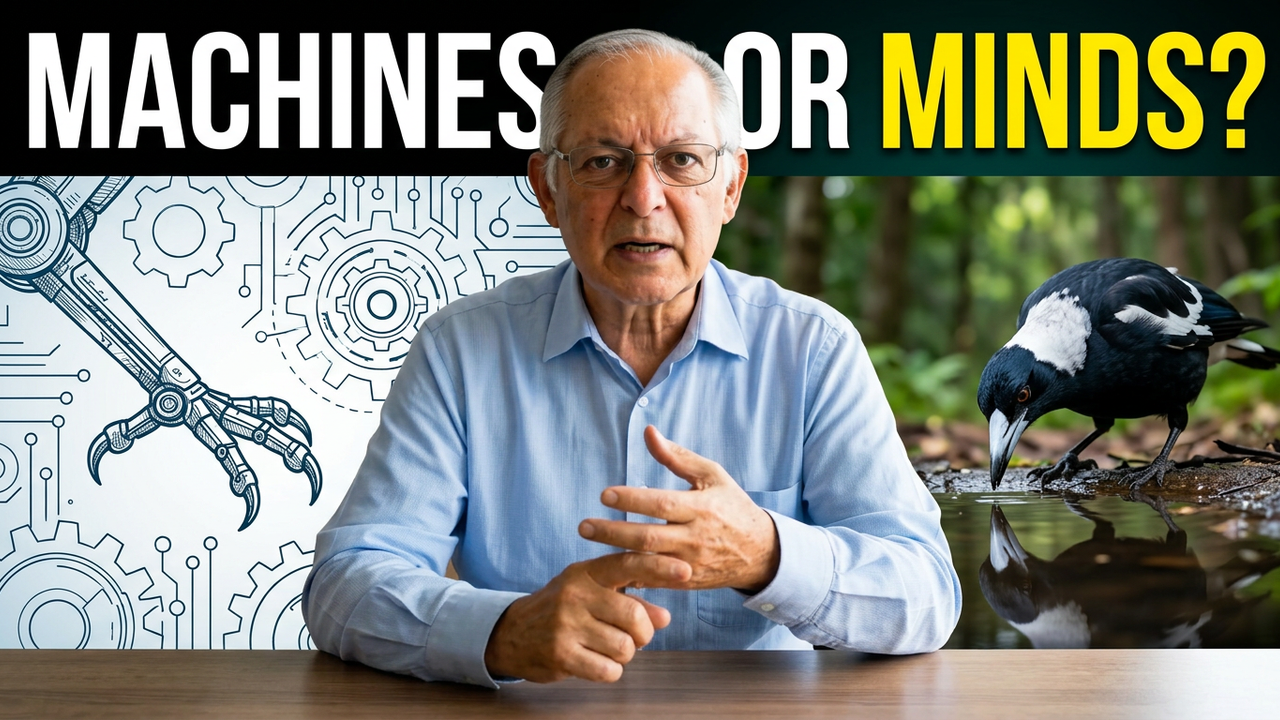
- A magpie was the first bird to pass the “mirror test,” recognizing that the dot on its neck in the reflection was on its own body.
This is all real, documented science. But—and this is the crucial part—the explanations for how this ability arose is full of “maybes” and “it’s thought that.” Scientists can describe the incredibly complex programming of a wasp’s brain as it hovers, but they have no idea how that programming was written. They see the code running but don’t know the coder.
Another expert argues we should take animal consciousness seriously, using their communication as a window into their thoughts. Neuroscience even shows striking similarities in brain function between humans and other animals.
So yes, animals are our closest neighbors. They act in ways we recognize. This begs the question: is the human mind just a product of the animal kingdom?
Absolutely not. Here’s the simplest way to see the uncrossable chasm. Imagine a combined Olympics and Nobel Prize ceremony. The result would be perfectly clear: Animals would win every Olympic medal. Humans would win every Nobel Prize.
Animals are physical and instinctual masters. They would dominate in running, jumping, swimming, and survival. But no animal, no matter how smart, is writing a symphony, building a telescope to peer into the origins of the universe, debating philosophy, or curing cancer. That’s the domain of the human mind.
The gap isn’t one of degree; it’s a difference in kind. It’s the difference between mastering your environment and seeking to understand the cosmos. Animal cognition highlights the brilliance of biological design, but it ultimately underscores the utter uniqueness and inexplicable nature of the human mind. Science can describe the difference but cannot explain it.
The Breakthroughs Behind Animal Cognition vs Human Mind
Animal intelligence highlights an unbridgeable chasm to humans.
From Comparative Psychology & Ethology:
Validates Animal Cognition to Magnify Human Uniqueness: It fully acknowledges the “whole universe of vivid animal experience” (from corvids to insects) not to show an evolutionary continuum, but to make the differences with humans more striking. The more intelligent animals are, the more their lack of a human-like mind stands out.
The “Olympic vs. Nobel” Distinction: It introduces a powerful heuristic: animals win all Olympic medals (physical prowess), but humans win all Nobel Prizes (mental, creative, and moral achievement). This frames the difference as one of kind, not degree.
Challenges Social Behavior Studies: It argues that studying animal behavior to explain human morality and social structures is fundamentally flawed because it ignores the core differentiator (neshama/consciousness), making the 98.8% DNA similarity with chimps irrelevant to the mind-body discussion.
From Theology & Biblical Anthropology:
Introduces Neshama as the Diagnostic Differentiator: It provides the first scriptural evidence that animals do not possess neshama (the breath of life/spirit), a fact established through a nuanced analysis of Joshua 10-11, where cattle (which breathe) are spared while beings with neshama are destroyed.
Establishes Humanity as an Exclusive “Race”: It concludes that the possession of neshama sets humans completely apart as a unique category of being. The Bible is, therefore, the story of this unique humankind and their relationship with their Creator, not a story of intelligent animals.
From Philosophy of Science:
Re-frames the Question of Consciousness: It shifts the question from “How did intelligence evolve?” to “Why do two qualitatively different types of intelligence exist?” The presence of sophisticated but categorically distinct cognition in animals demands an explanation that evolution alone cannot provide.
FAQ: Animal Cognition vs Human Mind
Animal cognition vs human mind — what’s the actual difference?
It’s not a matter of degree, it’s a difference in kind. Chapter 4 puts it as simply as possible: imagine a combined Olympics and Nobel Prize ceremony. Animals would win every Olympic medal — running, jumping, swimming, survival. Humans would win every Nobel Prize — the symphonies, the telescopes, the philosophy, the cure for cancer. Same planet, two completely different categories of achievement.
Do animals have consciousness?
Real cognitive skills, yes — a lot of them. Fish remember associations for over ten days. Bees grasp abstract concepts like “same,” “different,” and even “zero,” and pass new skills down like a culture. A magpie was the first bird to pass the mirror test, recognizing its own reflection. But the chapter is careful to separate “shows signs of a mind” from “has a mind like ours” — real skill, still a different category.
Why can animals be this smart and still not close the gap between animal cognition vs human mind?
Because the gap was never about degree of skill. Chapter 4 argues that no animal, however brilliant, is writing a symphony, building a telescope to study the origins of the universe, debating philosophy, or curing cancer — not because animals aren’t trying hard enough, but because that whole category of achievement runs on something animals never had access to in the first place.
How do I follow along each week?
Subscribe to the weekly email to get each new chapter as it releases, or catch the video version on YouTube channel @theexplanation.
What’s Next
This is chapter six of fifty-two. This chapter draws the sharpest line yet in the animal cognition vs human mind question — next week, Chapter 5 asks what actually explains our side of that line: the reasoning, the logic, the sense-making no animal can touch.
Want the full, scholarly original now instead of waiting a week at a time? Get Mind-Body Problem Solved.
 Buy Life After Breath at any on/offline shop
Dig Deeper into The Explanation
Online Study Courses to Uncover the Mystery of Adam and Eve’s Nakedness… with no fuss. Free video mini-course revealing the God-intended meaning of Scripture via Biblical Hebrew. It’s so easy, it’ll blow you away. Join now and add new motivation to your Bible study.
Join The Explanation Newsletter to stay informed of updates. and future events. No obligations, total privacy, unsubscribe anytime, if you want.
The form you have selected does not exist.
The Explanation series of seven books. Free to read online or purchase these valuable commentaries on Genesis 1-3 from your favorite book outlet. E-book and paperback formats are available. Use this link to see the details of each book and buy from your favorite store.

Since you read all the way to here… you liked it. Please use the Social Network links just below to share this information from The Explanation, Animal Cognition vs Human Mind: The Shocking 98.8% DNA Failure