
Umut Adan & Zebânis
Umut Adan, Zebânis
Umut Adan & Zebânis, Gümüşlük Music Festival, Gümüşlük, Bodrum, Turkey, July 24, 2026,
Aug 23, 2026
Photography by Serkan Minareci
Web Exclusive
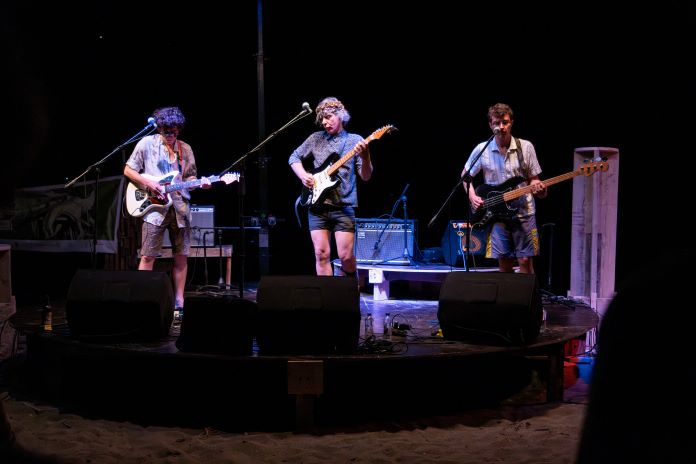
In the balmy air of south-western Turkey, time travel doesn’t seem impossible. Turkish songwriter Umut Adan and his band, Zebânis, take over a wooden stage on the shore of the Aegean Sea. In stylish 70s heeled boots, shorts and an ornate headband, Adan’s look is a cross between Marc Bolan and Serge Gainsbourg. What seems to be a reference to 20th-century pop culture carries a message as old as the world: “It is the selfless who taste life”, to quote Adan’s song “Bogotà”, from the 2026 album Başka Bahar.
As his Italian bandmates blend into the scenic seaside surroundings with their psychedelic jingle-jangle sound, the singer savours every word of the chorus, where Turkish meets French: “Gönül koymayan, les yeux fermés / Gönül koymayan, tes cheveux dorés / Gönül koymayan, avant que printemps” (“Unoffended heart, les yeux fermés / Unoffended heart, tes cheveux dorés / Unoffended heart, avant que printemps”). Behind the band are the dark outlines of Mount Kocadağ and the sea.
.jpg)
The fishing village of Gümüşlük might be somewhat off the beaten track, even compared with neighbouring Turgutreis, which is also part of the municipality of Bodrum, a well-trodden Turkish resort. Still, this intermediate position between the touristy hubs, as well as the lack of large chain hotels, benefits the atmosphere of the settlement, which over the years has gained a reputation as a sophisticated eco-village.
Since its first edition in 2004, the Gümüşlük Music Festival has played a major role in reinforcing and augmenting the genius loci. Gümüşlük itself has a remarkable history: just one day here can lead to discoveries akin to finding a precious family relic in a grandmother’s casket. A tiny peninsula just fifty metres off the village beach has retained the remains of the ancient harbour of Myndus. Though considered less significant than other similar locations in the Muğla region, Myndus was one of the smaller hubs for silver coin production – hence the name Gümüşlük, which means “a silver mine” in Turkish.
Although the industry has long gone, the concept of mining somehow applies to the Gümüşlük Music Festival. All activities here are aimed at forging a connection with the place, its mind-blowing nature and its history. Over the last few years, the festival has embraced eco-friendly initiatives. It became Turkey’s first “green” open-air event by utilising renewable energy sources for its operations.
The stage, bar and benches were made from recycled materials – some of them are creations by designers who took part in a workshop organised by the team earlier this year.
At Gümüşlük Müzik Festivali, education seems as important as music. Every year, the programme is preceded by the Gümüşlük Festival Academy (GFA), a series of workshops for artists from classical and jazz music backgrounds.

Having become an international event – this year’s line-up features Portuguese pianist Vasco Dantas, Iranian duo Donavazi Project and Dutch jazz quintet The Loek van den Berg – Gümüşlük Müzik Festivali reflects Bodrum’s ties with other cultures and countries. To this day, Greece is (almost) within arm’s reach. Ferries to the Greek islands run from Bodrum Castle. Built in the early 15th century by the Knights of St John (Knights Hospitaller), the castle was itself a transnational effort. It has four towers known as the English, French, German and Italian towers, named after the nations responsible for their construction.
Similar to festivals in other parts of Turkey, such as the Istanbul Jazz Festival, Gümüşlük Müzik Festivali extends beyond an expected timeframe. It is, in fact, a series of shows spanning the summer season. Starting on 17 July this year, the final event is scheduled for 6 September. Another reason why time travel feels easy.
Click HERE to check the festival programme.