
How Long Does Closing Take on a House?


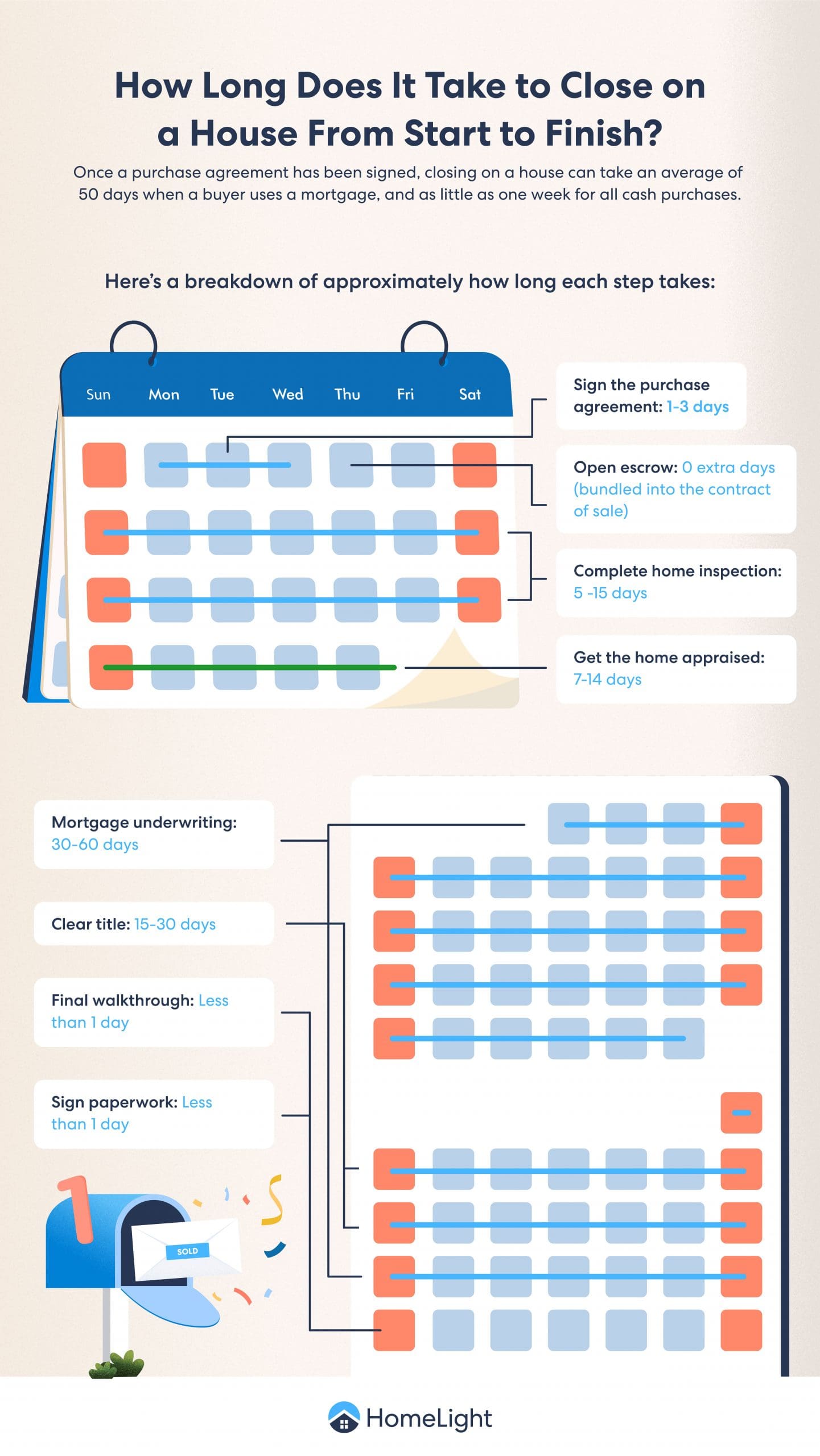
Mortgage underwriting: 30-60 days
The amount of time underwriting requires is usually between three and four weeks, but it can be lender-specific, Donaldson says.
“Large, risk-averse lenders such as Chase Bank and Bank of America will require significantly more time before they issue a final ‘clear to close,’” he explained. Big banks typically have a lot more internal red tape to deal with before they’re able to fund a loan and write a check.
On the other hand, smaller local lenders often have shorter closing times because they tend to be nimbler and more adept at navigating the quirks of their local market.
“Underwriting is going to take into account many factors, including the buyer’s credit score, buyer’s income, the appraisal, and many other factors,” says Eli Goodman, the owner of a house-buying company in Illinois.
“It’s important to work with a high-quality company that can get everything done fast and on time,” Goodman adds. “We have had many closings that have dragged on for months because the mortgage company was not organized. It’s also imperative that the buyer provides everything as requested.”
Clear title: 15-30 days
Donaldson estimates a two- to four-week wait to receive a title report or abstract of title after the contract of sale is fully signed, depending on the location.
For instance, the parties may receive a title report two weeks after entering into the contract if the property is in the Bronx.
However, if the property is in Westchester (one county immediately north), a title report may not be produced until four weeks after the contract is signed, as the local building departments are much slower in Westchester compared to New York City. Further, “clearing” the title could take weeks, if not months, depending on whether title claims are discovered.
“Typically, when we are clearing title, we will need all the parties on the title to have signed the purchase agreement, mortgage payoff, and any other payoff, such as liens or HOA, that may have been put on the property over the years,” says Goodman.
“Sometimes if there was a death, inheritance, or a lienholder that is not responding, clearing the title can take a long time, but it’s usually done well before you are ready to close.”
Final walkthrough: Less than 1 day
The final walkthrough, which should occur shortly before closing, should only take 30 minutes or so.
“This is where the buyer makes sure nothing has been damaged since they last saw the house, that the owner has cleaned out all their possessions, and that everything the seller agreed would come with the house is there,” says Goodman.
Sign paperwork: Less than 1 day
For an all-cash deal, Donaldson says the closing itself can be finished in 30 minutes. He recently closed a small commercial office space in Nassau County in just 25 minutes, where the buyer client paid all cash.
If the purchase is being financed with a loan, he estimates that the closing will take around 60-90 minutes because of the small mountain of paperwork the buyer will need to sign. However, a seller can usually skip the closing by either pre-signing the documents in advance or giving their attorney a power of attorney to sign on their behalf.
Common causes of closing delays
With any home purchase, there is always the potential for roadblocks to delay or derail the path to closing. According to the National Association of Realtors®, 14% of closings get delayed but eventually go to settlement — only 5% of contracts die before the deal closes.
Below are some of the most common holdups:
Buyer financing
Andrina Valdes, CEO of Alta Home Lending, estimates that a little over a fifth of closings are delayed because buyers experience holdups in getting their loan approved. As a key precautionary measure, the seller can request a preapproval letter prior to accepting a buyer’s offer.
A preapproval usually indicates that a lender has performed a preliminary credit check, reviewed the buyer’s debt to income (DTI) ratio, and looked at their finances to determine how expensive of a home they can afford.
“Beyond that, financing approval is almost entirely beyond a seller’s control, because the buyer has no obligation to provide anything to the seller other than a mortgage commitment letter by a certain date after the contract of sale is signed,” Donaldson says.
A preapproval helps to qualify a buyer, but it still isn’t a guarantee to lend. If a buyer makes a large purchase before closing, such as a car, that could shift their DTI outside of the limits set by the lender.
While less common, Donaldson says that 30-60 days can easily be added to the closing process if there was a material change to the buyer’s credit score from the time they received a pre-approval to when they submit their loan application.
Title issues (~11% of delays)
The discovery of a title issue can create a delay. This may include conflicts over property surveys, heirs laying claim to the property, or renovations made to the property without first obtaining a permit from the local building department.
To avoid title issues jeopardizing the deal, the seller can get a preliminary title report to determine any existing issues, such as tax debts or unpaid contractors (known in some states as “mechanic’s liens.”)
Another potential issue is if the seller made renovations without a permit. In that case, Donaldson says they should either clear up the issue proactively before going to market, or explain to a buyer that there is no certificate of occupancy or compliance for whatever work was done and that the house is being sold as-is.
Appraisal
As a condition of offering a mortgage, lenders will require that an independent appraisal is performed. If the house doesn’t appraise for at least the negotiated purchase price, it could put the deal in jeopardy or cause delays.
To help prevent this setback, Donaldson says the seller could invest in an independent appraisal prior to listing.
Another recommendation is to use a tool such as HomeLight’s Home Value Estimator to get an instant idea of what a property is worth on the open market. An online home value estimate won’t replace the appraisal, and could fail to account for details such as recent upgrades. However, it is a good starting point and helpful reference when selling a home.
Inspection issues
Although inspections can sometimes result in a list of issues that need to be addressed, Donaldson says they rarely cause delays to the closing process, because they are usually performed before the parties reach an accepted offer.
“However, a seller can get ahead of any possible issues by investing in an inspection before putting the property up for sale and providing their Realtor with a copy of the report, so they can then offer it to potential buyers,” he suggests. This could save time during closing, but the seller is required to disclose everything in the pre-inspection report (at least in most states), and pay for the pre-inspection with their own money.
Valdes adds that it can also be helpful for the seller to work with the inspector to find out what they need to perform a smooth inspection. This might mean clearing out attics and crawl spaces or being prepared to make any necessary repairs.
Final walkthrough surprises (small sliver)
In a vast majority of cases, Donaldson says there aren’t any unwelcome walkthrough surprises as long as the seller has maintained that the property is in good working order before closing.
“And even if something does happen, the easiest way to deal with it is to patch things up at the closing by way of extending a credit to the buyer for anything that isn’t working that should’ve been,” he adds.
Valdes offers this bit of advice to sellers to prevent unwelcome walkthrough surprises: “Leave your home empty and clean, review your contract to make sure all contingencies are met, and lean on your Realtor for closing day guidance.”
In closing…
Every real estate transaction is different — but if your buyer is using a mortgage, there will be a waiting period between signing the purchase contract and receiving your sale proceeds. This period averages around 43 days in today’s market.
The length of that wait can vary based on the buyer’s loan type, the volume of loans and refinances a lender is managing at that time, as well as issues that can occur with the inspection, appraisal, and title search.
If you’re selling to a buyer who is working with a lender, the 43-day average is likely a safe expectation. But if you’ve received an all-cash offer, you could close in as little as 7 days.
As a seller, the best ways to minimize the wait is to make sure there are no issues with the title, require that the buyer gets preapproved before entering into a contract, and consider getting a preliminary inspection to identify any issues that may need to be addressed before the sale.
Oftentimes, the shortest path to closing is to request a cash offer and cut out the loan underwriting process from the start. A service like HomeLight’s Simple Sale can provide you with an all-cash offer within 24 hours, without the need to prep, stage, or show your home.
Header Image Source: (fizkes/ Shutterstock)


