
Tomb of Dracula #50 (November, 1976)

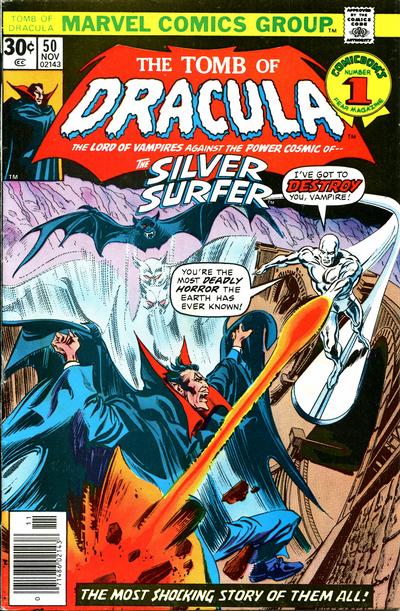
The main subject of today’s post — the fiftieth issue of the first Marvel title launched as part of the horror comics boom of the early 1970s to reach that fairly impressive number — doesn’t make much of the milestone so far as the book’s cover copy is concerned. Nor, as we’ll see soon enough, is there any mention about the book’s hitting the Big Five-O on the opening splash page. Still, your humble blogger feels fairly sure that the decision of writer/editor Marv Wolfman to feature a very special, if highly unlikely, guest appearance by the Silver Surfer in Tomb of Dracula #50 indicates a sense of occasion on his part, if no one else’s. And, certainly, the book felt special to me when my then nineteen-year-old self first picked it up, back in August, 1976.

Cover to Giant-Size Spider-Man #1 (Jul., 1974). Cover by John Romita.

Cover to Tomb of Dracula #44 (May, 1976). Art by Gene Colan and Tom Palmer.
No, this wasn’t the first time that Marvel’s version of the Lord of Vampires had crossed paths with one of the publisher’s superheroes. That ship had sailed over two years prior, when Dracula had co-starred with your friendly neighborhood web-slinger in Giant-Size Spider-Man #1 — although the closest the two characters had come to an actual confrontation was when they’d literally bumped into each other while Spidey was in his civilian guise of Peter Parker. Much more recently, Drac had unambiguously thrown down with Marvel’s best-established superhero of the supernatural persuasion, Dr. Stephen Strange, in a two-part crossover that had begun in Tomb of Dracula #44 and concluded in Doctor Strange #14.
Had that six-month-old issue of ToD sold so well that someone at Marvel called for scheduling another dustup between Count Dracula and a superhero, stat? That’s certainly possible, although if goosing the title’s sales was the main objective, the Silver Surfer seems like an odd choice for the job. Not only did the Sky-Rider of the Spaceways not currently have a series of his own — he wasn’t even appearing with any real frequency as a guest-star, due at least in part to Marvel publisher Stan Lee’s longstanding policy of maintaining dibs on the character. Prior to ToD #50 (and not counting the odd cameo here and there), the Surfer’s most recent outing had been in Fantastic Four #155-157, published over a year earlier; before that, you had to go all the way back to Defenders #11, which came out in September, 1973. If you were a relative newcomer to Marvel’s comics, you might not even know who this guy on the surfboard was.
Of course, it could be that the scarcity of Silver Surfer guest-shots in this era made them even more special to longtime fans, who gobbled them up and thus noticeably boosted sales for those issues. Who knows? Still, even if that were a contributing factor here, I’m inclined to think that the main reason we see the Surfer appearing in Tomb of Dracula #50 rather than, say, Daredevil or the Hulk, is that Marv Wolfman felt that the former character fit in particularly well with the quasi-religious themes he was presently exploring in his “Church of Dracula” story arc.
 I’ll have more to say about that notion further on, naturally — but, given that the last issue of ToD we looked at here was #47, we’ll need to spend some time catching up with pertinent events from the last two issues before delving into #50. We begin with #48, which, before anything else, boasts one of the finest covers — maybe the finest — that regular series artists Gene Colan and Tom Palmer ever turned out for this title. It serves to illustrate “A Song for Marianne!”, the first of the three named story-segments blurbed on the cover as a “Trilogy of Fear!” That phrase, along with the accompanying copy referring to “three tales”, indicates that the book features three separate stories, which is somewhat misleading; rather, we have one standalone 12-pager, followed by a couple of brief vignettes that advance the series’ ongoing plotlines.
The 12-pager, the aforementioned “A Song for Marianne!”, is told mainly in first person by the titular character, and is comprised almost entirely of flashbacks; as the tale proceeds, we learn how Dracula has influenced the narrator’s life (always for the worst, of course) for a hundred years, the last fifty of which she’s spent as a vampire alongside her similarly afflicted husband — a union which has just been ended by the vampire-slayer Blade, who killed hubby while he was robbing a hospital for blood. On the last page, we learn Marianne’s been telling her sad story to Dracula and his bride, Domini, as a prelude to asking the Count to put her out of her misery by staking her through the heart. And Dracula, demonstrating how much his still-new relationship with Domini has already changed him, agrees to do so: “Once, many years ago, it seems now, I would not have understood your request. But now, with my wife Domini at my side, I can understand such things as peace and rest and love.”
This character-centered piece is followed by the three-page “Lost: One Vampire!”, which finds four members of the series’ supporting cast — dedicated vampire hunters Frank Drake and Quincy Harker, and comic-relief hangers-on Harold H. Harold and Aurora Rabinowitz conferring together. Frank, who’s still smarting over his estranged girlfriend (and fellow vamp stalker) Rachel van Helsing’s calling him out over his macho posturing in the previous issue, is determined to go hunting for Dracula, and (for some inexplicable reason) wants the reliably ineffectual Harold to go with him. Harold is understandably reluctant, but his perpetual objet de désir, Aurora, is all for it, since she thinks the vampiric Count is “so dreamy“; she demands that either Harold helps Frank find Dracula, or she’ll never speak to him again…


Back inside the house, Aurora takes her leave of Quincy — who, as soon as he’s alone, begins to have severe chest pains. The eldest of Dracula’s foes manages to get to his heart medication in time to alleviate his symptoms, but it’s an ominous moment, for sure.
The third and last of this issue’s “tales” comes in at just two pages, the second of which is a full page splash. As “Doppelganger!!” opens, vampire detective Hannibal King (who provides his usual hard-boiled narration) and vampire killer Blade are following up on yet another lead on their mutual quarry, Deacon Frost — the undead bloodsucker responsible for murdering Blade’s mom and for turning King into a vamp like himself. As they advance on the building where they believe Frost may be holding up, King counsels caution — but Blade disdains this advice, choosing to kick in the front door instead. “No, you stupid moron, you’ll ruin everything!” But Blade tells him he’s already too late: “The door’s down, an’ the big white rabbit’s waitin’ inside.”

 Quite the cliffhanger — though one that, not unusually for this series, would be picked up on in the next issue only as a subplot. As indicated both by the “Next” blurb at the bottom of issue #48’s last page and the Colan-Palmer cover for #49, the “A” plot of the series’ next installment would be something completely different — an encounter between Dracula and such other literary figures as Frankenstein, Robin Hood, Zorro, D’Artagnan, Tom Sawyer, and Injun Joe (the latter two of which weren’t named in either of those places, but were pictured on #49’s cover all the same) — only the first (and maybe the last) of whom could honestly be called a “shock” star. What in the world was going on here?
“…And with the Word There Shall Come Death!” revolves around a woman named Angie Turner, who lives alone in a Gothic mansion (or at least appears to), and who possesses the power to bring fictional characters to life to keep her company. Somehow, Angie unintentionally sweeps up the “real” Count Dracula in place of the figure from Bram Stoker’s famous novel, and, naturally, conflict ensues. Ultimately, of course, Dracula extricates himself from this predicament, and we learn that the whole adventure, and even the mansion itself, has taken place within a fantasy world projected from the mind of the institutionalized Angie.
Like “A Song for Marianne!”, “…And with the Word There Shall Come Death!” is essentially a standalone yarn; unlike it, however, the main action isn’t presented in the form of a narrated flashback, so several arc-forwarding scenes can be interspersed along the way without it being structurally awkward. The first of these takes place at the very beginning of the story, as Dracula consults with the leader of the Satanic cult that has formed the foundation of his own new “church”, Anton Lupeski. As Drac hands his presumed subordinate a list of names he wants him to hit up for money, it’s worth noting that this scene gives us our first look at Lupeski not wearing his ceremonial mask — and it’s not exactly what you would call an improvement:

Dracula flies home to Domini just in time to get psychically whooshed away by Angie Turner, and then it’s finally back to Blade, as he closes in battle with his vampiric double…


Our final interlude this issue picks up where we left off with Frank and Harold…


And that, at last, is pretty much everything you need to know going into our main event. So let’s pick up our copy of Tomb of Dracula #50, turn past the Colan-Palmer cover to the opening splash page, and get this party started:

Luckily for Dracula’s intended meal, the street on which she was walking is less deserted than it first appeared. Three men come to the woman’s defense, and though he hurls them away, he decides it’s not worth it to hang around to finish the job of killing them (or even to have his dinner). “Using my vast powers on cretins is wasteful!” he declares, as he turns into a bat to fly home to Domini.

The last time we saw Anton Lupeski, he was threatening the just-captured Frank and Harold. Clearly, some time has passed since that scene, so what’s happened to them? And what about their would-be rescuer, Rachel van Helsing? Oh, well, I suppose we’ll find out a bit further on…


Who are these four hooded individuals who have accompanied Lupeski to this desolate-looking spot? No previous installment of the storyline has given any indication of the cult leader answering to anyone else (except Dracula, of course), but in the earlier scene that introduced the quartet, he definitely appeared to be showing them some deference. This is an intriguing mystery that, I’m sorry to say, Marv Wolfman never will get around to resolving — at least, not so far as I’ve been able to determine.

As mentioned earlier, the last comic the Silver Surfer had appeared in prior to this one was Fantastic Four #157 (Apr., 1975); as to what Wolfman means when he alludes above to “the irony of it all”, that issue had ended with the shocking revelation that a woman whom the Surfer had been led to believe was a mind-manipulated Shalla-Bal, but who’d been subsequently outed as a mere Latverian peasant girl, had in truth been his long-lost love all along. More than a year later, this fact was still known only to the Surfer’s great tormentor — Mephisto, the Lord of Hell who’d orchestrated the whole thing — and of course to us readers.

“For now, the Silver Surfer avenges himself! And let the Power Cosmic make all humans tremble!” This scene was hardly the first time that Marvel Comics readers had seen a frustrated Surfer lash out — or at least threaten to do so — against the unjust persecution directed his way by humanity. But it’s rather an odd choice for our storytellers to make in this particular story, which, as we’ll see, makes a great deal of hay out of the character’s supposed innate, almost divine goodness — especially since it appears that, if not for the sorcerous intervention of Anton Lupeski, the former herald of Galactus would likely have done some real damage to the trigger-happy folks in his flight path.


In the manner of a king and queen, Dracula and Domini give audience to a succession of men making offerings of various sorts (e.g., money, real estate, political power). Presumably, these are some of the people on the list Drac gave Lupeski in issue #49 — but he’s frankly disgusted by all of them…

I’m very fond of the way that Gene Colan and Tom Palmer visualize the Silver Surfer in this issue, due in large part to how Palmer uses solid blacks and screentones to help this typically very shiny character fit into the more shadowy aesthetic of the Tomb of Dracula series.

Is the the first time that we’ve seen the Silver Surfer display the power of intangibility, or short-distance teleportation, or whatever it is that allows him to fly through both a wall and a painting without making a mess of either? I’m not sure, but I do know that, back in August, 1976, it concerned my younger self not a whit; rather, I relished the way our storytellers were leaning so very heavily into the idea of the Surfer as a Christ-figure — something that I’d learn many years later hadn’t been part of Jack Kirby’s original conception of the character at all, but which Stan Lee had definitely incorporated into his scripts, especially those for the short-lived late-1960s Silver Surfer solo title (and particularly those featuring Mephisto)… though I don’t believe even Lee had ever done anything quite so overtly symbolic as having the Surfer literally emerge from a painting of Jesus.

Instantly reminded of how his beloved wife Maria was brutally killed by his enemy Turac hundreds of years earlier (a callback to Dracula Lives! #2), the Lord of Vampires flies into a not entirely unjustified rage. Ignoring the Surfer’s rather feeble explanation that he was aiming for Drac and Domini simply got in his way, he backhands the Surfer across the face, sending him sprawling…

The Silver Surfer’s ruminations on why his assault on Dracula is going “so sluggishly” is a clear hint to readers that Anton Lupeski’s magical influence has put this cosmically-powered hero off his game. Like the “red sun energy” that temporarily helped level the playing field between the co-stars of Superman vs. the Amazing Spider-Man earlier this same year, it’s intended to preempt objections from fans that, under ordinary circumstances, the Surfer should be able to obliterate Dracula in a matter or moments.

The storm winds summoned by Dracula buffet the soaring Surfer — and though they’re not enough to topple him from his board, they do require his attention. And by the time the being formerly known as Norrin Radd touches down again on earth, the vampire has disappeared…


And now we’re back to Frank Drake and Harold H. Harold — seemingly with no time to speak of having passed since we last saw them in ToD #49, despite everything we’ve seen Anton Lupeski get up to in the interim. I definitely get the feeling that something has gone awry in the storytelling here — perhaps due to some miscommunication between Marv Wolfman and Gene Colan as the tale progressed through the normal “Marvel method” stages of plotting, drawing, and scripting — but I’m not quite sure what.


That knowing look that the Silver Surfer “shares” with the painted image of Jesus is absolutely aces, in your humble blogger’s opinion; clearly, our story’s superheroic Christ-figure and its actual representation of Christ have arrived at An Understanding.
And that’s that for this 50th issue of Tomb of Dracula — which, whether actually intended to commemorate a numerical milestone or not, was nevertheless pretty special. But the ongoing saga of the Church of Dracula would continue, of course, as would the subplot regarding Blade’s evil vampire twin.. and we will of course continue to follow both storylines here on Attack of the 50 Year old Comic Books — so please, keep watching this space.


![Spider-Man: Brand New Day Review [Spoiler Free]](https://som2nynetwork.com/wp-content/uploads/2026/08/Brand-New-Day-336x220.jpg)

