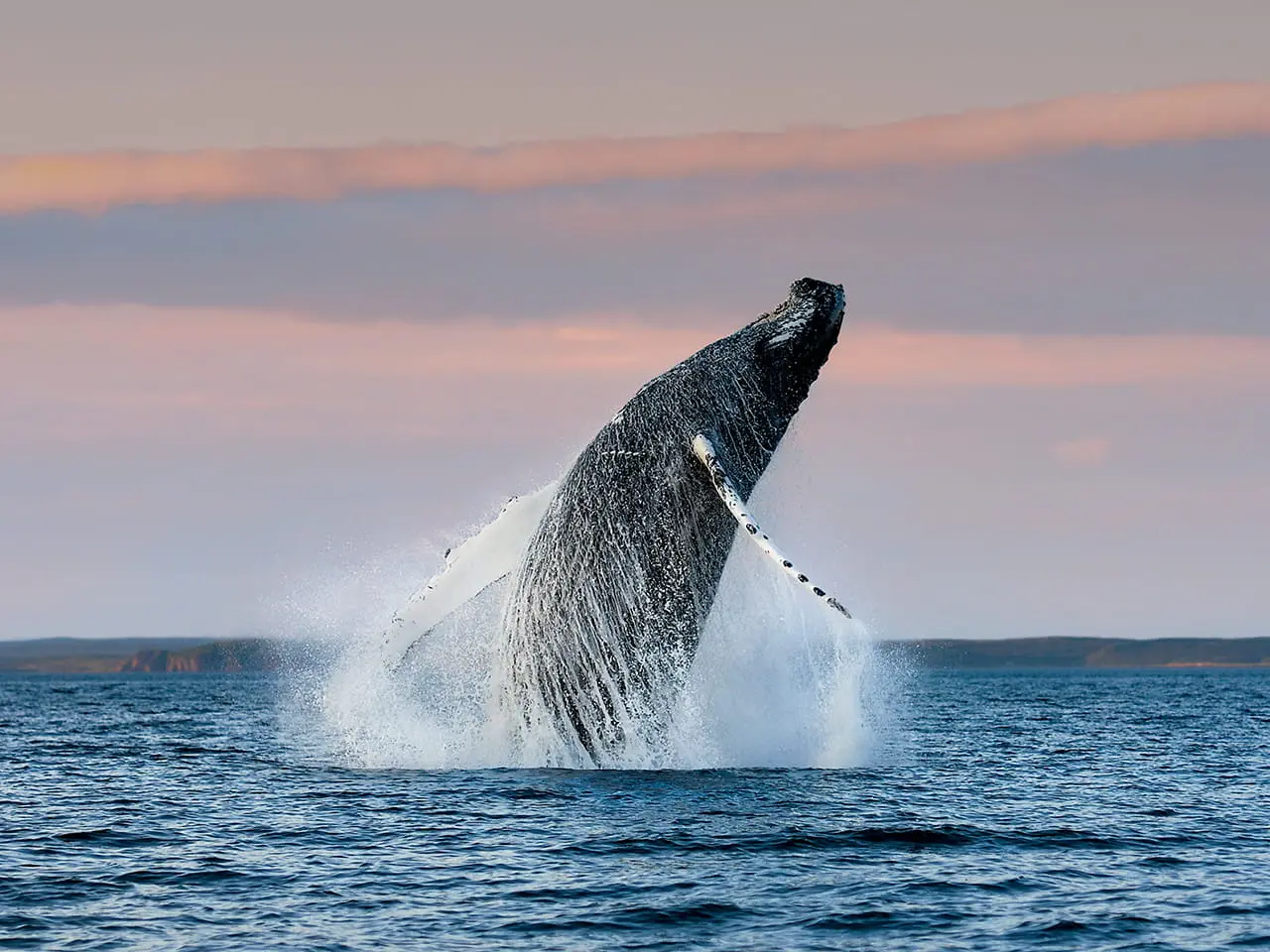

Let me be upfront with you: I am constitutionally incapable of being calm about whales. The moment a humpback breaches the surface – all 40 feet and 40 tonnes of it – I transform into a person who makes embarrassing noises and nearly drops their phone into the Atlantic. If you’re even a little bit like me, Newfoundland is going to ruin you in the best possible way.
Newfoundland and Labrador is home to the world’s largest population of feeding humpback whales, and every summer, thousands of them migrate here from the Caribbean to gorge on capelin and krill. Add in minke whales, fin whales, orcas, puffins by the half-million, and the occasional thousand-year-old iceberg drifting by, and you’ve got what might be the most spectacular wildlife destination in all of Canada. Possibly the world. (I’m not being dramatic. Okay, maybe a little.)
Whether you’re planning to head out on a boat tour or simply want to stand on a clifftop and watch giants breach in the distance, this guide covers everything you need to know about whale watching in Newfoundland.

Best Time for Whale Watching in Newfoundland
The prime whale watching season in Newfoundland runs from May through September, with the absolute sweet spot landing in July and August. This is when the waters are warmest and teeming with capelin – the small, silver fish that draws the whales close to shore in extraordinary numbers. Peak activity typically hits in July when capelin roll onto beaches, and the whales are basically right there to watch the show.
Humpbacks begin arriving as early as mid-April and stay through September, fueling up for their long return journey south. Spring (May–June) also overlaps with iceberg season, when massive bergs drift south from Greenland – meaning there’s a real chance of witnessing whales AND icebergs in the same tour. It’s what locals call “the trifecta”: whales, icebergs, and puffins, all in one outing. Some people come back to Newfoundland just chasing that triple play.
Mornings tend to offer calmer seas, which makes for smoother boat rides and better whale spotting. That said, whales don’t check the schedule – they’ve been reliably seen throughout the day.

Types of Whales You Can See in Newfoundland
Newfoundland’s waters host up to 22 species of whales. Here are the ones you’re most likely to encounter:
Humpback Whales
The undisputed star of the show. Humpbacks are the most commonly sighted species and they absolutely know it. They breach, they slap their tails, they lunge-feed through walls of fish – they are the theatrical divas of the whale world, and I mean that as the highest compliment. Around 10,000+ humpbacks make their way to Newfoundland’s coast each summer. They typically run 40–50 feet long, and watching one launch its full body out of the water is an experience that rewires your brain a little.
Minke Whales
The minke is the smallest of the baleen whales you’ll see in Newfoundland – though at around 18 feet, “small” is relative. They’re speedy and a bit elusive; they’ll surface briefly, take a quick look at your boat, decide you’re not that interesting, and dive for 15–20 minutes. Getting a good minke sighting feels like a small victory.
Fin Whales
The second-largest animal on Earth, fin whales can reach up to 27 metres in length. They tend to stay a bit further offshore than humpbacks and minkes, but they travel in groups of up to eight and are a jaw-dropping sight when they surface. Their massive dorsal fins cutting through the water is one of those things you don’t forget.
Pilot Whales
Pot-shaped heads, tight family groups of up to 100, and a serious love of squid – pilot whales are highly social creatures that often travel in impressive pods. Spotting a large group of them moving together is one of those quietly magnificent moments.
Orcas
Yes, orcas! They’re not as reliably spotted as humpbacks, but killer whales do pass through Newfoundland’s waters during migrations, particularly in northern areas and along the Labrador coast. Curious and social, they sometimes breach and interact with boats. If you see one, congratulations – you’ve won whale watching.
Bonus: Blue Whales & Sperm Whales
Blue whales – the largest animal to ever exist on Earth – can be spotted off the southwest coast of Newfoundland. Sperm whales also visit these waters. Sightings of either are rare enough to be bucket-list stuff, but Newfoundland is legitimately one of the better places in the world to have a shot at it.
If you don’t happen to catch one live, pop into the Core Science Building at MUN in St. John’s and check out the blue whale skeleton hanging from the ceiling to really get a sense for how big these giants are. If sperm whales are your thing, go say hi to Terry at the Sperm Whale Pavilion in Triton. Ask him about the whale connection to perfume.

Top Whale Watching Destinations in Newfoundland
Witless Bay Ecological Reserve (Bay Bulls)
If you only have time for one whale watching experience in Newfoundland, make it Witless Bay. This ecological reserve, reached by boat from the nearby town of Bay Bulls (just 30 minutes south of St. John’s), is one of the best places in the entire world to watch humpback whales in the wild. The abundance of capelin draws hundreds of whales close to shore, and the reserve is also home to roughly half the breeding Atlantic puffins in North America. Yes, half. In North America. That’s over 260,000 pairs! The combination of whales surfacing, puffins darting past your head, and dramatic sea stacks in the background is almost unfairly spectacular.
St. John’s
Newfoundland’s capital city is also a surprisingly excellent whale watching base. You can spot whales from iconic land-based viewpoints like Signal Hill and Cape Spear (Canada’s most easterly point) during the summer months. For a closer encounter, Iceberg Quest Ocean Tours departs right from downtown St. John’s harbour, whisking you past Signal Hill, Fort Amherst, dramatic sea caves, and out toward Cape Spear. The East Coast Trail – a 336-kilometre coastal hiking route – also offers excellent land-based whale spotting from clifftops along the Avalon Peninsula.
St. Vincent’s Beach
Here’s one of the great secrets of whale watching in Newfoundland: you don’t always need a boat. St. Vincent’s Beach, about two hours south of St. John’s on the Irish Loop, sits at the edge of waters that drop off very sharply near shore. In late June and July when the capelin arrive, humpbacks follow them right in – sometimes so close you feel like you could almost touch them from the cobblestone beach. There’s a wheelchair-accessible visitor centre and paved parking. It’s free, it’s extraordinary, and it makes you feel like the universe is just showing off.
Trinity Bay & the Bonavista Peninsula
About three hours from St. John’s, the historic village of Trinity and the broader Bonavista Peninsula offer some of the most stunning whale watching scenery in the province. Hike the famous Skerwink Trail and you might find yourself staring down at a dozen humpbacks from the clifftops – it’s the kind of moment that makes you understand why people move here. In spring and early summer, the area also offers excellent iceberg viewing, and several quality boat tour operators run out of both Trinity and Bonavista. The capelin-driven ecosystem here draws a remarkable variety of whales and seabirds, including Atlantic puffins, northern gannets, and bald eagles.
Twillingate
Twillingate, on Newfoundland’s north coast, sits right in the heart of Iceberg Alley, making it one of the best places in the world to see both icebergs and whales in the same outing. The scenery here is wild and dramatic, with rugged islands, sea caves, and stunning coastal vistas. The whale timing here is slightly behind the Avalon Peninsula – things really pick up in mid to late July – but the combination of giant ice and humpbacks makes it worth the trip. You can also spot whales from the Twillingate Lighthouse if you’d rather keep your feet on dry land.
St. Anthony (Northern Newfoundland)
Way up on the northern tip of the island, St. Anthony offers a different, quieter whale watching experience with fewer crowds and a real sense of adventure. This is also prime territory for orca sightings, and the Strait of Belle Isle is listed among the top whale watching viewpoints in the province. Tour operators like Northland Discovery run excursions out of this area. If you’re making the drive north, you’re likely also visiting L’Anse aux Meadows – so you can experience Viking history AND humpbacks in one trip. Not a bad day.
Best Whale Watching Tour Companies in Newfoundland
O’Brien’s Whale and Bird Tours (Bay Bulls)
One of the most established names in Newfoundland whale watching, O’Brien’s has been running tours out of Bay Bulls since 1985 – over 40 years of experience. They operate a fleet of four vessels, including options for larger groups, and their guides are known for blending sharp ecological knowledge with genuine entertainment. Voted best boat tour by Newfoundlanders, which is honestly the most trustworthy endorsement there is. Highly recommend booking ahead in peak season.
Gatherall’s Puffin & Whale Watch (Bay Bulls)
Also operating out of Bay Bulls and rated “Best of the Best” by TripAdvisor, Gatherall’s operates the largest tour boat in Newfoundland. Its catamaran design means a smoother ride, more deck space, and the ability to travel further to find whales. Multiple viewing decks, an onboard canteen, washrooms, and a knowledgeable, entertaining crew make this a top pick for families or anyone who appreciates the option of a snack while watching a whale. Shuttle service is available from St. John’s.
Sea of Whales Adventures (Trinity)
For a more intimate experience, Sea of Whales in the historic village of Trinity is hard to beat. With a maximum of 12 passengers, tours feel personal rather than like a crowd event. Their guides have over 25 years of experience studying whale behaviour in the waters of the Bonavista Peninsula, and they know these animals. You might see fin, humpback, sperm, minke, and pilot whales on a single tour – and occasionally orcas too.
Trinity Eco-Tours (Trinity)
Also based in Trinity, Trinity Eco-Tours runs Zodiac and kayak excursions for those who want to get really close to the action. They’re affiliated with the World Cetacean Alliance and take responsible wildlife viewing seriously. The Zodiac tours are particularly thrilling – low to the water, fast, and wonderfully exposed to the elements. Guide “Skipper Bob” has something of a legendary reputation among whale watchers in these parts.
Twillingate Adventure Tours (Twillingate)
Operating right in the heart of Iceberg Alley, Twillingate Adventure Tours takes you out on a rigid-hull Zodiac to experience icebergs, whales, seabirds, and dramatic coastline all at once. After your tour, their on-site Annie’s Harbour Restaurant specializes in fresh local seafood, which feels like exactly the right way to end the day.
Tips for the Best Whale Watching Experience
Dress for the Ocean, Not the Shore
Even in July, the North Atlantic is cold – and out on the water, the wind makes it feel colder. Layers are non-negotiable. Bring a windproof jacket, a hat, and yes, gloves (even in summer, you’ll thank yourself). Many Zodiac tour operators provide full-body flotation suits, which double nicely as wind protection. There is no whale cool enough to make up for spending two hours shivering.
Put the Phone Down (Sometimes)
Gatherall’s says it best: the whales are not going to text before they surface. Watch the water, not your screen. That said, do have your camera ready because the moment a humpback decides to breach right next to your boat, you’ll want documentation for people who will otherwise refuse to believe you. Tip: a zoom lens helps with puffins; whales usually come close enough for a phone photo.
Be Patient
Whale watching is, as one local operator puts it, about 90% patience and 10% luck. Sightings can never be guaranteed – these are wild animals in a very large ocean. Most reputable tours have excellent sighting records, but some days the whales are elsewhere. Embrace the journey. The coastline alone is worth the trip.
Book Early for Peak Season
July and August tours fill up fast, especially for smaller, more intimate operators. If you have a specific date in mind, book well ahead. Most operators offer online reservations.
Respect the Wildlife
All whale watching boats in Newfoundland are required to maintain approach distances and follow regulations that protect the animals. Responsible operators won’t try to force an encounter – they let the whales decide how close they want to get. (And sometimes they get very, very close. The whales are curious.)
FAQs
When is the best time to go whale watching in Newfoundland?
May through September, with July and August being peak season. If you want the chance to see both whales and icebergs, aim for late May to late June. If puffins are your priority (they are the correct priority), May through August is your window.
Can you see whales without taking a boat tour?
Absolutely. St. Vincent’s Beach is famous for shore-based whale watching where humpbacks come remarkably close. Signal Hill and Cape Spear in St. John’s, Cape Bonavista, the Skerwink Trail, and the Twillingate Lighthouse are all excellent land-based viewpoints. You might not get as close as a boat tour, but you also won’t need Dramamine.
Are whale watching tours suitable for children?
Generally yes, though it depends on the tour type. Larger vessels like Gatherall’s or O’Brien’s bigger boats are more stable and better suited for younger kids. Zodiac tours are more adventurous and better for older children and adults comfortable with a rougher, more exposed ride. Check age and weight recommendations with each operator.
What should I bring on a whale watching tour?
Beyond warm layers and a windproof jacket, here’s what makes a difference:
- Binoculars (great for spotting blows in the distance)
- Camera (or phone with a decent zoom)
- Sunscreen and sunglasses (the glare on the water is intense)
- Seasickness medication if you’re prone to motion sickness
- Snacks and water for longer tours
Can you see icebergs and whales on the same tour?
Yes – and this is one of Newfoundland’s greatest party tricks. In late May and June, icebergs drifting down from Greenland often coincide with the early whale season. Twillingate and Trinity are particularly well-positioned for this combo. Add puffins and you’ve achieved the holy trifecta.
Final Thoughts
Whale watching in Newfoundland is one of those rare travel experiences that lives up to – and often exceeds – the hype. There’s something genuinely humbling about being on the water when a humpback decides to breach right beside your boat, or standing on a beach while the ocean in front of you is alive with feeding giants.
The province is spectacularly set up for it: accessible spots close to St. John’s, intimate zodiac tours in historic Trinity, dramatic iceberg-and-whale combos in Twillingate, and that glorious free show at St. Vincent’s Beach where the whales practically come to meet you. Whether you’re a first-time visitor or a Newfoundland regular, the whales have a way of making every single trip feel like the first time.
Pack warm. Book early. Keep your eyes on the water. And try not to make too many embarrassing noises when the humpback breaches.
No promises on that last one.
Book Your Trip to Newfoundland & Labrador
Book Your Flight
Find a cheap flight by using Expedia. It’s one of my favourite search engines because it allows you to search for and compare flights from multiple airlines.
Book Your Accommodations
You can book your hotel with Booking.com as they have the most comprehensive inventory so they are best for booking a hotel. If you want to stay in a vacation rental or cottage in Newfoundland & Labrador, use VRBO to find the perfect place for the whole family.
Book Your Car Rental
Newfoundland & Labrador is mainly rural and it’s best to have a vehicle at your disposal. Be sure to book your car rental with Discover Cars early because they often sell out in summer.
Book Your Travel Insurance
While Newfoundland is generally a safe province, you never know when something could happen. Be prepared with travel insurance from SafetyWing. Travel insurance has certainly saved my butt before.