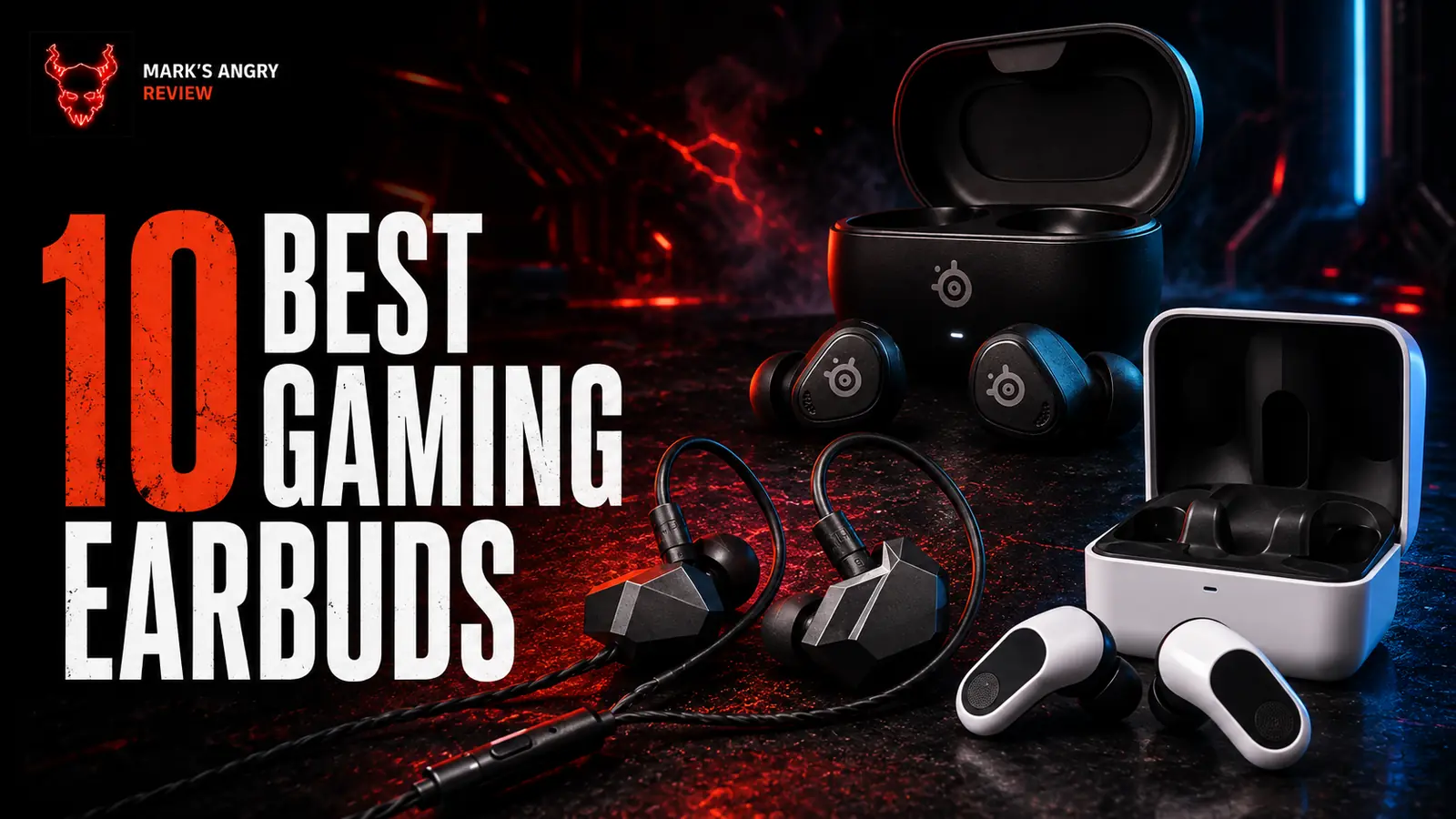
Gaming earbuds in 2026 are finally good enough to replace a headset without making every footstep sound like it was recorded inside a wet cereal box. Unfortunately, the market is also stuffed with plastic trinkets wearing RGB eyeliner and shouting words like “tactical,” “AI,” and “pro” at your wallet. There’s a lot of stupid out there!
So I ignored the marketing goblins and ranked the ten gaming earbuds that actually deserve consideration. Every model was scored against the same ten weighted criteria, with latency, positional accuracy, and sound quality doing most of the heavy lifting. A logo does not earn points. Neither does a dongle with delusions of grandeur.
This list reflects products and US availability checked in August 2026. The SteelSeries winner also matches the current top choice from RTINGS and PC Gamer, which is reassuring because occasionally the internet manages to agree on something without needing adult supervision.
The 10 Criteria That Actually Matter for Gaming Earbuds in 2026
- Latency, 15 points: How quickly the sound reaches your ears over the intended gaming connection. Bluetooth lag that arrives after your death screen is not “cinematic.”
- Positional accuracy and imaging, 15 points: How precisely the earbuds place footsteps, gunfire, voices, and other useful noises in three-dimensional space.
- Overall sound quality, 15 points: Detail, balance, bass control, clarity, and whether music sounds like music instead of a hostage recording.
- Comfort and secure fit, 10 points: Long-session comfort, stability, tip options, pressure, and whether the buds attempt to excavate your skull.
- Microphone and chat clarity, 10 points: Voice intelligibility, background-noise handling, and whether your squad can understand you without hiring a translator.
- Session endurance and reliability, 10 points: Realistic battery life, charging, connection stability, or freedom from batteries when the earbuds are wired.
- Platform compatibility and connectivity, 10 points: Support for PC, consoles, handhelds, and phones, plus useful switching between 2.4 GHz, Bluetooth, USB-C, or 3.5 mm.
- Noise control and isolation, 5 points: Active noise cancellation, passive isolation, transparency modes, and control over how much of the outside world ruins your game.
- Controls, software, and usability, 5 points: Sensible buttons, dependable touch controls, EQ options, presets, setup, and the absence of ritual sacrifice.
- Value, 5 points: What you actually receive for the money, not what the launch presentation claimed while smoke machines covered the evidence.
The Top 10 Gaming Earbuds of 2026 at a Glance
| Rank | Gaming earbuds | Critical score | Best for | Biggest annoyance |
|---|---|---|---|---|
| 1 | SteelSeries Arctis GameBuds | 89/100 | Best overall | Merely adequate microphone |
| 2 | Final VR3000 | 86/100 | Best wired value | The cable exists and knows it |
| 3 | Sony INZONE Buds | 85/100 | Long wireless sessions | No normal Bluetooth audio |
| 4 | ASUS ROG Cetra True Wireless SpeedNova | 84/100 | Rich sound and features | Fit and microphone are inconsistent |
| 5 | ASUS ROG Cetra Open Wireless | 81/100 | Open-ear comfort | Premium price, bargain-bin case |
| 6 | Sony INZONE E9 | 80/100 | Competitive FPS imaging | No built-in microphone |
| 7 | HyperX Cloud MIX Buds 2 | 78/100 | Comfortable all-round use | Middling battery and microphone |
| 8 | Razer Hammerhead V3 HyperSpeed | 76/100 | Fast multi-platform wireless | Weak ANC and uneven sound |
| 9 | JBL Quantum TWS Air | 75/100 | Affordable dual-source gaming | No ANC and aging endurance |
| 10 | PlayStation PULSE Explore | 74/100 | PS5 and PlayStation Portal | Five-hour battery at a premium price |
1. SteelSeries Arctis GameBuds: 89/100

The SteelSeries Arctis GameBuds win with an 89/100 because they are the least compromised gaming earbuds here. The Xbox version is the clever buy, since it works across Xbox, PlayStation, PC, Switch, handhelds, and mobile. The compact pebble case, tidy buds, and physical buttons look restrained, which is apparently rebellious in an industry addicted to radioactive gamer jewelry.
Low-latency 2.4 GHz audio is fast and stable, imaging is convincing, and the balanced tuning works for shooters, RPGs, and music. You also get Bluetooth quick switching, ANC, transparency, more than 100 game presets, about 10 hours per charge, a 40-hour case, and Qi charging. The physical controls are especially welcome after years of performing touch-control séances mid-match.
The microphone is passable, not heroic, and noisy rooms expose it quickly. Wear detection can be overeager, Bluetooth remembers only one device at a time, and the price is not cute. Still, every rival has a larger wound. Scorecard: latency 14/15, imaging 14/15, sound 14/15, comfort 9/10, mic 6/10, endurance 9/10, compatibility 10/10, noise control 4/5, usability 5/5, value 4/5.
2. Final VR3000: 86/100

The wired Final VR3000 takes second with 86/100, because physics remains stubbornly unimpressed by wireless marketing. Its angular black IEM shells look like tiny stealth bombers, while the included locking ear hooks and five tip sizes keep them planted. Plug the 3.5 mm cable into a controller, PC, handheld, or console adapter and the job is done. Miraculous.
There is no wireless delay, no pairing tantrum, and no battery dying during overtime. More importantly, the VR3000 produces excellent spatial separation for the money. Footsteps have direction and distance, effects stay distinct, and the tuning avoids the bloated bass sludge that manufacturers confuse with excitement. Universal 3.5 mm support also makes it the least fussy option in this ranking.
The cable can snag, the inline microphone is basic, and there is no ANC, app, or wireless convenience. The sculpted shells may need some fit experimentation too. Those are honest limitations, not buried firmware surprises. Scorecard: latency 15/15, imaging 14/15, sound 13/15, comfort 8/10, mic 5/10, endurance 10/10, compatibility 10/10, noise control 3/5, usability 3/5, value 5/5.
3. Sony INZONE Buds: 85/100

Sony’s INZONE Buds score 85/100 and land third by being absurdly good at the two things wireless gaming buds routinely butcher: battery life and comfort. The low-profile body sits lightly in the ear instead of drilling inward like a tiny tax collector. They are plain, clean, and unmistakably Sony, meaning they resemble equipment instead of a nightclub emergency exit.
The USB-C 2.4 GHz connection delivers roughly 30 ms latency, strong directional detail, and support for PC, PS5, Switch, and compatible mobile devices. Battery life reaches around 12 hours from the buds and 48 hours with the case. ANC, 360 Spatial Sound, and a useful PC app round out a package built for people whose gaming sessions have accidentally become a second job.
The microphone is only okay, some ears may find the fit too loose, and Bluetooth uses LE Audio instead of ordinary classic Bluetooth. That last detail can turn phone compatibility into a scavenger hunt. Scorecard: latency 15/15, imaging 14/15, sound 12/15, comfort 9/10, mic 6/10, endurance 10/10, compatibility 7/10, noise control 4/5, usability 4/5, value 4/5.
4. ASUS ROG Cetra True Wireless SpeedNova: 84/100

The ROG Cetra True Wireless SpeedNova earns 84/100 and fourth place by piling useful technology into an aggressively angular pair of buds. The RGB stems and geometric case scream “gaming” with all the subtlety of a leaf blower in a library. At least the design feels deliberate, and the IPX4 protection means a sweaty ranked session should not murder them.
SpeedNova’s 2.4 GHz link is quick, Bluetooth adds flexibility, and Dirac Opteo processing helps produce detailed, full-bodied sound. Adaptive ANC is effective, the feature set is extensive, and total battery life can reach 46 hours when the power-hungry extras are restrained. PC, PlayStation, Switch, and mobile support make these genuinely versatile, while the microphone’s bone-conduction assistance is more than pure brochure confetti.
They can feel bulky in smaller ears, directional imaging is good rather than elite, and the microphone still sounds thinner than the price suggests. Battery claims also shrink once ANC, RGB, and 2.4 GHz join the party. Scorecard: latency 15/15, imaging 12/15, sound 14/15, comfort 7/10, mic 6/10, endurance 9/10, compatibility 9/10, noise control 4/5, usability 4/5, value 4/5.
5. ASUS ROG Cetra Open Wireless: 81/100

The ROG Cetra Open Wireless arrives in 2026, scores 81/100, and takes fifth as the best open-ear choice. Its chunky hooks sit around the ears rather than sealing the canals, which is excellent for comfort and situational awareness. The buds look like wearable punctuation marks, while the enormous case feels cheaper than its premium price. ASUS apparently spent the case budget on adjectives.
The secure fit is superb for long sessions, 2.4 GHz latency is low, and Bluetooth handles ordinary daily use. Physical controls beat unreliable tapping, the quad-mic system is respectable, and battery life reaches 16 hours per charge with 64 hours total. IPX5 protection helps too. For glasses wearers, streamers, or anyone who needs to hear the door, these solve a real problem instead of inventing one.
Open earbuds provide almost no isolation, so immersion disappears the moment someone starts vacuuming. Bass is surprisingly competent but cannot match a sealed design, the case is comically large, and the launch price is painful. Scorecard: latency 14/15, imaging 12/15, sound 12/15, comfort 10/10, mic 7/10, endurance 10/10, compatibility 9/10, noise control 1/5, usability 5/5, value 1/5.
6. Sony INZONE E9: 80/100

The Sony INZONE E9 gets 80/100 and sixth place because it is a brilliant specialist with the social skills of a parking meter. Co-developed with Fnatic, this wired IEM is tuned for competitive FPS play. Its low-profile black shells are discreet, comfortable, and supplied with multiple tip styles, a carry case, and a USB-C audio box for PC alongside the regular 3.5 mm connection.
Positional accuracy is the reason to care. The E9 separates close and distant cues exceptionally well, keeps bass from trampling footsteps, and never needs charging. Passive isolation is excellent with the right tips, latency is effectively nonexistent, and the fit survives long sessions. If locating a reload behind a wall matters more than making an orchestra sound lush, Sony has built your oddly specific little weapon.
There is no built-in microphone. None. Apparently communication was optional DLC. The restrained bass and clinical tuning also make music and cinematic games less exciting, while the price is steep for a wired product. Scorecard: latency 15/15, imaging 15/15, sound 11/15, comfort 9/10, mic 0/10, endurance 10/10, compatibility 9/10, noise control 5/5, usability 3/5, value 3/5.
7. HyperX Cloud MIX Buds 2: 78/100

The HyperX Cloud MIX Buds 2 score 78/100 and place seventh as the sensible all-rounders nobody writes terrible poetry about. The buds and compact case use a simple rounded design, with none of the mechanical-insect nonsense found elsewhere. They are light, comfortable, and easy to carry, which matters more after hour four than another strip of microscopic RGB.
The USB-C 2.4 GHz dongle gives PC, PlayStation, Switch, and handheld players responsive audio, while Bluetooth 5.3 LE covers mobile duty. Hybrid ANC, ambient mode, in-ear detection, and straightforward touch controls make them easy to live with. Sound is clear and enjoyable, the fit is forgiving, and the included adapter reduces the usual dongle gymnastics.
Battery life is merely adequate at roughly seven hours plus 19 from the case, the microphone is average, and Xbox support remains absent. The soundstage and imaging are dependable but lack the surgical placement of the leaders. Scorecard: latency 14/15, imaging 11/15, sound 11/15, comfort 9/10, mic 6/10, endurance 7/10, compatibility 9/10, noise control 4/5, usability 4/5, value 3/5.
8. Razer Hammerhead V3 HyperSpeed: 76/100

Razer’s 2026 Hammerhead V3 HyperSpeed earns 76/100 and eighth place. The clever charging case can act as the 2.4 GHz receiver and store the USB-C dongle, which is genuinely smart. The glossy, bulky buds are less smart. They look like someone polished two beetles and attached logos, because restraint remains illegal at Razer headquarters.
The wireless link is properly fast, Bluetooth 6.0 expands everyday compatibility, and support covers PC, PS5, Switch, Steam Deck, and mobile. Battery life reaches around 40 hours with the case, 11 mm drivers supply plenty of impact, and THX Spatial Audio helps directional play. At its best, this is a responsive and convenient multi-platform package.
Unfortunately, the highs can sound muffled, music performance is uneven, ANC is weak, the microphone is inconsistent, and touch controls occasionally interpret intent through astrology. It is quick, but quick is not the same as complete. Scorecard: latency 15/15, imaging 12/15, sound 9/15, comfort 7/10, mic 5/10, endurance 9/10, compatibility 9/10, noise control 2/5, usability 4/5, value 4/5.
9. JBL Quantum TWS Air: 75/100

The JBL Quantum TWS Air scores 75/100 and takes ninth because it still covers the essentials without demanding a ceremonial sacrifice from your bank account. The design is generic black-stem territory, but the case stores the USB-C dongle neatly. It is not beautiful. It is not offensive. In gaming hardware, that level of emotional stability deserves a small parade.
The 2.4 GHz connection is responsive, Bluetooth works simultaneously through JBL Dual Source, and compatibility includes PC, PlayStation, Switch, handhelds, and mobile. Four microphones keep chat usable, 6.8 mm drivers sound respectable, the app offers customization, and QuantumSURROUND is available on PC. IPX4 protection and ambient mode add practical value.
There is no ANC, total endurance is only about 24 hours, microphone performance varies with background noise, and imaging does not threaten the top six. These are competent older buds surviving on versatility and price, not technical dominance. Scorecard: latency 14/15, imaging 11/15, sound 11/15, comfort 8/10, mic 6/10, endurance 7/10, compatibility 9/10, noise control 1/5, usability 4/5, value 4/5.
10. PlayStation PULSE Explore: 74/100

The PlayStation PULSE Explore finishes tenth with 74/100, despite producing some of the best sound in the entire ranking. Its planar magnetic drivers deliver superb clarity, separation, and positional detail, while PlayStation Link makes PS5 and PlayStation Portal use wonderfully direct. The white, winged design looks like two tiny spacecraft attempting an emergency landing in your ears.
Latency is excellent, game audio is spacious and precise, and simultaneous PlayStation Link plus Bluetooth is useful for calls or mobile audio. The hidden microphones use noise-rejection processing, the case is sturdy, and native integration makes the Explore uniquely convenient for committed PlayStation players. Sony put Ferrari drivers in this thing, then attached them to a shopping cart.
Battery life is only about five hours, the case adds just ten more, there is no ANC, microphone quality is mediocre, EQ control is limited, and the premium price is difficult to defend. Great sound cannot erase daily irritation. Scorecard: latency 15/15, imaging 15/15, sound 14/15, comfort 7/10, mic 5/10, endurance 5/10, compatibility 7/10, noise control 2/5, usability 2/5, value 2/5.
How the Gaming Earbuds Ranking System Works
Every product starts at zero, not 100. It earns points across the ten criteria listed above, and the points add directly to a final score out of 100. That matters because review scores have become participation trophies. If everything receives 9/10, the numbers are decorative wallpaper and I may as well rank the boxes by how aggressively they use the word “elite.”
Latency, positional accuracy, and sound quality are worth 15 points each because gaming earbuds must first be good at gaming and good at being earbuds. Comfort, microphone quality, endurance, and compatibility receive 10 points each because a brilliant-sounding product is still useless if it hurts, disconnects, dies, or makes you sound like a witness under voice protection. Noise control, usability, and value receive five points each.
Scores combine current manufacturer specifications, available connection modes, US availability, hands-on findings from reputable reviewers, and comparative judgment across the whole field. Headline battery claims are discounted when features like ANC or 2.4 GHz reduce them. Marketing labels receive no credit. A feature earns points only when it improves the actual experience.
Wired earbuds receive full endurance credit because they do not have batteries, plus full latency credit when the analog or USB connection is effectively immediate. Their cables, weaker mobility, and missing wireless features are penalized under comfort, usability, microphone quality, or compatibility where appropriate. Wireless products are judged primarily through their low-latency gaming mode, not ordinary Bluetooth pretending very hard.
An 80 to 89 score means excellent with clear flaws. A 70 to 79 means good, but compromised enough that the buyer needs a specific reason. Nothing reached 90 because every current model has at least one irritating weakness, from mediocre microphones to embarrassing battery life. Ties are broken by latency and imaging first, then comfort, compatibility, and value. That is the system: weighted, repeatable, and less easily bribed by shiny plastic.
Final Thoughts
If you’re tired of clunky headsets weighing you down, it’s time to switch to gaming earbuds. Not only are they portable and comfy, but the audio quality will blow your mind. Listen up, gamers! Whether you’re a noob or a pro, these tiny trinkets can seriously level up your gaming game, whether you’re on the couch or on the move.
What the hell is this? Are you seriously telling me that gaming earbuds are going to keep getting better? No cap, Sherlock. Of course, they’re going to improve with technology. I mean, what kind of a pointless statement is that? Get a grip.