Event Production Services Explained: Complete Corporate Guide

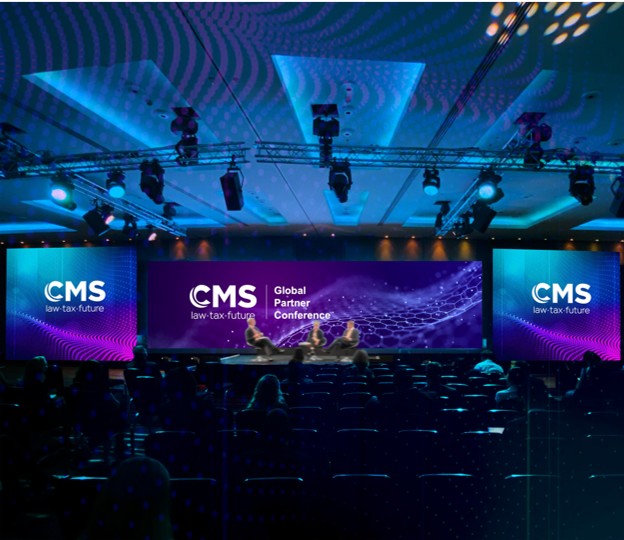
When people remember a corporate event, they rarely think about the lighting cues, stage transitions, or technical rehearsals that made it all possible. They remember how it made them feel. A keynote that held their attention. A product launch that built genuine excitement. An awards evening that felt seamless from start to finish.
Those experiences do not happen by chance. They are the result of professional event production services working behind the scenes to transform an event concept into a polished, engaging experience.
The stakes are significant, as delegates now expect in-person corporate events to incorporate modern production technology as a baseline expectation of professionalism. When event production services fall short of that standard, audiences notice immediately, even when they cannot quite name why.
Let’s understand what event production covers, how it differs from event planning, and what to look for when choosing the right event design and production company for your next corporate event.
What Are Event Production Services?
Event production services encompass the full technical and creative delivery of a live event, everything the audience sees, hears, and feels from the moment they enter the room.
While event planning focuses on objectives, budgets, and logistics, production is responsible for creating the environment, atmosphere, and audience experience that supports those goals.
A professional production team manages everything required to deliver a seamless live event: creative design, staging, audiovisual technology, technical rehearsals, live streaming, and on-site show management.
For businesses, effective event production goes beyond impressive visuals. It creates moments that engage audiences, reinforce brand identity, and help organisations communicate with impact- the kind of impact that is still being discussed long after the event ends.
What Happens Behind Every Successful Event?
The most memorable corporate events are built through detailed planning, technical expertise, and creative collaboration long before the first delegate arrives. Each element of production plays a distinct role in shaping what the audience ultimately experiences.
1. Creative Event Design
Every production begins with a creative concept, the visual identity that gives an event its character and strategic purpose. Production teams develop concepts that reflect the event’s objectives, audience, and brand identity, shaping everything from room layouts and stage design to content, graphics, and delegate flow.
Creative direction matters because it determines whether an event feels coherent or cobbled together. When the environment, content, and brand narrative align, delegates absorb the message without consciously realising it. Attention is higher, recall is stronger, and brand perception shifts in the intended direction.
At SEVEN, our creative studio develops this direction from the initial brief, ensuring the creative concept and the production plan are built as one rather than handed between separate teams.
For experiential event production, creative design goes further still, building environments that invite participation rather than passive observation:
- Multi-zone spaces where delegates move between areas with distinct atmospheres
- Interactive installations that create genuine moments of discovery
- Sensory journeys where sound, lighting, and spatial design combine into a coherent emotional arc
A strong example of this approach was our activation for TravelUp’s “Up Yours” campaign.
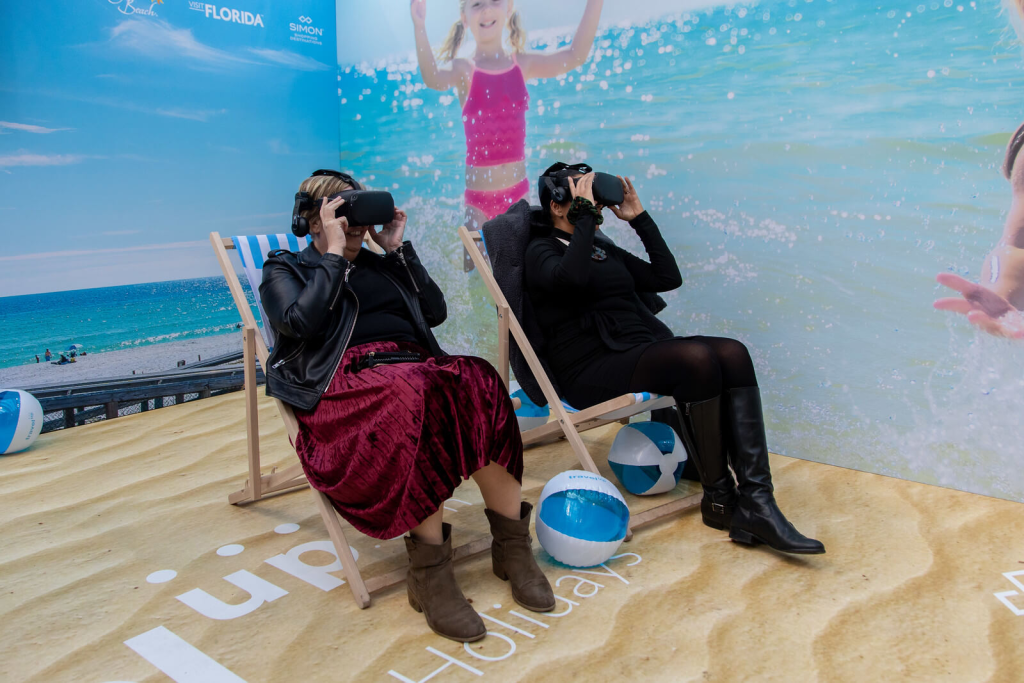
We transformed London’s Waterloo Station into an immersive Florida-inspired destination, giving commuters the chance to escape the winter commute through an interactive virtual reality experience.
Bespoke scenic elements, tropical beach styling, branded graphics, realistic flooring, and ambient heating worked together to recreate the warmth and atmosphere of the Sunshine State.
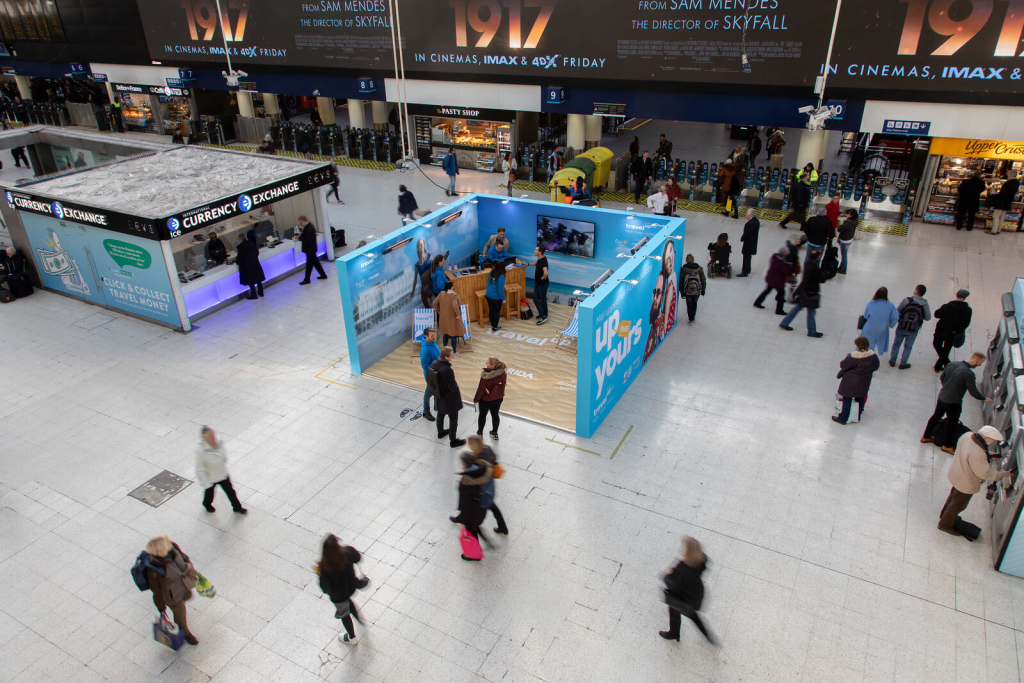
Rather than simply promoting a holiday destination, the activation immersed people in the experience, creating an emotional connection that encouraged them to imagine themselves there before they had even booked a trip.
Experiential design is one of the defining shifts in corporate events, with immersive staging and spatial flow now treated as strategic tools rather than aesthetic choices.
Activations like the TravelUp campaign demonstrate how thoughtful creative direction can transform an everyday space into a memorable brand experience that captures attention, encourages participation, and leaves a lasting impression.
2. Stage, Set and Scenic Production
The physical environment has a significant influence on how audiences experience an event. Stage layouts, scenic elements, branding, and production design work together to create the right atmosphere while supporting presenters and performers throughout the programme.
The reason stage design matters beyond aesthetics is authority and credibility. A well-designed fabrication signals to the audience that the organisation behind the event takes the occasion seriously, before a speaker has said a word, the room has already formed an impression. A generic stage in a generic room communicates the opposite. For experiential event production, the stage or fabrication becomes part of the narrative itself: curved LED walls, multi-level set pieces, and integrated content screens transform a presentation into something the audience physically feels rather than merely watches.
Technical planning also covers production schedules, equipment logistics, supplier coordination, and installation, ensuring every element is in place and tested well before delegates arrive.
3. Lighting, Audio, Visual Technology and Hybrid Production
AV and technical production is the most consequential element of the on-day experience. Poor audio is the single most common reason delegates disengage.
When the sound quality is poor, authority drains from the speaker, and attention follows. Poor lighting makes content difficult to read and stages hard to see from the back of a large room.
A professional production team selects and operates every technical element calibrated to the specific venue, room acoustics, and content requirements:
- LED video walls and projection mapping that ensure visual content lands with impact
- Broadcast-quality sound systems matched to the room’s acoustic profile
- Live streaming infrastructure for remote or international audiences
Hybrid production is now a core expectation rather than an optional extra. Event organisers now plan to include a virtual component at their next in-person event — making hybrid capability a standard feature of any professional production offer, not a specialist add-on.
4. Technical Rehearsals and Show Calling
What separates professional event production services from basic AV hire is what happens before the audience arrives.
Technical rehearsals allow every element, audio cues, video playback, lighting states, speaker run-throughs, and transition timings to be tested and locked before the event goes live. The value is not just error prevention.
Rehearsals give speakers confidence, sharpen timing, and surface any mismatch between the creative vision and the technical reality while there is still time to resolve it.
Show calling is the discipline of running those elements in real time on the day. A dedicated operator cues every technical moment to the second, keeping the event on schedule, and resolving anything unexpected before the audience notices.
It is invisible when done well. It is conspicuous and costly when absent.
Event Production vs Event Planning: What’s the Difference?
Although the terms are often used interchangeably, event planning and event production perform different but complementary roles.
Understanding the distinction helps buyers resource events correctly and avoid the common mistake of treating production as an afterthought once all planning decisions have been made.
| Event Planning | Event Production | |
| Focus | Strategy, logistics, delegate experience | Technical and creative delivery |
| Covers | Objectives, venue, suppliers, budget, communications | AV, staging, lighting, content, crew |
| Timing | Begins months before the event | Intensifies in weeks before and on the day |
| Output | A well-organised event | A well-executed, impactful experience |
| Delivered by | Event manager or agency | Production company or in-house studio |
The strongest corporate events bring planning and production together from the brief stage, not as a handover at the end, but as two disciplines informing each other throughout.
When creative, production, and event management teams are integrated under one roof, briefing gaps close, decision-making accelerates, and the event that reaches the audience is the event that was originally conceived.
What to Look for in an Event Design and Production Company?
The quality of your event design and production company determines the quality of everything your audience experiences. When evaluating a production partner, the questions that matter most are:
- In-house creative capability: do they design in-house or outsource to third parties? In-house means faster iteration, stronger creative coherence, and a single point of accountability from concept to execution.
- Relevant experience: can they demonstrate comparable events at a similar scale and with a similar level of venue complexity to yours?
- Hybrid and live streaming: is this a core service with dedicated technical infrastructure, or a bolt-on capability?
- Rehearsal and show-calling process: how do they manage technical preparation, and who calls the show on the day?
- Integrated planning and production: do they work collaboratively with your event management team from the outset, or do they step in at the end?
- Post-event content capture: do they produce footage and photography to extend the event’s value beyond the room?
These criteria matter because the difference between a good production company and a great one is process, accountability, and the ability to translate a brand story into a live experience that audiences remember.
At SEVEN Events, our in-house creative studio handles every layer of production, from initial concept and scenic design through to technical direction and post-event content capture. Our integrated approach means planning, creativity, and production are developed together from day one, not handed between separate teams.
Working across 85+ countries since 2009, we have delivered production management and exhibition design for clients including Telefónica Tech, Just Eat, and Sophos, events where production was not a support function but the central reason the experience worked. Speak to our team about your next event.
SEVEN’s Insight
Exceptional corporate events are never the result of technology alone. They are built through thoughtful creative direction, meticulous preparation, and professional event production services that reliably bring every idea to life on the day, in front of an attentive audience.
For any corporate event where audience experience matters, where the brand is on show, or where the business needs measurable impact, experiential event production is not an optional upgrade. It is the infrastructure every other investment depends on. Get it right, and delegates carry the experience with them long after the room has emptied.
FAQs
What are event production services?
Event production services cover the full technical and creative delivery of a live event, stage design, lighting, audio, visual technology, live streaming, content playback, technical direction, and on-site crew management. Together they determine the quality of everything the audience sees, hears, and experiences on the day.
What is included in event production?
A full production service typically includes creative set and scenic design, AV specification and operation, lighting design, live streaming and hybrid production, pre-event technical rehearsals, show calling on the day, and post-event content capture.
What is the difference between event planning and event production?
Event planning covers strategy, logistics, and supplier management. Event production covers the technical and creative delivery, the AV, staging, lighting, and content that determines the quality of the audience experience. The strongest events integrate both disciplines from the brief stage.


![Sleeper Service – ‘saturate’ [Review] – Reverb Music](https://som2nynetwork.com/wp-content/uploads/2026/08/ebd3f-sleeperservice_2-min-336x220.jpg)