A practical buyer’s guide for self-managed communities and community management companies
Most “best HOA software” articles start with a ranked list of vendors. That can be useful when you already know exactly what you need. But for most boards and management teams, the harder question comes first: what actually makes one HOA management platform better than another?
After more than 16 years working in property management, I have learned that the best platform is not automatically the one with the longest feature list. It is the one that removes work, improves financial and operational visibility, gives homeowners practical self-service options, and helps the association make consistent, well-documented decisions.
The right fit will still depend on your community size, operating model and current systems. However, the qualities that define strong HOA management software are remarkably consistent.
| QUICK ANSWER The best HOA management software is purpose-built for community associations, connects accounting, operations and the resident experience, automates repetitive work, makes self-service easy, creates dependable audit trails, scales with the organization, and includes strong onboarding and support. For HOAs and management companies that want one connected platform instead of several disconnected tools, Condo Control is designed around these requirements. |
What HOA management software should actually do
HOA management software is a central platform for the financial, operational and governance work required to run a homeowners association. Depending on the community, that may include assessments and payments, accounting, homeowner communication, maintenance and work orders, architectural change requests, violations, document storage, meetings, electronic voting, amenity bookings and reporting.
Basic software stores this information. Better software connects the work from beginning to end.
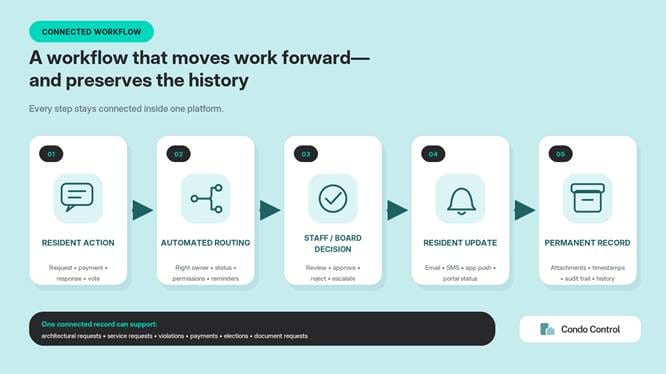
For example, when a homeowner submits an architectural request, the platform should do more than save a form. It should notify the right reviewer, preserve plans and photos, track the decision, notify the homeowner, and keep the final record available to the next board. The same principle applies to a late assessment, a maintenance request, a violation or a board vote.
That connection between submission, action, communication and recordkeeping is what turns a collection of features into a management system.
The best HOA software starts with outcomes, not a feature count
A feature checklist tells you what a platform can technically do. It does not tell you whether the software will reduce board workload, help managers respond faster or give residents a reason to log in.
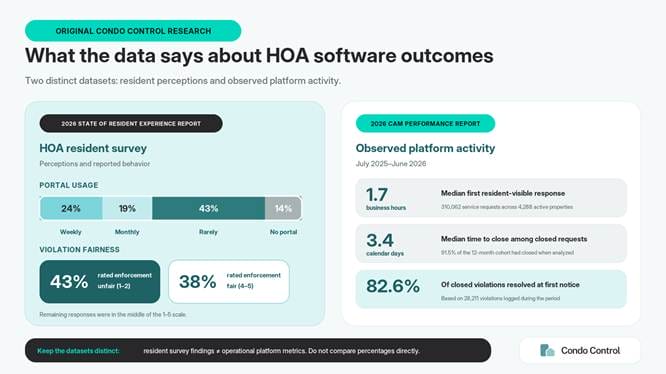
That distinction matters. In Condo Control’s 2026 State of Resident Experience Report, only 24% of HOA residents said they used their portal weekly. Another 43% said they rarely used it, and 14% reported having no portal at all. A portal that residents ignore does not meaningfully reduce email, phone calls or administrative work.
The same report found that 61% of HOA residents received replies to emailed questions only after three to five days or more than five days. It also found that 43% rated violation enforcement as unfair, compared with 38% who rated it fair. These are not simply communication problems. They are workflow and visibility problems.
Strong HOA software should improve measurable outcomes such as:
- Less time spent answering repeat questions and searching for records
- Faster and more consistent handling of requests, approvals and violations
- Clearer owner ledgers, collections and financial reporting
- Higher resident adoption of payments, documents, voting and self-service tools
- Better continuity when board members, managers or staff change
- More visibility for boards and executives without asking managers to assemble manual reports
The most important evaluation question is therefore not “How many modules does the platform have?” It is “Which recurring problems will this platform remove, and how will we verify that it worked?”
The qualities that define the best HOA management software
It is purpose-built for community associations
HOAs are not rental portfolios. They are owner-governed communities with boards, assessments, operating and reserve funds, governing documents, elections, architectural standards and enforcement processes. Software designed primarily for landlords may handle payments and maintenance, but it often requires workarounds for association governance.
A purpose-built platform should understand owner ledgers, recurring assessments, board permissions, architectural reviews, violation notices, electronic voting, document retention and association reporting. Those workflows should be native to the product, not recreated through spreadsheets, generic task tools or a chain of add-ons.
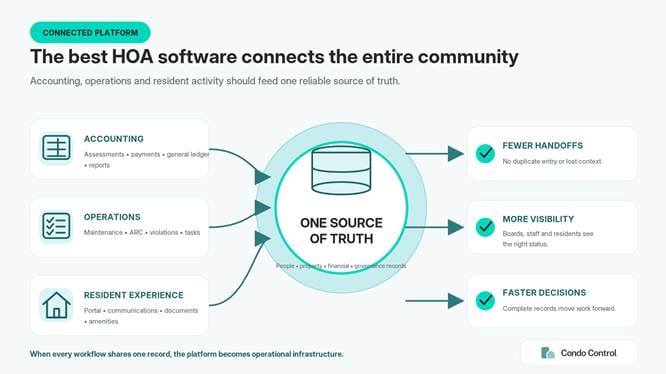
It creates one connected source of truth
Many communities assemble their technology one problem at a time: accounting in one system, payments in another, maintenance in email, violations in a spreadsheet, documents in shared folders and voting with a separate provider. Each tool may work on its own, but the handoffs create duplicate data, conflicting records and extra work.
The best HOA management software connects accounting, operations, resident communication and governance. A payment should update the owner ledger. A fine should flow into the financial record. An approval should remain attached to the request. A notice should have a delivery history. Board members, managers, staff and residents should see the information appropriate to their role without maintaining separate versions of the truth.
It uses automation and AI to complete work
Modern HOA software should do more than digitize manual steps. It should reduce the number of steps people need to perform.
Useful automation includes recurring charges, payment reminders, late-fee rules, request routing, task assignments, follow-up notices, scheduled reports and status updates. Useful AI can answer routine resident questions from approved community information, help managers draft communications, and summarize long financial or governance documents.
The test is simple: does the technology close part of the workflow, or does it create another inbox that someone still has to manage? During a demo, ask the vendor to show the complete process from resident action to staff response, notification and final record.
It gives residents a reason to use it
Resident adoption is not created by sending more login reminders. It is created by making the platform useful in everyday community life.
Homeowners should be able to pay assessments, check their balance, find governing documents, submit and track requests, respond to violations, vote, book amenities and receive important notices from a phone. Communications should reach residents through the channels they actually use, including email, SMS and app push notifications, with delivery history available when proof matters.
When residents can complete common tasks without contacting the board or manager, the portal becomes a service channel instead of a static website.
It includes financial management built for associations
Financial capability should go beyond accepting online payments. The strongest platforms support the association’s complete financial workflow: a double-entry general ledger, accounts payable and receivable, recurring assessments, owner ledgers, bank reconciliation, budgeting, operating and reserve fund visibility, approval controls and audit-ready reporting.
If your organization keeps an external accounting system, the integration should be tested carefully. Ask whether data moves both ways, which records sync, how exceptions are handled and whether staff still need to re-enter charges, payments or vendor information.
It makes operations and governance consistent
Architectural requests, violations, maintenance issues, board tasks and elections are frequent sources of delay and conflict because the process is often informal. The best software turns those activities into structured workflows with clear ownership, status, templates, reminders, attachments, timestamps and permissions.
That structure helps self-managed boards avoid losing information when volunteers change. For management companies, it helps every manager follow the same process across every community. For residents, it provides clearer expectations and a record of what happened.
Violation management is a useful test of whether a platform merely stores records or helps the association manage risk. Strong software should show open cases by age, distinguish active cases from stale ones, preserve each escalation stage, identify repeat issues by unit or category, and give managers and boards a current history of notices, evidence and responses.
Condo Control’s 2026 Community Association Management Company Performance Report analyzed 28,211 violations logged from July 2025 through June 2026. Of the violations that had closed, 82.6% resolved at first notice without escalating beyond the initial action. The finding is observational, not proof that software alone caused the outcome, but it shows why clear notices, documentation, follow-up and reporting belong in one workflow.
It provides visibility for every role
Different users need different views of the same operation. Residents need their balance, documents and request status. Board members need financial reports, approvals, projects and governance records. Managers need a prioritized queue. Operations and finance leaders need portfolio-level visibility into open work, collections, workload and risk.
Strong reporting should be current, role-based and easy to export. It should help people act, not simply produce more data. An audit trail should show who made a change, when it happened and what the previous record contained.
It is supported by serious onboarding, security and service
A platform can have excellent features and still fail if the migration is disorganized, training is generic or help is difficult to reach. Before choosing a vendor, understand who owns implementation, what data will be migrated, how roles and permissions will be configured, how residents will be introduced to the system, and what support remains available after launch.
Security and reliability should be evaluated with the same care. Ask about independent security certifications, encryption, role-based access, audit logs, backups, uptime, incident response and data export. These are core product qualities because HOA software holds financial, personal and governance records.
Condo Control is designed as a connected management and accounting platform for self-managed communities and property management companies. More than 3.5 million residents use the platform, and Condo Control has served community associations for more than 18 years.
Its strength is not one isolated feature. It is the way the major parts of association management work together.
Accounting, operations and the resident experience in one system
Condo Control combines a full association accounting suite with payments, collections, communications, maintenance, architectural requests, violations, electronic voting, documents, amenities and resident self-service. Communities can run the general ledger, payables, receivables, billing, reconciliation and reporting beside the operational activity that creates many of those financial records.
Explore Condo Control’s HOA management platform and association accounting capabilities.
Practical automation and AI
Residents can use self-service tools and an AI assistant for routine questions, while managers can use AI to draft communications and summarize long documents. Automated routing, templates, reminders and reporting help reduce repetitive work without removing human control from decisions that require judgment.
Learn more about the Condo Control AI assistant.
A resident experience designed around useful actions
Residents can pay, submit requests, review documents, vote, receive notices, book amenities and track activity from the same platform. Managers and boards can send communications through multiple channels and maintain delivery and read records. That gives residents more control while reducing the number of routine contacts that reach volunteers and staff.
That resident experience can also be measured. The same performance report analyzed 310,062 service requests opened across 4,288 active properties from July 2025 through June 2026. The median first resident-visible response was 1.7 business hours. Among closed requests, the median time to close was 3.4 calendar days, and 91.5% of the 12-month cohort had closed when the data was analyzed.
These are observed results on the platform, not proof that Condo Control alone caused them. They demonstrate the visibility a connected request workflow can create for residents, boards and managers.
Standardization for one community or an entire portfolio
A self-managed HOA can use Condo Control to keep institutional knowledge out of personal inboxes and spreadsheets. A property management company can apply role-based permissions, templates, processes and reporting across multiple communities, giving executives more visibility and helping managers handle more doors without relying on inconsistent manual practices.
Guided activation and measurable support
Condo Control assigns an Activation Specialist to manage setup, data migration, configuration, role-based training and go-live. Published support metrics show a 6.5-minute median first response, a 14.9-hour median full resolution and 99.9% uptime. Human support is supplemented by built-in AI assistance outside regular coverage hours.
Review Condo Control’s onboarding process and published support metrics.
| CUSTOMER OUTCOME EXAMPLE Diamondhead Lake HOA, a 351-home community, reported a 15% decrease in delinquent payments, a 10% reduction in office costs, a 40% increase in efficiency and approximately five hours saved per day after centralizing its work in Condo Control. These results came from reducing manual recordkeeping, improving access to information and making everyday processes easier to manage. |
Source: Diamondhead Lake HOA customer story
Do not let a software vendor show only its most polished dashboards. Give the vendor real scenarios from your community and ask to see each one from beginning to end.
- A homeowner submits an architectural change request with photos. Show how it is routed, reviewed, approved or denied, communicated and retained.
- An assessment becomes due. Show the resident payment experience, the owner ledger, reminders, late-fee handling, reconciliation and board reporting.
- A manager or board member records a violation. Show the notice, supporting evidence, resident response and complete history. Then identify cases open for more than 90 days, distinguish actively progressing cases from stale ones, display each escalation stage, flag repeat violations and produce a board-ready status report.
- A resident submits a maintenance request. Show assignment, vendor coordination, status updates, approvals and closure.
- The association prepares for an annual meeting. Show notices, quorum tracking, proxy or electronic voting, live results and record retention.
- A new board member or manager takes over. Show permissions, training, historical records and how responsibilities are reassigned.
- The community migrates from its current system. Show the implementation plan, data mapping, validation, resident launch and support process.
- The association decides to leave in the future. Show how its documents, financial records and operational history can be exported.
For every scenario, ask four follow-up questions: Who still needs to touch the task? What happens automatically? What can the resident see? Where does the final record live?
It is also useful to speak with a customer that resembles your organization. A 30-home volunteer-run association, a 500-home master-planned community and a management company overseeing 50 associations will use the same platform very differently.
Frequently asked questions about HOA management software
How much does HOA management software cost?
Pricing varies based on the number of homes or communities, the modules included, accounting and payment requirements, implementation, support and transaction fees. Compare the total cost of ownership, not only the subscription price. Ask each vendor to identify migration fees, required add-ons, payment charges, training costs, integration fees and future price increases in writing.
Can an HOA use QuickBooks instead of HOA management software?
QuickBooks can support general accounting, but it does not by itself manage the full resident, governance and operational experience of an HOA. Some associations pair it with a purpose-built HOA platform, while others choose software with association accounting included. When comparing either model, verify how owner ledgers, assessments, payments, approvals and bank reconciliation move between systems and where duplicate entry may remain.
Is HOA software useful for a self-managed association?
Yes, especially when volunteers need to preserve records, standardize recurring work and give homeowners self-service options. A small self-managed HOA should prioritize ease of use, clear permissions, automation, resident support and a realistic implementation plan. It should also confirm that the value of reduced administrative work justifies the cost and complexity of the platform.
How long does HOA software implementation take?
The timeline depends on data quality, integrations, accounting setup, workflow configuration, training and resident launch requirements. A vendor should provide a named implementation owner, milestones, data-validation steps and a go-live plan. Condo Control says a typical HOA activation takes approximately one to four weeks, although more complex organizations may require additional time.
What is the best HOA management software?
The best HOA management software is not the platform with the most logos on a comparison chart. It is the platform that becomes a dependable operating system for the community.
It should reduce manual work, keep the books and records clear, make common tasks easy for homeowners, support consistent governance, and give boards and management teams the visibility to act before small issues become larger ones.
Condo Control is built around those qualities. It connects accounting, operations, communication, governance, resident self-service, AI and support in one platform for self-managed HOAs and property management companies.
See how Condo Control would work for your community by booking a personalized demo.