From the 1930s to the 1950s various lobbies expressed anxiety over the arrival of the “super pub” – public houses that were bigger and flashier, with broader appeal and less soul.
We’d previously come across the term superpub in a quite different context, writing about the Wetherspoon chain and its contemporaries in the 1990s. (See 20th Century Pub, chapter 9, ‘That’s no Moon’).
But an earlier usage also appears in 20th Century Pub, in passing, in a quote from A.E. Richardson, professor of architecture at the Royal Academy, in a letter to The Builder magazine from May 1950. Here’s a fuller version of the quote we used in the book, with our own emphasis:
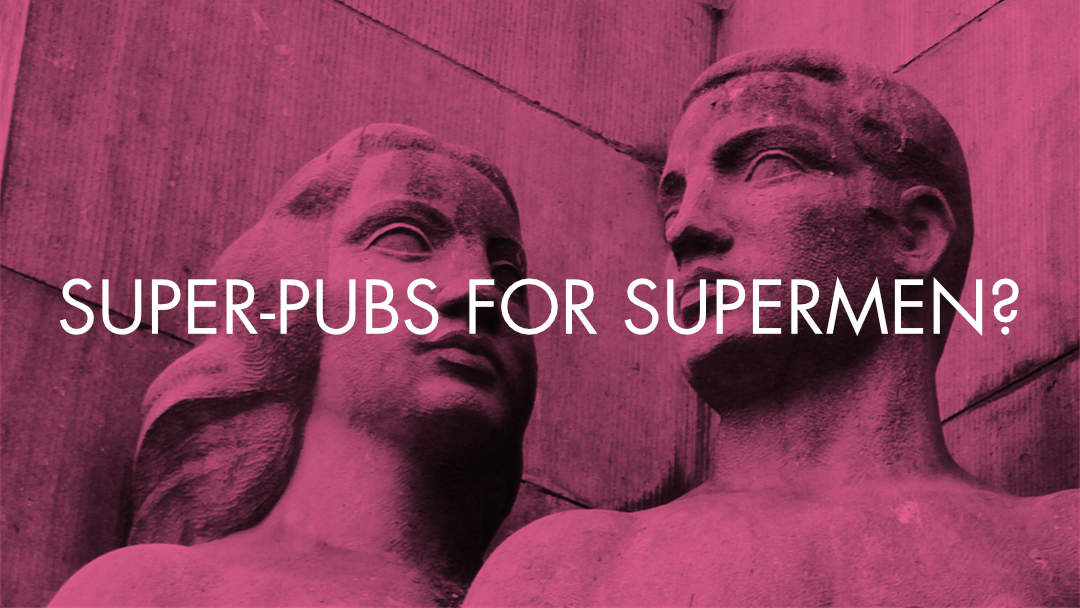
There now arises the grim spectacle of the prefabricated and metallic inn which, as yet, only exists on paper… The mentality which has evolved the designs, recently made public, is typical of an age of morons… The designers and promoters of competitions for modern pubs apparently wish to cater for beings from another sphere. They aim at producing the super-pub for supermen. Where are the gin palaces of other times, the saloon bars and the ladies of the Criterion? Where are the slot machines and all the impedimenta of Victorian temptation? ” Blown away are those Jacobean fantasies, for which are thankful… But now, fantastic modernistic interiors seem to anticipate the operating theatres of hospitals. How we long for the small tap-rooms of village pubs, the parlours of distant country inns: the taters, tarts, and tidiness of Sam Weller’s day. All such places appealed by their homeliness; they were delightful with their sanded floors, Windsor chairs and odd prints on the walls.
Richardson, we’re fairly certain, is deliberately evoking Nietzsche and Nazism – the concept of the Übermensch, and Bernard Shaw’s Nietzschean play Man and Superman from 1903. Britain had just fought a war against Germany, against these very ideas, and to preserve “our way of life” – of which the traditional pub was a key part.
Also in 1950, the Reverend Kenneth Hyde, youth secretary of the National Free Church Federal Council, addressed a rally at Crosby Congregational Church. In his speech he complained that councils had prioritised super cinemas and super pubs over churches on new housing estates. (Crosby Herald, 30 September.) Again, there’s a suggestion that the super-pub isn’t super at all but, rather, an existential threat.
Tracking back further, we find the headline ‘The Super-Pub vs. the Home’ in the Liverpool Daily Echo for 10 February 1949 in a piece which quotes the chairman of the Chester licensing magistrates:
I know it to be the opinion of some that the provision of licensed houses to attract the family is the ideal… I think the implication of this suggestion requires more consideration than has been given to it. For my part I trust the day will not arrive when the British people will consider that the centre of gravity of family life should be removed from the hearth to the licensed house. I hope also that the little cosy homely ‘pub’ will still have its place by the side of the larger and more pretentious licensed premises. The little ‘house’ with the intimate atmosphere and coterie of regular customers is as important as the more spacious modern premises.
There’s also this very brief line in an edition of The Sunday Mirror from 23 January 1949:
Birmingham is to have a seven-floor super-pub near New-street Station.
Which pub this was, or if it was ever built, we’ve not yet been able to work out.
In 1948, R.H. Hosking, head of Coventry art school, gave a talk about architecture and planning in the city and, according to a report in the Coventry Evening Telegraph on 2 November that year, argued that:
Ugly items… were too numerous to mention, because in the past there had been no one to take up the cudgels on behalf of beauty. Another form of spoliation was the enormous spread of building that took place between the wars, with needless repetition of characterless houses. only broken here and there by a “super-pub” or shopping centre.
We can track the use of the term back to before World War II, with reference to the improved public house movement. At this point, though, it seems less scary (less Nietzschean) and reflects a certain futuristic optimism:
Nowadays one hears often enough of super-cinemas, dance-halls, etc., but seldom of a super-public-house. Yet that is what the brewers, Messrs. Truman, Hanbury and Buxton have erected in Waterloo Street, Hammersmith… Every possible device has been arranged for the comfort and convenience of the public, not only in the saloon, but private and public bars as well.
(West London Observer, 7 April 1933.)
We think the pub in question is the architecturally significant Hope & Anchor, by the way, Waterloo Street having become Macbeth Street at some point, although the reported opening dates don’t quite match.
A piece by T.S. Williams on pub names in The Birmingham Daily Gazette for 12 November 1934 echoes this optimism, while also reflecting the tension between tradition and modernity:
Not that in many ways the excellent modern public-house is not decidedly an improvement on the confined and dowdy type which still litter our cities and towns. But the super-pub of its own spaciousness does not compare with the compact little inn for warm conviviality and invitingness.
Whether used positively or negatively the word ‘super’ generally seems to imply that these pubs are not quite on a human scale, and either impressive or scary depending on your perspective.
In the 1990s, when people were marvelling at the massiveness of The Moon Under Water in Manchester, the term ‘superpub’ arguably continued to have this dual meaning.
The difference is that, by the 1990s, it was a bit of tabloid newspaper or marketing hyperbole, rather than having any whiff of heavy philosophy about it.