Rosenheim is a city in Upper Bavaria with a population smaller than that of Taunton. We chose it as a stop on the way home from Czechia not realising that we’d picked the biggest weekend of the year until we tried to book a hotel.
We arrived in Rosenheim from Brno via Vienna and Salzburg after a day of delayed trains. It was cloudy, spitting with rain, and the first building we saw on the way to our hotel was boarded up and derelict.
The walk to our hotel was along the ring road, past a string of modern office and apartment blocks. The pavement wasn’t finished.
As we approached our hotel a bunch of lads in matching shirts, members of a drinking society from the Upper Palatinate, blocked our way. One of them said something and lurched towards us, before being pulled away by his pal. They laughed as we scurried away.
Just to remove any last shred of romance the hotel in question, the only place in the city with available rooms, was a Premier Inn. We might as well be in Wolverhampton. We began to wonder if we’d made a mistake.
We went out later that evening in search of the cute old town we’d seen in photos. First, though, we had to stop and marvel at the colossal Auerbräu brewery that loomed over the district like a fortress or city wall. Auerbräu is owned by Paulaner these days, and the building could do with a lick of paint, but it’s impressive nonetheless. Through the great gates there’s what amounts to a small town in its own right and there are acres of yards where beer crates and kegs are stacked to the sky.
Then, walking through quiet streets lined with bland post-war buildings, convenience stores and chain shops, we found ourselves thinking not of global Brooklyn but of global Croydon high street.

We began to get our first inkling of magic when we passed a shop selling Trachten, Bavarian traditional clothing, that was open late, with a DJ playing. As we approached the main square we began to notice crates full of empty beer bottles stacked beside bins, and heard the murmur of a happy crowd.
The Rosenheim Herbstfest, or Wies’n, starts on the last Saturday of August so this was, in effect, Herbstfest Eve.
It seemed as if everyone was out, drinking on cafe terraces, or just standing around red crates of Flötzinger beer on the cobbles. We’d seen Auerbräu but it was clear that it’s Flötzinger, the city’s independent brewery, that the locals really love. The crowd skewed young and punky. Some wore T-shirts or badges inviting Nazis to go and fuck themselves.
We ended up at the Flötzinger Bräustüberl (brewery tap) where, in sweltering heat, enormous Schnitzels were being ferried about and devoured. Flötzinger Wies’n Märzen was being served from bottles and could hardly have been fresher, or more pleasingly cold.

The next morning, in bright sunlight, Rosenheim still looked like Croydon, but with a backdrop of the Bavarian Alps.
The lads from the drinking club were out and about in their matching shirts, ready for another big day, and across the road at Auerbräu they were prepping the shirehorses for the big parade.
At the bus station, young Austrians in Trachten were emerging from coaches, warming up for the festival with bottled beers or cans of Spezi, and a few tentative drinking songs.
A troupe of people on vintage bicycles were getting into costume, and taking their penny farthings in circles to check the brakes.
From the railway station came a stream of people, also mostly on Trachten – groups of young men with stylish haircuts and knees on show in Lederhosen; young women in Dirndls, arm in arm; families with babies in tiny Alpine hats; and pensioners in polished shoes.

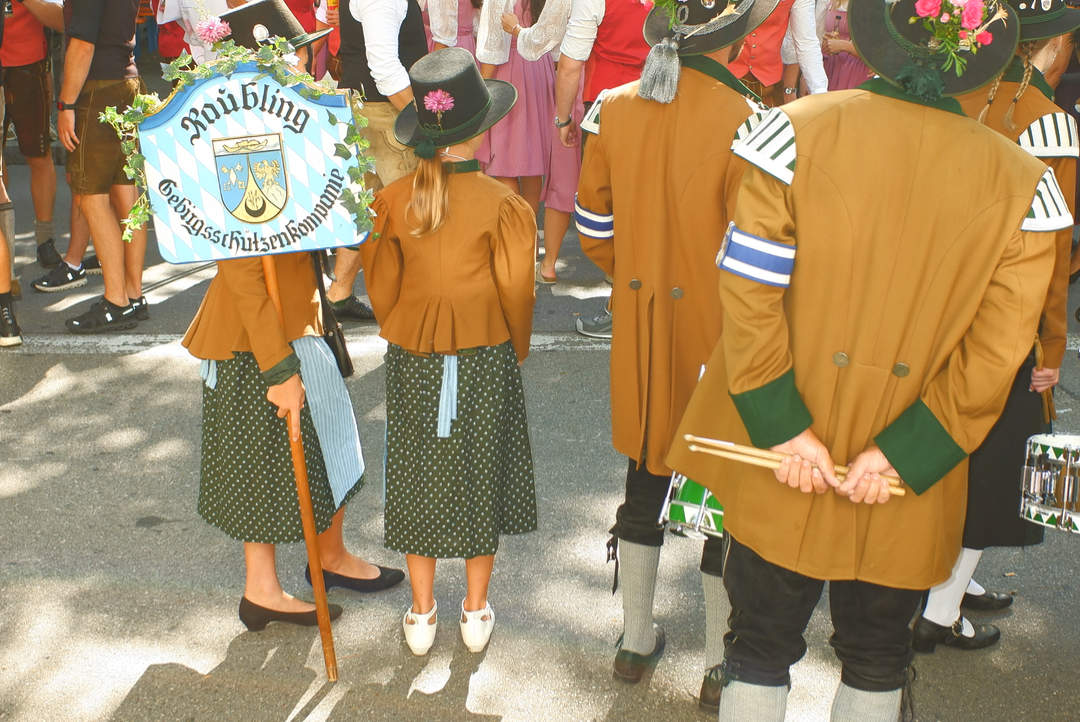
The procession started at eleven o’clock with drays from both big breweries, brass bands, groups of Alpine militia with rifles over their shoulders, a platoon of bakers carrying baskets loaded with pretzels, a group of butchers carrying strings of sausages and joints of meat, and rank after rank of Dirndl-clad waitresses preparing for duty at the festival ground.
Every time a band played an oompah-ing march, blasting out the first notes in unison, we felt faintly uneasy: it’s not always a good sign when Germans start marching to stirring music. The presence of the occasional non-white face in the procession was reassuring, however, as was the Tatzelwurm – a local cryptid – represented by someone in a ridiculous, gaudy, saggy panto costume. Nobody was taking any of this too seriously.
When the procession was over we drifted with the crowd towards the festival ground. There were a handful of police officers and some volunteer firefighters managing thousands of people.
We noticed that the entrance to the festival ground was guarded by concrete bollards designed to prevent terrorist attacks but nowadays they can at least be decorative; these were in the shape of giant Maßkrugs.

In that first session, every seat in every beer hall and beer garden was taken, with people sitting patiently waiting for the beer to be tapped at midday. They looked thirsty and hot, but contented. The most wonderful time of the year had arrived, after all.
The Flötzinger Festzelt looks temporary but is apparently a permanent structure, mothballed for long stretches of the year. It’s colossal with seats for about 10,000 people, served by around 200 waitresses. Even without a seat, and without a beer, we stood mesmerised, bathing in the jet engine roar of the crowd and the brassy blast of the band.
We had lunch in town, not fancying fairground food, and drank Augustiner (somewhat guiltily) while watching festivalgoers come and go around us.
We noted that some younger women have rejected the trad wife Dirndl in favour of versions that are punkier, or more goth. A black Dirndl with a lace panel covering the collarbone and neck, complementing tattooed arms, is a strong look. Young men with footballers haircuts swaggered about in Lederhosen and knee socks, vape sticks in one hand, beers in the other. Anyone not in Trachten looked underdressed.

Though everyone was merry, we hardly saw any drunkenness. The exception was on Saturday night when an amateur from out of town seemed to have forgotten how to walk so tried running instead. This did not go well, though the semi-circle he traced across the cobbles while charging into a wall was rather elegant. On this, at least, we can go beyond impressions and look to the police statistics:
The first Oktoberfest ban of the year was issued shortly before 4 p.m. A 32-year-old man from Lower Austria had attracted attention in a beer tent due to his unruly behavior. With a blood alcohol level of nearly 0.3%, he was also heavily intoxicated. His visit to the Oktoberfest was thus brought to an early end…
By our count, there were ten people drunk enough to cause any trouble, in a city of about 70,000 people, with tens of thousands of visitors from out of town. (There was also a murder. But whether that’s connected to the festival is not yet clear.)
We made it into the Flötzinger Festzelt for a drink on Sunday when we hoped it might be a little quieter, the whole city presumably having at least a little hangover. In the mid-afternoon lull we found space on the end of a bench and enjoyed a couple of Maßs of Märzen and a pretzel the size of a bin lid.

Around us, little kids in Trachten charged about chasing each other, nearly but not quite taking out cheerful waitresses as they carried six, eight, ten glasses of beer. Young people flirted and couples smooched. A mountainous man who was a living caricature of a burly, contented Bavarian sat next to us and in his giant hand a litre of beer looked like half a pint. He got foam in his handlebar moustache.
In some ways, it all reminded us of being back at home, in the West Country. The Furry Dance at Helston Flora Day. Bridgwater Carnival and Bridgwater Fair.
But can you imagine all the young people in a British town or city dressing up in morris dancing outfits or tweeds for a day out on the town? Or perhaps that’s what the much-mocked Peaky Blinders trend of a few years ago was all about.