When did sofas (or settees, or couches) start appearing in pubs? And what does their presence say about the type of pub you’re in?
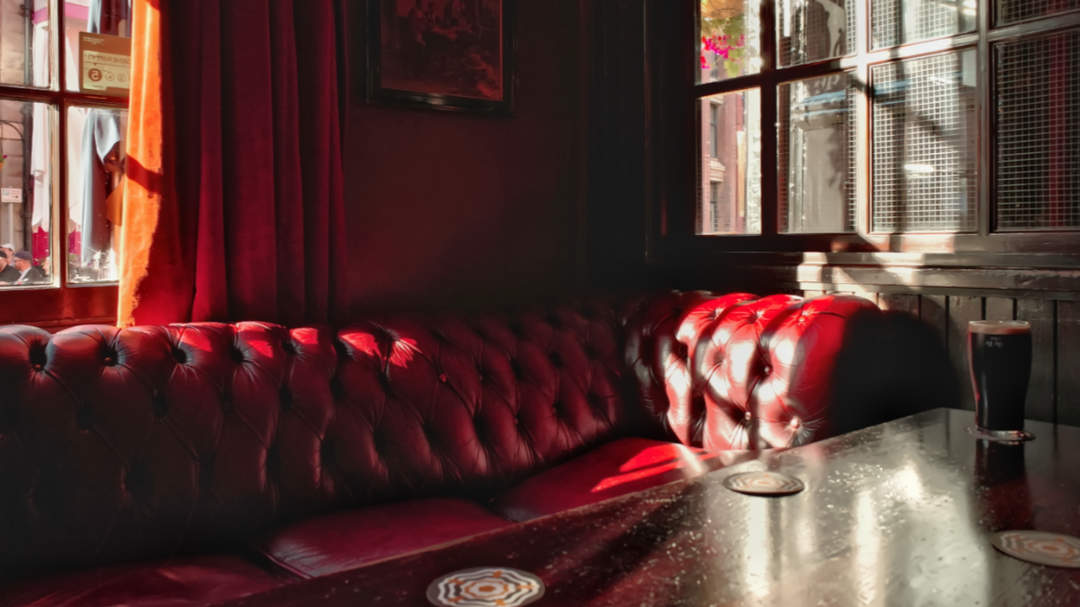
Pub sofas are generally big, squishy, and covered with leather.
They’re at the edge of the room beside the fireplace, or under a painting of, say, a horse, or a blackboard advertising upcoming events.
There might be a low coffee table, or an end table or two, for the placing of drinks. Sometimes, two sofas will face each other, or there might be a matching armchair.
We’re not fans of sofas in pubs. We sink into them, they make us drowsy, and they make us feel as if we’re at home. Not in the sense of homeliness; as in, why did we bother coming out?
It’s not even as if they’re usually especially comfortable. You’ll see people perched on the edge of the cushions, leaning forward, as if they’re not stopping for long.
Most frequently, people sitting on the sofa in a pub are using it as a sort of waiting area, hoping that a proper table becomes available soon.
What we’re wondering is, were they always there, these great lumps of useless soft furniture? Our gut feeling is that they appeared in the 1990s and 2000s as part of the general middle-classing of pubs.
That’s certainly when we remember first noticing them, at pubs in places like Brixton and Hackney, where someone might be DJing ‘chilled out beats’ to go with the Sunday Roasts.
Let’s test that hypothesis with a little research.

Is there evidence of sofas in pubs before the 1990s?
Of course our hypothesis is proven wrong within ten minutes of doing any research.
We often refer to a wonderful book called The Planning and Equipment of Public Houses by Francis W.B. Yorke, published by the Architectural Press in 1949. It’s a practical manual for how to build, set up and run a pub, and offers a (belated) snapshot of the interwar scene.
In a section about how to furnish a pub, Yorke writes:
Superior rooms, particularly rest rooms, should be provided with settees.
In this context ‘rest room’ isn’t American for ‘bog’ and elsewhere in the book Yorke calls it “a ladies’ rest room” and says it should be “furnished with settees and a table for periodicals”. He specifies that this type of room is usually found in “the larger roadside inn”.
This is all very specific, though, and Yorke doesn’t recommend sofas/settees for any other type of room in a pub, including lounges, where he only recommends “loose furniture” and says: “Tables should be small and seats comfortable.”
There’s also this from the Western Morning News for 18 June 1924, about The Queen’s Head in Plymouth, Devon:
The entrance is unusually large for such a house, and once across the threshold one has to pause to take in the tasteful layout of the interior… Large red tiles form an Old English floor, and all around the room are placed oldfashioned settees, such as can be found in many a Devonshire farmhouse. These have slightly sloping backs and Sheraton legs. In front of the settees are placed dark stained oak tables.
Now, we’re not experts in the history and design of the sofa (although writing blog posts like this can easily send you down the rabbit hole) but that doesn’t quite sound like the type of plump and padded sofa we’ve got in mind. As far as we can tell, it’s more like a bench, only not bolted down.
Another Architectural Press book, Inside the Pub by Maurice Gorham and H. McG. Dunnett, published in 1950, includes numerous photos of pubs, including some very smart ones. None of them have sofas.
There is, however, an illustration by Gordon Cullen of an ideal “Lounge Bar or Cosy” which does feature something that, to our eyes, look distinctly like proper, upholstered, comfy sofas.

But looking through the many photos of post-war pubs that we’ve scanned and shared here on the blog, we can’t see any free-standing sofas. The closest it gets is the occasional padded bench, apparently fixed to the wall – and even those are quite rare.
A third Architectural Press book, The Traditional English Pub by Ben Davis, published in 1981, puts a capper on this discussion, because he has no time at all for “Reclining chairs” (armchairs), never mind sofas. They are, he says, “ill-adapted for conversation in any room where the sound level is high”. His general feeling is that pub furniture should be small, with tables just big enough to hold 6 pints of beer and chairs with just enough space for a single bum.
We think we can say at this point that, yes, historically there were occasionally sofas or settees in pubs, but they were pretty unusual.

Plastic plants and sofas
Here’s something handy from the Kentish Express from 10 June 1993 in which Digby Kennard attempts to sum up what happened to pubs in the 1980s:
Out went dominoes, strippers, meat raffles, cabaret acts and half of mild in the corner snug. In came video screens, disco lights, fake palm trees, sofas and pina coladas on the patio.
This is fascinating because it connects sofas with something similar to – but not quite the same as – the gentrification of the pub. It’s the same trend that John Sullivan was satirising in the yuppie-era episodes of Only Fools and Horses when Del Boy forsakes The Nags Head for the wine bar.
On 17 April 1985, The Liverpool Echo published an interview with Whitbread Merseyside’s property manager Dough Howarth which includes this insight:
When it comes to designing for pubs women use, Doug says: “I would perhaps use some pastels and softer furniture, like sofas.”
We found several promotional stories about pub refurbishments from the late 1980s which make a point of mentioning the installation of sofas as a selling point. For example, there’s a piece headlined‘Dream pub is a reality’ from The Sussex Express 4 April 1986: “Festoon blinds adorn the windows and sumptuous sofas are placed around one of the open fires.” Sumptuous! We’re definitely getting into squishy territory here.
One rather critical piece, from The Yorkshire Post and Leeds Intelligencer for 19 June 1990, is headlined ‘Shock of the nouveau pub’ and expresses dismay that, in refurbishing a pub in Mexborough “Tetleys have gone for the pink sofas with plates and prints effect”.
We reckon we can conclude from all this that by the start of the 1990s, if you were refurbing any larger pub you might well pop in a sofa or two. We also think it’s probably fair to say that this represented the ‘loungification’ of the pub as a whole.

What job is the pub sofa doing?
Researching this, we’ve developed a theory about one useful function of the pub sofa: softening the edges of pubs that, throughout the 20th century, lost much of their character.
Partitions were bashed out to create larger spaces, with snugs and lounges disappearing in the process. Historic fixtures and fittings were torn out or covered up. Ornate decoration was replaced by clean minimalism.
Eventually, attempts were made to rectify this by giving pubs elaborate themes or re-Victorianising them. But the former came to seem naff pretty quickly, and the latter became more difficult as the supply of genuine antiques dried up. (See: reproduction Britannia tables.)
In this context, a big leather sofa with deep buttons became an easy, affordable way of adding instant ‘production value’. They implied a touch of luxury, despite their impracticality, in the same way gilded signs, cut glass, elaborate ironwork and wood panelling made 19th century pubs feel like palaces. And they perhaps evoke the textures of the good quality padded bench seating that went into a skip decades ago.
It’s a particularly chunky form of greebling, if you like, to go with the horse brasses and faux-vintage Reader’s Digest books purchased by the metre.
Perhaps they also helped to fill dead spots. Back in 1981, Ben Davis was concerned with packing people into pubs and maximising the use of space. By the 1990s, the narrative had switched and the great worry was that pubs didn’t have enough customers.
The pub sofa is out
In 2026, pub sofas feel like a hangover. There are a few around in Bristol, especially in pubs that pride themselves on having a laidback atmosphere.
At The Old Stillage near us, for example, there are a couple of sofas in one corner of the bar that create a sort of replica of the lounge in a stoner flatshare.
But if in the 1980s and 1990s a refurb was an opportunity to pop a sofa in, in the 2020s a refurb is when you whip them out.