

Every year our chapter of P.E.O., the philanthropic organization that awards millions in scholarships to women, has a Silent Auction event which is a major fundraiser for us. I try to bake something for the auction each year because those attending know that I bake delicious things which means that the bidding is high for my baked items.
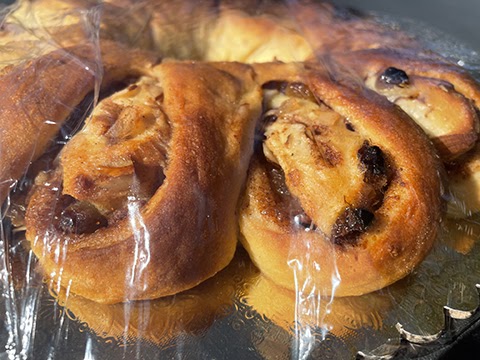
This year I made a yeasted wreath. The winning bidder called it a breakfast wreath, so I am, too. I took the photos with the wreath already wrapped for the bidding, so it’s a little harder to tell how it looked.
I made this over two days because it requires mashed potatoes along with the usual flour, yeast, salt, and other pantry staples. I peeled and diced the Idaho potatoes, then cooked them in water until tender. When I was ready to turn them out of the pot, I placed the colander in a large bowl so that I could collect the potato water.
One thing to know is that bread dough with potatoes…and potato water in this case…tends to be sticky. The directions tell you how to make the dough with a lot of hand kneading, but I recommend using your stand mixer if you can. Just be careful of how much flour you add. The finished dough will still slump down and be sticky, but it should climb the dough hook before you are finished and when you turn it out of the stand mixer bowl, you should be able to see some gluten strands already formed.
This is a rich dough, with egg, milk, and butter, so it’s a celebration bread!
I did change the filling from the first time I made this wreath in 2015. This time I added 1 tablespoon orange zest, freshly grated, plus 1/2 cup dried cranberries and 1/2 cup sliced almonds. I mixed the orange zest into the cinnamon sugar mixture. So once the dough was rolled out, I used a pastry brush to coat most of the dough with melted butter. You want to leave one long edge with no butter so that you can seal that edge to the roll of filling and dough. After the melted butter, I sprinkled the cinnamon sugar mixture as evenly as I could over the melted butter, then sprinkled the dried cranberries and then the almonds. After that I rolled it up and proceeded as in the recipe. It makes it a bit harder to roll, but not much and it adds flavor, fragrance and yummy fruit and nuts to the finished product!

Cinnamon Bun Wreaths with Orange, Cranberries and Slices Almonds
and adaption of a recipe from Maida Heatter’s Cakes
Dough:
1 cup mashed potatoes (see Notes)
1 cup milk
1/2 cup plus 1 tablespoon granulated sugar, divided
1/2 teaspoon salt
2 oz. (1/2 stick) unsalted butter, cut up
1/4 cup warm water (105-110 degrees F)
1 envelope active dry yeast
1 egg at room temperature
1 teaspoon vanilla extract
About 4 1/4 cups unsifted all-purpose flour or bread flour,
plus additional flour, mostly for kneading
(bread flour is excellent in bread where there is a lot of butter and sugar)
Notes: The mashed potatoes can be made with instant dry mashed potatoes or fresh potatoes.
It takes about 3/4 pound fresh potatoes to make 1 cup mashed. Peel, cut into chunks, place in a small saucepan with water, boil, partially covered, until tender, drain, and then mash the potatoes. Be sure to save the water the potatoes were boiled in and use some of it for dissolving the yeast. Since yeast loves potatoes so much, this will make it extra happy.
Filling:
2 tablespoons granulated sugar (I used brown sugar)
1 1/2 teaspoons cinnamon
1/4 teaspoon nutmeg
1 tablespoon orange zest
1/2 stick (4 tablespoons) unsalted butter, melted
1/2 cup dried cranberries
1/2 cup sliced almonds
Instructions:
Generously butter a 4-6 quart bowl or other container for the dough to rise in. Set it aside.
Place the mashed potatoes (which may be warm or cool, as long as below 111 degrees F) in a saucepan and, stirring constantly, add the milk very gradually. Stir in 1/2 cup of the sugar and the salt and butter. Place over low heat and stir occasionally until the mixture is warm (105-110 degrees F).It is not necessary for the butter to have melted completely, but OK if it does.
Meanwhile, in a 1-cup glass measuring cup, stir the warm water (can be potato water) with the remaining 1 tablespoon sugar, sprinkle on the yeast, stir briefly with a knife, and set aside for about 10 minutes until the mixture rises to about the 3/4 cup line.
In a small bowl, beat the egg to mix and add the vanilla.
When the potato-and-milk mixture is warm enough, transfer it to the large bowl of an electric mixer. Beat in the yeast mixture and the egg. On low speed, gradually add about 3 cups of the flour. Beat on low speed for a minute or two. Remove the bowl from the mixer. The dough will be wet and sticky now. With a heavy wooden spoon, gradually stir in the remaining 1 1/4 cups of flour. Dough will still be sticky.
Flour a large work surface. Turn the dough out onto the floured surface. The dough will still be too sticky to knead. Add a bit of additional flour and, with a dough scraper or a wide metal spatula, turn the dough over and over with the additional flour – adding still a bit ore if necessary – until you can handle the dough. (a glass of wine to the side and/or some swearing help when getting through this part – Elle’s notes.) You might have to add 1/2 to 3/4 cup additional flour. Remember, though, that potato based dough has a tendency to remain a bit sticky even when enough flour has been added, so do not use more than you must…err on the side of sticky dough.
After about five minutes active kneading, the dough should be smooth and feel alive. If you can be really careful to not add too much flour, you can also do the kneading with your stand mixer.
Place the dough in the buttered bowl, turn it around in the bowl to butter all sides, cover the bowl with plastic wrap (or a clean shower cap) and place it in a clean, draft-free spot to rise for 1 to 1 1/2 hours, until the dough is at least double in volume.
Once dough had doubled in volume, make a fist and punch it down in the middle, then fold in and press down the sides of the dough to deflate all of it. Turn the dough out onto a lightly floured surface and use a knife or bench scraper to divide the dough in half. Return half the dough to the rising bowl and re-cover.
The dough may fight you…if so, let it sit for a few minutes while you make the filling components, then return to it and continue shaping.
For the filling, in a small bowl, mix the sugar with the cinnamon, nutmeg and orange zest. Brush half the melted butter over the rolled out dough, leaving about 1/2-inch clear around long edges. Sprinkle on half the cinnamon sugar mixture evenly over the butter, then sprinkle half the dried cranberries and then half the sliced almonds over that evenly. Roll up on the long side like a jelly-roll, pinching the edges together once it is all rolled.
Carefully lift the rolled dough onto a parchment lined baking sheet (or use a silicon mat lined baking sheet) and form into a wreath shape. Pinch the ends together. Use a pair of clean scissors or kitchen shears to cut the dough about every two inches, leaving the dough attached at the inner edge of the roll. Carefully take each cut section and turn it so that you can see the filling. Do that with each cut section around the wreath. See the photo above in the beginning of the post to see how it looks at the end, before rising.
Repeat the rolling, filling, rolling up, cutting and turning with the other half of the dough and filling. I used two baking sheets so that they wouldn’t stick together.
Set the wreaths in a warm, draft free place and let rise until puffy, about 1 hour. I covered them loosely with oiled plastic wrap. Towards the end of that time, preheat the oven to 375 degrees F. Before preheating, adjust the rack one-third up from the bottom of the oven.
If desired, brush the risen wreaths with egg wash (1 egg beaten with 1 tablespoon water) and then sprinkle with sanding sugar, but this is optional. Bake the risen wreaths for about 10 minutes, then reverse the pan from front to back and continue to bake until the wreaths are light golden brown. I baked one pan at a time, but you could probably bake both pans at once if you switched them around half way through baking. Ovens vary, but it will probably take about 25-30 minutes total, but check at 20 minutes. Once baked, remove from the oven and let cool on a rack five minutes while you prepare the icing, if using (Note: if you use sanding sugar, no icing is needed and the wreath can be frozen. If you ice the wreath it’s best not to freeze it.)
Optional Icing
In a small bowl mix together 1 tablespoon warm milk and enough confectioners sugar (about 3/4 cup) to make an icing that is the thickness you like. Drizzle the icing over the cooled wreaths.
A cooled, iced wreath makes a nice gift and is also a lovely addition to your holiday table, especially at breakfast or brunch!