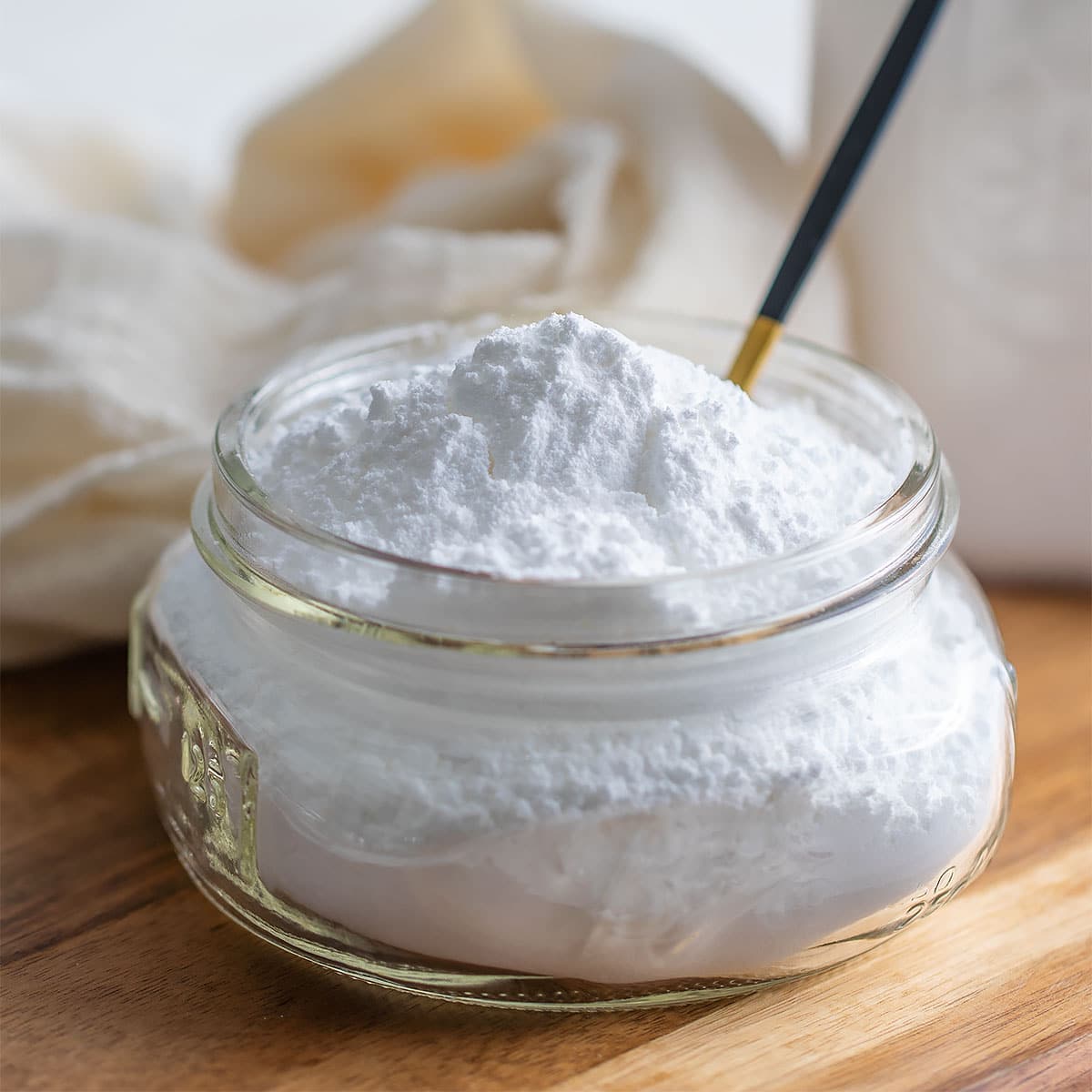
Confectioners’ sugar, also known as powdered sugar or icing sugar, is simply granulated sugar ground into a very fine powder. It’s used in everything from frosting and icing to cookies, cakes, and other desserts.

And if you run out in the middle of baking, there’s no need for a trip to the store! You can make powdered sugar at home in just a few minutes using regular granulated sugar and cornstarch. I’ll show you how to get it finely powdered and smooth, plus how to store it properly.
This homemade version works beautifully for frostings, glazes, icing, dusting desserts, and baking, and you only need two pantry ingredients.
📺 Watch Me Make This Recipe

What Is Confectioners’ Sugar?
Confectioners’ sugar is the same thing as powdered sugar. It’s granulated white sugar that has been ground into an extremely fine, powdery consistency.
Commercial confectioners’ sugar usually contains a small amount of cornstarch, which acts as an anti-caking agent and helps prevent the fine sugar from forming clumps.
You may also see it called icing sugar or 10X sugar. These names generally refer to the same finely ground sugar used for making smooth frostings, glazes, icings, and many baked desserts.
What Is Powdered Sugar Used For?
Powdered sugar is especially useful when you need sweetness without a grainy texture. Because it is ground so finely, it dissolves much more quickly than granulated sugar.
It’s commonly used for:
- Frostings and buttercream
- Glazes and icing
- Dusting cakes, cookies, and pastries
- Whipped cream and other creamy desserts
- Shortbread and tender cookies
Powdered sugar also behaves differently from granulated sugar in baking. When creamed with butter, granulated sugar helps create tiny air pockets, while powdered sugar produces less aeration. This is why recipes such as shortbread often use powdered sugar to create a more tender, crumbly texture.
Is Confectioners’ Sugar the Same as Powdered Sugar?
Yes! Confectioners’ sugar and powdered sugar are the same thing, and the two names are commonly used interchangeably in recipes.
Depending on where you live, you may also know it as icing sugar. In the US, packages are often labeled powdered sugar or confectioners’ sugar.
So, if a recipe calls for confectioners’ sugar and you have powdered sugar in your pantry, you can use it without making any changes to the recipe.

What’s the Difference Between Confectioners’ Sugar and Baker’s Sugar?
Confectioners’ sugar and baker’s sugar are not the same thing. The main difference is how finely the sugar is ground.
Baker’s sugar is finer than regular granulated sugar but still consists of tiny sugar crystals. You may also see it called superfine sugar, ultrafine sugar, extra-fine sugar, or caster sugar. Its fine crystals dissolve quickly, making it useful in delicate baked goods and desserts.
Confectioners’ sugar, on the other hand, is ground until it has a very fine, powdery texture and typically contains cornstarch to help prevent clumping.
So although both are finer forms of granulated sugar, baker’s sugar is still crystalline, while confectioners’ sugar is a powder.
Ingredients for Homemade Powdered Sugar
You only need two ingredients to make confectioners’ sugar at home:
- Granulated sugar: Regular white granulated sugar is the base. It will be blended until it reaches a very fine, powdery consistency.
- Cornstarch: This helps keep the powdered sugar dry and prevents it from clumping during storage. I use 1 tablespoon of cornstarch for every 1 cup of granulated sugar.
That’s all you need to make homemade powdered sugar that can be used for baking, frosting, icing, and glazes.
From my experience, a spice grinder works best. Its smaller container and sharp blade grind the sugar quickly and give me a much finer result.
You can also use a coffee grinder or food processor, but I find the spice grinder more efficient, especially when making powdered sugar in small batches.

How to Make Powdered Sugar
Making powdered sugar at home takes just a few minutes.
- Add the ingredients: Place the granulated sugar and cornstarch in a clean, completely dry spice grinder.
- Mix before blending: Close the lid and gently shake the grinder for a few seconds to distribute the cornstarch through the sugar.
- Blend: Grind the mixture for about 2 minutes, then stop and carefully stir it with a spoon or spatula.
- Blend again: Continue grinding for another 3 to 4 minutes, or until the sugar has a very fine, powdery texture.
- Check the texture: Rub a little between your fingers. It should feel soft and powdery rather than gritty.
- Sift if necessary: If some larger sugar crystals remain, sift the powdered sugar through a fine-mesh strainer.
- Re-grind the coarse sugar: Return whatever remains in the strainer to the grinder with about 2 tablespoons of the sifted powdered sugar, then blend again until fine.
Your homemade confectioners’ sugar is now ready to use immediately or store for later.
Tips for Making the Best Homemade Powdered Sugar
- Make sure your grinder is completely dry: Even a little moisture can make the sugar clump.
- Work in small batches: If your sugar has large crystals or your grinder is small, blending smaller amounts will give you a finer, more even powder.
- Don’t skip the cornstarch: It helps absorb moisture and keeps the homemade confectioners’ sugar from clumping during storage.
- Check the texture with your fingers: The finished sugar should feel very fine and powdery, not gritty.
- Sift if needed: If you still have larger crystals after blending, sift the sugar and re-grind what remains.
- Don’t add vanilla seeds while grinding: They introduce moisture and can affect the texture of the powdered sugar.
- Expect more volume: One cup of granulated sugar will produce roughly 1½ to 2 cups of powdered sugar after grinding.

How to Store Homemade Powdered Sugar
Transfer the homemade powdered sugar to a clean, completely dry airtight container and store it in a cool, dry place such as your pantry or kitchen cupboard.
Moisture can cause powdered sugar to form lumps, so always keep the container tightly sealed and use a dry spoon when measuring it.
If the sugar develops a few small clumps during storage, sift it before using it in your recipe.
For the best texture, I prefer making only as much homemade confectioners’ sugar as I expect to use rather than preparing a very large batch far in advance.
Frequently Asked Questions
Can I make powdered sugar without cornstarch?
You can grind granulated sugar into a fine powder without cornstarch if you plan to use it right away. However, I add cornstarch to this recipe because it helps prevent the powdered sugar from clumping during storage.
How do I know when the sugar is powdered enough?
Rub a small amount between your fingers. It should feel very fine and powdery rather than gritty. If you can still feel sugar crystals, continue blending or sift the mixture and re-grind the coarse pieces.
Can I use a blender to make powdered sugar?
A powerful blender may work, but from my experience, a spice grinder gives the best result because its smaller container and sharp blade grind the sugar very finely. A coffee grinder can also be used.
Can homemade powdered sugar be used for frosting and icing?
Yes. Once the sugar has been ground very finely, you can use it for frostings, icing, glazes, and other recipes that call for confectioners’ or powdered sugar.
How much powdered sugar does 1 cup of granulated sugar make?
One cup of granulated sugar makes approximately 1½ to 2 cups of powdered sugar, depending on how finely it is ground.
Use Confectioner’s Sugar in These Recipes

Confectioners’ Sugar Recipe
No powdered sugar in the house, and you want to bake? Don’t worry, you can make Confectioners’ sugar at home using just two ingredients! Learn exactly how here!
- 1 cup sugar
- 1 tablespoon cornstarch
-
From my experience, the best appliance that would give the best result is a spice blender. It is smaller and the blade is sharper, hence, the mixture blends quickly and results in fine powdered sugar.
-
In a blender, add the sugar and the cornstarch, close the lid of the blender and mix the ingredients for a few seconds before attaching it to the machine.
-
Blend the sugar and cornstarch for 2 minutes, stop and stir the mixture using a spoon or a spatula. Blend again for a few minutes about 3 to 4 minutes.
-
Run the sugar through your fingers, if it’s not fine enough you have two options. Either, blend for two more minutes, or sift the sugar through a fine strainer and blend what remains in the strainer with two tablespoons from the sifted sugar again.
-
You can store the powdered sugar in a container and it will last as long as the regular sugar.
- Do not skip adding cornstarch it will keep the sugar dry and prevent it from clumping.
- If you are using sugar with large granules, you will have to blend longer, and it is best to blend in small batches.
- This recipe will give almost 1 and a half to almost two cups of powdered sugar.
- Make sure the blender is dry before using it.
- Do not add vanilla seeds to the sugar while blending it.
- You can use powdered sugar in making Buttercream, Frosting, Icing sugar, Kahk (Arabian Cookies), and more.
Serving: 2 Cups | Calories: 400kcal | Carbohydrates: 103g | Protein: 0.01g | Fat: 0.3g | Sodium: 1mg | Potassium: 2mg | Fiber: 0.04g | Sugar: 100g | Calcium: 1mg | Iron: 0.1mg