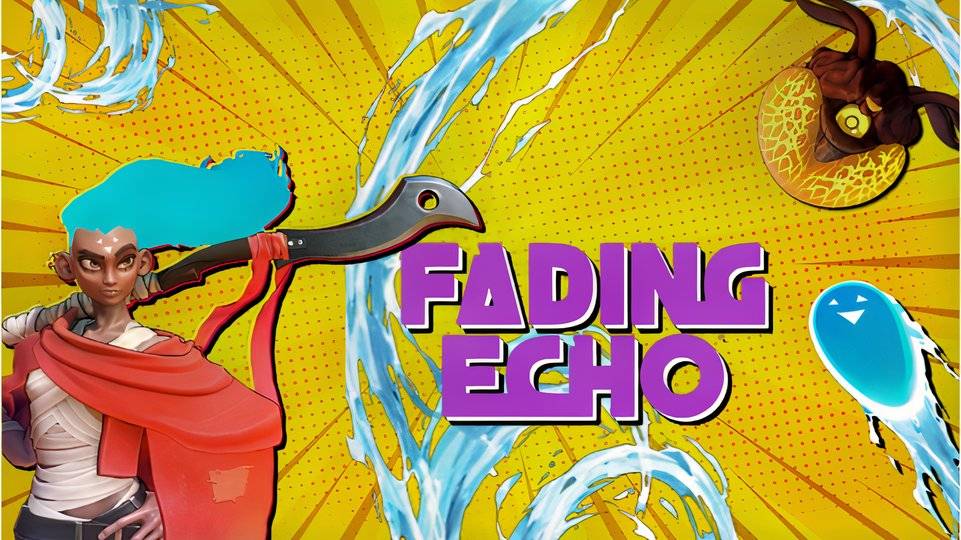
When your beloved world, Corel, has become nothing but a barren wasteland infected with a looming corruption called the Paradox, your only choice is to fight back and save your homeland.
But what if the only way you could save the world was with water? After spending time exploring its shifting world and mastering its elemental systems, it’s clear that Fading Echo has plenty to offer, even if it stumbles along the way. In this review, we’ll be diving beneath the surface of Fading Echo to find out what there is to love about this action-adventure RPG, and what bogs down the experience.
Story and Setting
Fading Echo follows our protagonist, One, a teenaged girl from the dying desert planet of Corel. She is a young nomad and a legend — a person born with the special ability to control (and change into) water. One is tasked with saving Corel from the Paradox that is quickly taking over, and has scattered her world across multiple fractured realities.
One is meant to do this by finding and collecting Aether, a powerful resource that keeps Corel afloat, and funneling it to the heart and central hub of her planet, known as the Bastion. Our protagonist must travel through time and space, unlock twelve Aether sources, and reconnect vital energy streams to awaken the only being who can help you save this dying world — Vellum.
Vellum is the Aetheric Intelligence that has kept Corel alive and thriving. Vellum is everything: the world and the path guiding you to victory; offering not just knowledge, but consequence — and every step towards Vellum is a step towards truths that One may not be ready to face.

An aspect of this game that I enjoyed was the radio system. When you reach certain points in the story, you’re met with prompts to speak to characters via radio — whether that be One’s mother, Vellum, or others. What the characters have to say is usually world-building lore, but these prompts can be skipped. This allows more focused players or speed-runners to entirely skip over the storyline and focus solely on the combat and puzzle-solving. I very much love lore and flavor text, so I was practically foaming at the mouth each time One’s radio chimed.

Eventually, One meets Maddock, the overarching villain of the story, whose goal is to fracture the Echoverse through corruption rather than simple destruction. Maddock is voiced by the talented Matthew Mercer, and is quite complex. Rather than simply wanting terrible things for others, Maddock is a bit of a genius, and sees flaws in the Echoverse that he thinks he can fix with the Paradox. Because unlike free-flowing water, Maddock is a man who loves all things linear. By destroying reality as we know it, he can rid the world of countless outcomes and possibilities. Maddock seeks one thing with the Paradox: a single outcome. A sole timeline. And merely one, decided future.
It is up to One herself to stop Maddock and free the world of darkness and collapse. However, despite being polar opposites, both Maddock and One are fighting for the future of Corel. I enjoy stories and villainy that are not simply black and white. Rather than a straightforward hero-versus-villain story, it’s a conflict between competing ideals, with both sides unwavering in their convictions.

Combat and Gameplay
While the story is certainly charming and builds a strong foundation, Fading Echo ultimately lives and dies by its gameplay mechanics, as with any action RPG. One can transform into a small blob of water with the tap of a button, which allows for chain attacks as you quickly switch between forms. A large portion of enemies are adverse to water, giving One an edge in a great deal of combat.
Despite water being the basis of One’s powers, there are other elements to consider. The first additional element that we’re introduced to is lava, and as an extension, steam. The developers of Fading Echo, Emeteria, have clearly given a considerable amount of thought to how certain elements may work against, or with, one another. While One can interact with lava to an extent, what happens when water meets extreme heat? You get steam.
Turning herself into a ball of steam allows One to glide across trenches and offers higher jumps than any other form. While it is a short-lived form, it’s also an excellent addition to combat, providing plenty of evasive tactics that other elements do not.
Shortly thereafter, One comes across what is essentially the world’s sewage. When in her water form, One can glide over the toxic waste without issue, and absorb it. This state allows for high jumps and quite a bit of bounce, allowing One to scale walls and waterfalls alike. This form is used most often to reach treasures, and to poison enemies.
The final form that One has access to is Corruption itself. Coming into contact with the pink corruption changes your form and alters environmental interactions, enabling you to glitch through barriers and reach hidden areas. During combat, though, it’s something you’ll want to avoid, as it can cause One a great deal of damage.

Fading Echo features a great deal of platforming, which, with the default PC keybindings, can be clunky at best. I’ll be entirely transparent in saying that I cannot count the number of times I accidentally had One transform midair, or on a blob-specific platform, and promptly fell to my death. I adjusted the keybindings to suit my own preferences, and this issue, for the most part, was remedied.
Generally speaking, I found the combat to be far easier than navigating the more complicated maps and solving some of the puzzles. Out of the two main attacks One has, the ‘kick’ is incredibly overpowered. Once you discover that a single kick shoves any enemy off of the nearest ledge, the fights become considerably easier.
Most of the game’s puzzles aren’t solved with critical thinking so much as they are time-based. Only certain elements can open locked doors or enter new areas, and it’s up to the player to use their blobby little resources wisely, and in a timely manner. I find that this adds to the urgency of the plot, because we have to move hastily and stay on track, rather than gallivanting around the Echoverse foraging, or whatever it is the people of Corel do when the world isn’t ending. The puzzles can, however, become repetitive.

Audio, Visuals, and Performance
When I first began playing Fading Echo, what caught my eye immediately was the unique visuals. The characters, landscapes, and even dialogue boxes read as though all of this is taking place inside a comic book or visual novel, a la Spider-Man: Into the Spider-Verse. This makes the game considerably more visually interesting than popular 3D realism or retro pixel art.
If the art and gameplay don’t completely win you over, the voice acting certainly will! A lot of the dialogue is admittedly corny. There’s no shortage of ‘dad-tier’ jokes, and a lot of the lines elicited a snort or an eye roll from me, but the cast makes them charming, in a way. The extremely talented Samantha Béart voices One, Laura Bailey stars as Vellum, and Matt Mercer performs incredibly as Maddock. The cast is brilliant and distinct, and as a diehard Baldur’s Gate 3 fan, it was incredibly amusing to imagine Karlach traversing across Corel, and I certainly got a kick from placing Minsc in Maddock’s place.
The soundtrack is over 47 minutes of what can only be described as an interdimensional voyage, and even the track titles are fitting to the plot of the game. The music captures the heat of combat and the visceral hope and melancholy of what it must be like trying to save a world that is collapsing around you.

I had a few issues with the game’s performance. Input lags were common, despite my PC being up to the simple task of running Fading Echo, and I eventually had to drop the graphics preset from ‘Epic’ to ‘Medium’ in order for things to run smoothly. Across both Steam Deck and PC, frame drops were an issue, though this rarely affected gameplay to a severe degree.
Final Thoughts, Replayability, and Score
Fading Echo is an ambitious action-adventure that stands out through its creative elemental mechanics, engaging combat, and imaginative world design. While a few rough edges prevent it from reaching what I feel is its full potential, the overall experience is one that’s easy enough to recommend. Performance issues, some admittedly repetitive puzzles, and a handful of balancing issues keep it from being a truly fantastic game, but they never overshadow the creativity at the heart of the experience. With its inventive elemental mechanics, memorable world, and stellar voice cast, Fading Echo is an adventure that’s easy to recommend to fans of action-adventure RPGs.
At its base price of $20, Fading Echo is certainly worth the purchase. For an additional $7, you can get your hands on the Deluxe Edition, which includes the game, a downloadable version of the soundtrack, and the Fading Echo Digital Art Book.
All in all, Fading Echo is a game that succeeds far more than it stumbles. Its unique elemental systems, charming cast, and imaginative world make it an adventure worth taking – even if the waters aren’t always calm.