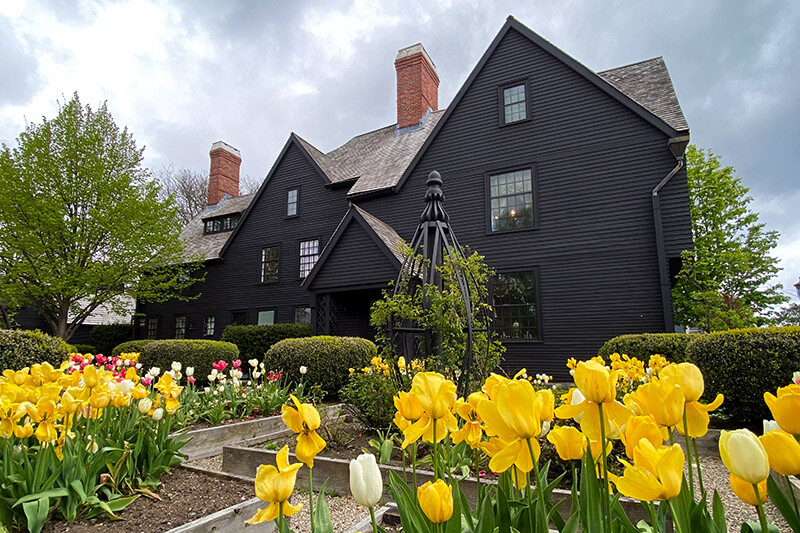

The House of the Seven Gables in Salem, Massachusetts, is one of the most visited museums in New England. Its real history, and the family who built it, turn out to be darker than anything its author had to invent.
The House of the Seven Gables is a museum now, the centrepiece of a small historic site on Salem’s waterfront where you can buy a ticket, join a guided tour and climb the narrow attic stairs the same way I did on a grey Salem afternoon.
It hasn’t always had seven gables, though. The real building has been added to, subtracted from and rebuilt across more than three centuries, and the version visitors walk through today owes as much to a twentieth-century restoration chasing a novel’s description as it does to its own history. The book came first. The distinctive seven-gabled form came later, once fiction had made the house famous enough to need them.
Nathaniel Hawthorne’s Family Connection to the House of the Seven Gables
The House of the Seven Gables was built in 1668 by a sea captain named John Turner and stayed in the Turner family for three generations before the fortune ran out and the house passed to another seafaring family, the Ingersolls.
Susanna Ingersoll, who inherited the house, was a cousin of the American novelist Nathaniel Hawthorne, born in Salem in 1804 and already famous on both sides of the Atlantic for The Scarlet Letter by the time he started visiting her there. Listening to her stories about the place, he found the setting for his second novel. He never lived in the house himself. He borrowed it, the way he borrowed most things from his family, and turned it into a confession.
Nathaniel Hawthorne wasn’t born Hawthorne. He was born Hathorne, and sometime in his twenties he started spelling it differently, adding a single letter that put just enough distance between himself and the family name. The man he was trying to get away from was his own great-great-grandfather, John Hathorne, a magistrate who sat in judgement during the Salem witch trials of 1692. Unlike his fellow judge Samuel Sewall, who later stood up in his Boston church and confessed his guilt to the whole congregation, Hathorne apologised for none of it. He died believing he’d been right.
A curse Hawthorne didn’t have to invent
Published in 1851, The House of the Seven Gables tells the story of a Puritan colonel who accuses his neighbour, a carpenter named Matthew Maule, of witchcraft purely so he can seize Maule’s land. Maule is hanged for a crime he didn’t commit, and at the gallows he curses the colonel with the words God will give him blood to drink. The colonel gets his house and his curse too, dying of a sudden haemorrhage on the day the building is finished, blood staining his shirt exactly as promised. The curse then works its way down through generations of Pyncheons until the family is finally, narrowly, freed from it.
Hawthorne didn’t invent that curse. Sarah Good, the same woman whose four-year-old daughter spent eight months chained in a Boston jail while her mother stood trial, the same woman who I wrote about here, is recorded saying almost the same words on the scaffold to the minister pressing her to confess. I am no more a witch than you are a wizard, and if you take my life, she is also associated in later retellings with the line “God will give you blood to drink”, though historians treat this as folklore rather than a verbatim transcript. Local legend has it that the minister died decades later of an internal haemorrhage. The story has been passed down ever since as proof the curse had landed exactly where it was aimed. Whether or not that’s true, Hawthorne knew the line well enough to lift it almost word for word and hand it to a fictional carpenter in a story about a family that built its fortune on someone else’s false conviction.
There’s a more personal grudge buried in the plot too. Hathorne, in the real trials, pursued a wealthy Salem merchant named Philip English and condemned his wife Mary to die as a witch. She escaped, fleeing the colony before the sentence could be carried out, but the dispute over English’s land and money between the two families lingered for years afterwards. Hawthorne grew up knowing that history, and when he needed a story about a powerful man manufacturing a witchcraft charge to steal a poorer man’s land, he didn’t have to look past his own family tree to find it.
Visiting the House of the Seven Gables Today
There’s plenty to see here beyond the literary connection too. The mansion is the oldest surviving seventeenth-century wooden house in New England, and the site has grown well past its original walls. Hawthorne’s actual birthplace, a much smaller home he lived in until he was six, was moved here in 1958 and sits a short walk from the mansion, his father’s portrait and the desk he wrote at now on permanent display inside it. The famous secret staircase, the one I climbed myself, was added by Caroline Emmerton when she restored the house into a museum in 1908, inspired by the novel rather than any genuine evidence one had ever existed there. The seaside gardens she planted along the harbour are still maintained today, and the view alone is worth the ticket. None of it needs the curse to be worth the visit.
But the bones underneath the restored gables are real enough. A judge who never said sorry. A grandson who inherited guilt he hadn’t personally earned and spent his whole career failing to put down. A curse borrowed from a woman his own family helped hang.
Hawthorne added one letter to his name and called it distance. It was never going to be enough, not when the house he made famous was built, in fiction and in fact, on inherited guilt.
For more Massachusetts inspiration, tips and travel guides, try these…
Salem: The US Town that turned a curse into a calling
How to spend 48 hours in Salem, Massachusetts
The Ultimate Boston Travel Guide
A love letter to Boston
The Isabella Stewart Gardner Museum – The greatest gallery you’ve never heard of
The Lenox Hotel Boston
 An award-winning travel writer and photographer, Aleney de Winter was fresh from school when she first set off to explore the far reaches of Australia with a two-man tent and a beaten-up Kingswood for company. Three decades, and two kids later, and she’s still on the go, with her itchy-footed offspring in tow.