Does attention travel faster than light? : Conferences That Work

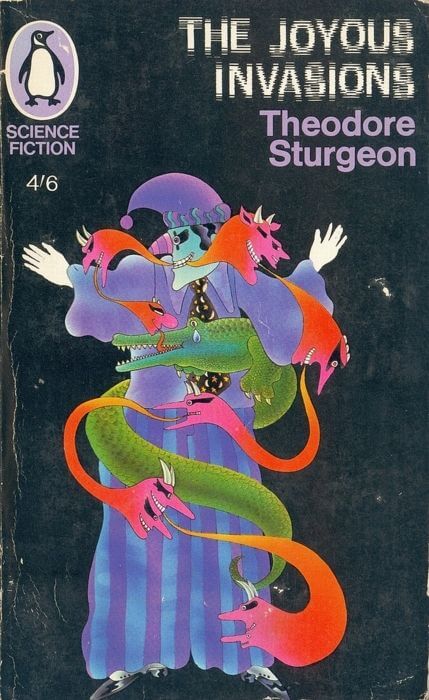
 My battered 1967 Penguin edition of science fiction writer Theodore Sturgeon‘s collection, The Joyous Invasions, lies on my desk, opened to the story “To Marry Medusa.” I read the following passage as a teenager. It grabbed my attention, lodged in my imagination, and has stayed with me ever since:
“What can travel faster than light?
Stand here by me, friend, on this hillside, under the black and freckled sky. Which stars do you know — Polaris?” Good. And the bright one yonder, that’s Sirius. Look at them now: at Polaris: at Sirius. Quickly now: Polaris, Sirius. And again Sirius, Polaris.
How far apart are they? It says in the book: thousands of light-years. How many? Too many: never mind. But how long does it take you to flick your gaze from one to the other and back? A second? A half-second next time, then a tenth? You can’t say that nothing, absolutely nothing, has traveled between the two. Your vision has: your attention has.”
—Theodore Sturgeon, The Joyous Invasions, “To Marry Medusa”

A childhood fascination
I have loved science fiction from an early age. It was, perhaps, the reason I was drawn to study physics. It was obvious that the universe contained mysteries I couldn’t explain. I wanted to understand them, and perhaps even contribute a little to that understanding someday.
Sturgeon’s opening sentence, “What can travel faster than light?” drew me in. The subsequent two paragraphs seemed convincing. I could easily visualize my attention flicking between two points of light in the night sky that were “thousands of light-years” apart. Surely my attention could move faster than light!
At the time, I hadn’t studied much physics. So, I added this puzzling discrepancy to the long list of things I didn’t understand but hoped I might one day.
The physics of attention
I don’t remember when I first recognized that Sturgeon’s seductive argument—that attention could leap between two distant stars faster than light—was a beautiful metaphor, not a physical possibility.
At some point, I realized that when we gaze at Sirius, we are not seeing the star as it is now. We are seeing photons that left Sirius about nine years ago and have been traveling through space ever since. The same is true of Polaris, whose light has taken centuries to reach us. When I shift my gaze from one star to the other, I am not moving my attention across the universe faster than light; I am simply turning my eyes toward a different stream of arriving photons—light that began its journey from another star long before it reached my eyes.
Paying attention
I eventually realized that attention doesn’t travel through space. It selects among information that has already reached us.
Science and fiction were never really in conflict here. Science explains the mechanism; fiction illuminates the experience. Understanding why Sturgeon’s argument failed didn’t make the passage less magical. If anything, it made me appreciate what he was actually describing.
Metaphor in art has the power to move us, to transport us to a place where the impossible seems possible, where mystery is ever present. Moments like these are gifts. You’re suspended between belief and disbelief, enjoying the experience even as a distant part of yourself knows it won’t last.
Nothing actually traveled faster than light. My attention didn’t leap across hundreds of light-years. The photons arriving at my eyes obeyed exactly the same physical laws they always had.
Yet for a few moments, as a teenager reading Sturgeon, it felt as though they didn’t.
That feeling was real.
I still treasure both.