Thomas Edison: Turning Invention Into Business

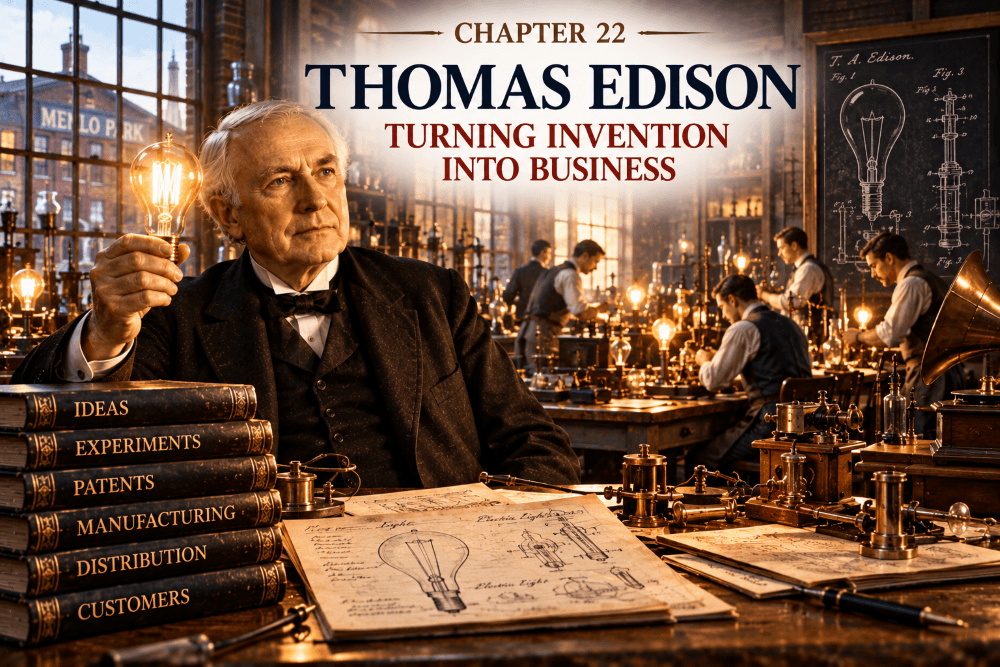
Thomas Edison (February 11, 1847 – October 18, 1931) is remembered as one of history’s greatest inventors.
The phonograph.
Electric lighting.
Motion-picture technology.
Electrical systems.
More than a thousand U.S. patents were issued in his name.
But describing Edison simply as an inventor misses one of the most important parts of his story.
Thomas Edison was an entrepreneur.
And perhaps his greatest entrepreneurial innovation was not a particular machine.
It was a system for producing innovation.
At his famous laboratory in Menlo Park, New Jersey, Edison assembled:
Machinists.
Chemists.
Experimenters.
Draftsmen.
Technicians.
Engineers.
Instead of waiting for a lone inventor to experience a flash of inspiration, Edison created an organization designed to experiment continuously.
Then he connected invention with:
Capital.
Patents.
Manufacturing.
Infrastructure.
Distribution.
Marketing.
Customers.
Edison understood a principle that every technology entrepreneur eventually discovers:
Inventing something and building a successful business around it are two different problems.
His entrepreneurial contribution to our history is:
Commercializing innovation and building the industrial R&D laboratory.
Who Was Thomas Edison?
Thomas Alva Edison was born in Milan, Ohio, in 1847.
His family later moved to Port Huron, Michigan.
Edison received relatively little formal schooling and educated himself extensively through reading and experimentation.
From an early age, he was intensely curious.
Chemistry interested him.
Machines interested him.
Electricity interested him.
But Edison also demonstrated another instinct:
He liked business.
As a teenager, he sold newspapers, candy, and other goods to railroad passengers.
He learned something every entrepreneur must eventually understand:
A product has little commercial value unless you can reach customers.
Long before Menlo Park, Edison was already combining curiosity with commerce.
The Telegraph Gives Edison His Education
One technology played an especially important role in Edison’s early career:
The telegraph.
The telegraph was one of the nineteenth century’s revolutionary technologies.
Before telegraphy, information could travel no faster than people, horses, ships, or trains.
The telegraph changed that.
Messages could cross enormous distances almost instantly.
Railroads used it.
Newspapers used it.
Financial markets used it.
Businesses used it.
Edison learned telegraphy and worked as a telegraph operator.
This placed him inside one of the most technologically advanced industries of his time.
He learned how electrical equipment worked.
He repaired machines.
Modified systems.
Observed problems.
Designed improvements.
This pattern appears repeatedly in entrepreneurship:
Work inside an existing system long enough and you begin noticing opportunities outsiders cannot see.
Edison’s First Important Business Lesson
One of Edison’s early inventions was an electrical vote recorder.
The idea appeared sensible.
Legislators could record votes automatically.
Voting would become faster.
More efficient.
More technologically advanced.
There was only one problem.
Potential customers did not particularly want it.
Why?
Because legislative delay could be useful.
Politicians sometimes wanted time to debate.
Negotiate.
Persuade.
Lobby.
Delay decisions.
Edison had solved a technical problem.
But he had not solved a customer problem.
The experience reportedly influenced his approach to invention.
The entrepreneurial lesson is timeless:
Just because something can be built does not mean people will buy it.
Invention vs. Innovation
There is an important distinction between these two words.
An invention is something new.
A device.
A process.
A technology.
An innovation is something new that becomes practically useful or commercially successful.
An invention can remain inside a laboratory forever.
An innovation enters society.
People use it.
Companies manufacture it.
Customers buy it.
Markets develop around it.
Edison increasingly became interested in the entire journey:
Idea → experiment → product → business → market.
That journey is commercialization.
Edison Goes Where Problems Are Valuable
Edison eventually moved to New York and became involved with telegraphic equipment used in financial markets.
Wall Street depended on fast information.
Stock prices needed to reach:
Brokers.
Investors.
Trading offices.
Exchanges.
A delay could cost money.
Edison worked on improvements involving stock-ticker technology.
Here he encountered another fundamental entrepreneurial principle:
The economic value of an invention depends partly on the value of the problem it solves.
Saving someone five minutes may be convenient.
Saving a financial institution five minutes can be extremely valuable.
Edison Gets His First Big Payday
In 1869, Edison received a substantial payment for rights connected with improved stock-ticker technology.
The young inventor suddenly had something every ambitious entrepreneur needs:
Capital.
He could hire people.
Purchase equipment.
Build machines.
Conduct experiments.
Develop products.
Instead of merely selling his labor, Edison could begin constructing an organization.
The inventor was becoming an entrepreneur.
Why Innovation Needs Capital
The popular image of invention is wonderfully simple.
Someone has an idea.
Builds something.
Changes the world.
Reality is considerably more expensive.
Experiments require materials.
Materials require money.
Machinists need wages.
Laboratories require equipment.
Patents require legal work.
Factories require capital.
Distribution costs money.
Marketing costs money.
Innovation therefore depends on finance.
This connects Edison to a theme we have encountered repeatedly throughout The History of Entrepreneurship:
Capital allows ideas to become organizations.
Menlo Park: The Invention Factory
In 1876, Edison established a research laboratory at Menlo Park, New Jersey.
This became one of the most famous technological laboratories in history.
Menlo Park was different from the traditional inventor’s workshop.
Edison assembled people with different skills in one place.
Machinists could build experimental equipment.
Chemists could investigate materials.
Draftsmen could create designs.
Experimenters could test ideas.
Prototypes could be modified rapidly.
The objective was speed.
Design.
Build.
Test.
Fail.
Modify.
Test again.
Edison was creating something remarkable:
An invention factory.
The Myth of the Lone Genius
History loves stories about individual geniuses.
One brilliant person.
One revolutionary idea.
One moment of inspiration.
Reality is usually more complicated.
Edison was unquestionably an extraordinary inventor and organizer.
But his laboratories depended on teams.
Assistants conducted experiments.
Machinists built prototypes.
Chemists tested materials.
Other inventors contributed ideas.
Technicians solved practical problems.
Edison coordinated, directed, experimented, and made crucial decisions.
But innovation was becoming collaborative.
That may be the more important story.
Edison helped transform invention from an individual activity into an organizational process.
Can Innovation Be Manufactured?
The Industrial Revolution had already transformed the production of physical goods.
Factories organized:
Workers.
Machines.
Capital.
Materials.
Processes.
They produced textiles.
Steel.
Machinery.
Consumer products.
Edison applied similar organizational logic to invention.
What if a laboratory could systematically produce:
Experiments?
Patents?
Technologies?
Products?
Instead of manufacturing cloth or steel, the laboratory would manufacture:
Innovation.
This was an important step toward the modern corporate research-and-development system.
In 1877, Edison created one of his most astonishing inventions:
The phonograph.
Before recorded sound, human voices disappeared after they were spoken.
Music disappeared after it was performed.
If you wanted to hear a musician, you generally had to be physically present.
The phonograph changed that.
Sound could be recorded.
Stored.
Reproduced.
For people experiencing it for the first time, the technology seemed almost magical.
The invention made Edison internationally famous.
He became known as:
The Wizard of Menlo Park.
But the phonograph also demonstrated something important about entrepreneurship.
Technology could create entirely new human behaviors.
Entrepreneurs Can Create New Markets
Before recorded sound, there was no mass consumer market for recorded music.
The technology helped create the market.
This happens repeatedly in entrepreneurial history.
Before photography, consumers did not buy cameras.
Before telephones, people did not make telephone calls.
Before automobiles, ordinary consumers did not buy gasoline for transportation.
Before personal computers, households did not buy software.
Sometimes entrepreneurs satisfy existing demand.
Other times:
Innovation makes entirely new demand possible.
Edison Takes On Electric Light
The phonograph made Edison famous.
But electric lighting would become even more consequential.
For thousands of years, humans fought darkness using:
Fire.
Candles.
Oil lamps.
Gas.
Kerosene.
Electricity offered another possibility.
But the challenge was not simply making something glow.
Electric lighting had to become:
Reliable.
Safe.
Affordable.
Durable.
Manufacturable.
Distributable.
Commercial.
That was a much bigger problem.
Thomas Edison Did Not Invent the First Light Bulb
One of the most persistent myths about Edison is that he simply invented the electric light bulb from nothing.
Electric lighting existed before Edison.
Other inventors had already experimented with incandescent lamps.
Arc lighting was already being used in certain applications.
British inventor Joseph Swan independently developed important incandescent-lighting technology.
Edison’s achievement was different.
He helped develop an incandescent-lighting system that could become commercially practical.
The entrepreneurial challenge was not merely:
Can we make a bulb glow?
It was:
Can we build an economical system capable of lighting homes and businesses?
A Light Bulb Without Electricity Is Useless
Imagine Edison gives you a wonderful electric light bulb in 1880.
You take it home.
Now what?
There is no outlet.
No electrical wiring.
No power station.
No utility company.
No electric meter.
The bulb may be technologically impressive.
But commercially:
It is almost useless.
Edison understood this.
Electric lighting required an entire ecosystem.
Generators.
Power stations.
Wires.
Sockets.
Switches.
Meters.
Fuses.
Distribution networks.
Installation.
Maintenance.
Financing.
Customers.
The entrepreneurial problem was vastly larger than the invention.
Edison Sold Light, Not Light Bulbs
This leads to one of the most valuable business lessons in Edison’s career.
Customers rarely want the physical object itself.
They want the result.
People did not really want:
Light bulbs.
They wanted:
Light.
This principle applies everywhere.
Customers don’t want drills.
They want holes.
They don’t want accounting software.
They want financial control.
They don’t want cloud servers.
They want computing capacity.
They don’t want a train.
They want transportation.
The entrepreneur must understand what the customer is actually trying to accomplish.
Sell the solution, not merely the object.
Edison Builds an Ecosystem
Once Edison understood that the product was electric illumination rather than merely a bulb, the scope of the business changed.
He needed complementary technologies.
A generator required wires.
Wires required customers.
Customers required lamps.
Lamps required switches.
The network required meters.
The entire system had to work together.
This is what we might call:
Ecosystem entrepreneurship.
Sometimes creating one successful product is impossible without creating the surrounding infrastructure that makes the product valuable.
Pearl Street Station
In 1882, Edison’s electrical system reached an important milestone.
The Pearl Street Station began supplying electricity to customers in lower Manhattan.
Generators produced electricity.
Underground conductors distributed it.
Customers received electrical power.
Lights illuminated buildings.
This was much more important than demonstrating a glowing bulb in a laboratory.
Edison was demonstrating:
A functioning commercial electricity network.
Electricity was becoming a service.
There is an enormous business-model difference between selling a bulb and selling electricity.
Sell a bulb:
One transaction.
Sell electricity:
The customer pays again and again.
Today.
Tomorrow.
Next month.
Next year.
This creates recurring revenue.
Infrastructure businesses often possess this characteristic.
Railroads repeatedly sell transportation.
Telegraph networks repeatedly sell communication.
Utilities repeatedly sell electricity.
The entrepreneur moves from selling an object to operating a system.
That can radically change the economics of a business.
The Network Flywheel
Electric infrastructure also creates a powerful economic flywheel.
More customers
↓
Greater utilization
↓
Costs spread across more users
↓
More investment becomes economical
↓
The network expands
↓
More customers can connect
Then repeat.
We have seen similar dynamics throughout entrepreneurial history.
Ports.
Roads.
Shipping networks.
Railroads.
Telegraphs.
Now electricity joined the infrastructure of industrial civilization.
Thomas Edison and Patents
Edison understood another essential part of technological entrepreneurship:
Intellectual property.
Over his lifetime, Edison received more than a thousand U.S. patents.
Patents attempt to solve a basic economic problem.
Research is expensive.
Copying can be cheap.
Imagine spending years developing a new technology.
You finally succeed.
A competitor immediately copies the invention without paying any of your development costs.
Why would entrepreneurs continue investing heavily in research?
Patent systems attempt to create an incentive.
The inventor publicly discloses the invention.
In exchange, the government grants temporary exclusive rights.
Ideas Become Business Assets
Patents created something economically important.
Ideas could become assets.
Companies could:
Own patents.
License them.
Sell them.
Bundle them.
Use them in negotiations.
Enforce them in court.
Technology companies increasingly competed not only through factories and products but through legal rights over inventions.
Modern technology businesses inherited this world.
Semiconductors.
Pharmaceuticals.
Telecommunications.
Software.
Biotechnology.
Intellectual property became part of business strategy.
Edison vs. Tesla and Westinghouse
Edison’s electrical systems were built around direct current, or DC.
But another system emerged:
Alternating current, or AC.
Inventor and engineer Nikola Tesla developed important technologies for AC power systems.
Entrepreneur and industrialist George Westinghouse acquired rights to Tesla’s patents and became a major commercial advocate of alternating current.
The competition became fierce.
Edison and his interests promoted DC.
Westinghouse promoted AC.
The conflict became known as:
The War of Currents.
The Battle to Become the Standard
The War of Currents was more than a competition between electrical technologies.
It was a battle over:
Standards.
Once a city builds infrastructure around one electrical system, changing becomes expensive.
Power stations.
Motors.
Wiring.
Equipment.
Factories.
Everything becomes connected to the chosen standard.
This creates a phenomenon we still see today.
Competing standards battle in:
Technology.
Transportation.
Media.
Communications.
Computing.
Charging systems.
The winner can gain enormous economic advantages because entire ecosystems begin building around it.
Edison Becomes the Incumbent
There is an irony here.
Edison had built his reputation by disrupting older technologies.
Now AC threatened his own electrical system.
Suddenly the innovator had something to defend.
Factories.
Infrastructure.
Patents.
Investors.
Reputation.
Customers.
Edison strongly defended DC.
This illustrates one of the great paradoxes of entrepreneurship:
Today’s disruptor can become tomorrow’s incumbent.
Once entrepreneurs have invested heavily in a technology, they may resist the next technological change.
The Innovator’s Trap
Why do successful businesses sometimes resist superior technologies?
Because changing is expensive.
Existing factories may become obsolete.
Employees possess old skills.
Customers use old systems.
Capital has already been invested.
Managers built careers around the existing technology.
The company may understand the new technology perfectly well.
But adopting it can threaten the business that already exists.
Success creates assets.
Assets create commitments.
Commitments create resistance.
This is one reason disruptive innovation can be so powerful.
AC Ultimately Becomes Dominant
Alternating current eventually became the dominant approach for large-scale electricity transmission and distribution.
Its ability to transform voltage made long-distance transmission more practical.
Westinghouse became a major force in the electrical industry.
Meanwhile, the companies associated with Edison also evolved.
The market did not care that Edison was famous.
Engineering realities still mattered.
Economics still mattered.
Competition still mattered.
Even one of history’s greatest innovators could support a technology that ultimately lost the standards battle.
This is another important lesson.
Entrepreneurs often become famous because they were right when others were wrong.
But previous success does not guarantee future accuracy.
Markets change.
Technology changes.
Customer preferences change.
Competitors improve.
A great entrepreneur can make a bad prediction.
Edison’s experience with DC reminds us:
Past success is evidence of ability. It is not proof of permanent correctness.
Edison Builds Companies, Not Just Inventions
Edison participated in the creation of multiple companies to commercialize his technologies.
These organizations required far more than inventors.
They needed:
Investors.
Managers.
Factories.
Engineers.
Salespeople.
Lawyers.
Technicians.
Installers.
Manufacturing capacity.
Distribution.
Capital.
The modern technology company was beginning to emerge.
Innovation was becoming inseparable from organization.
Edison’s electrical interests went through several corporate reorganizations.
In 1889, major Edison electrical businesses were consolidated into the Edison General Electric Company.
In 1892, Edison General Electric merged with the Thomson-Houston Electric Company.
The resulting business became:
General Electric.
Notice something remarkable.
Edison’s name disappeared.
The corporation continued.
The entrepreneur had helped create an organization that could exist independently of him.
The Company Becomes Bigger Than the Founder
This connects directly to an earlier entrepreneurial development in our history.
Permanent capital.
A partnership can disappear when partners leave.
A corporation can survive.
Managers change.
Shareholders change.
Products change.
Technologies change.
The institution remains.
Eventually, a successful company may become much larger than the entrepreneur who created it.
The founder begins the story.
The corporation continues writing it.
West Orange and the Expansion of Industrial Research
Edison later built an even larger research complex at West Orange, New Jersey.
The laboratory expanded the model pioneered at Menlo Park.
Teams could work on:
Electricity.
Chemistry.
Materials.
Batteries.
Recorded sound.
Motion pictures.
Manufacturing processes.
Research had become organizational infrastructure.
A company could deliberately invest money today in hopes of discovering profitable technologies tomorrow.
That idea would become fundamental to twentieth-century capitalism.
Failure Becomes Part of the Business Model
Edison’s laboratories conducted enormous numbers of experiments.
Many failed.
That is exactly what research requires.
If you already know the answer, you do not need an experiment.
Innovation involves uncertainty.
The question is not:
How do we eliminate failure?
It is:
How do we make failure inexpensive and informative?
A failed experiment can eliminate one possibility.
Reveal new information.
Improve understanding.
Point toward another approach.
Failure becomes part of the cost of discovering something valuable.
The Economics of Experimentation
Imagine 999 experiments fail.
Experiment number 1,000 produces a technology worth $100 million.
Were the first 999 experiments wasted?
Not necessarily.
They helped navigate the search.
They revealed what did not work.
They generated information.
They narrowed the possibilities.
This produces a different kind of business logic.
In manufacturing:
Repeated failure destroys profits.
In research:
Repeated failure may be necessary to produce the breakthrough.
The entrepreneur must therefore learn to manage two very different systems.
Production rewards consistency.
Innovation requires experimentation.
Build, Test, Learn, Repeat
Edison’s laboratories repeatedly moved through a cycle:
Build.
Test.
Observe.
Modify.
Test again.
Modern entrepreneurs use different terminology.
Prototype.
Experiment.
Iterate.
Measure.
Learn.
The principle is remarkably similar.
Instead of debating endlessly whether something will work:
Test reality.
Reality provides information arguments cannot.
Imagine thousands of possible solutions to a technological problem.
Most do not work.
Some work poorly.
A few work extremely well.
Innovation requires searching through those possibilities.
Edison’s organizational innovation was partly about increasing the speed of that search.
More equipment.
More specialists.
More experiments.
Better documentation.
Faster prototyping.
The organization could explore more possibilities in less time.
Innovation could be accelerated through management.
Edison and Motion Pictures
Edison and his laboratory also contributed to the early development of motion-picture technology.
Devices were developed for recording and viewing moving images.
The economic significance was enormous.
Recorded sound allowed a performance to be heard without the performer being present.
Motion pictures extended the same principle to visual performance.
An event could be:
Recorded once.
Reproduced repeatedly.
Distributed widely.
Sold to many customers.
Technology was changing the economics of entertainment.
Technology Turns Experiences Into Products
Before recording technologies, many experiences were inherently local.
A musician performed for the people in the room.
An actor performed for the people in the theater.
A speaker addressed the people who were physically present.
Recording changed this.
The performance could become a product.
One performance.
Many copies.
Millions of customers.
This creates enormous scalability.
The marginal cost of reaching the next customer can fall dramatically.
That principle eventually produced:
Records.
Movies.
Radio.
Television.
Streaming.
Digital media.
The modern entertainment industry grew from the ability to separate the performance from the performer.
Edison Also Failed
The mythology surrounding successful entrepreneurs often removes the failures.
Edison had plenty.
Some inventions failed commercially.
Some ventures lost money.
Some technologies were defeated by competitors.
One particularly painful example involved iron-ore processing.
Edison invested heavily in machinery designed to process low-grade iron ore.
The technology was ambitious.
But market conditions changed.
Higher-quality ore became economically available.
The business case deteriorated.
The technology could work.
The market no longer cared.
A Working Technology Can Still Be a Bad Business
This may be one of the most important lessons for technology entrepreneurs.
A product can work perfectly and still fail.
Why?
The alternative becomes cheaper.
Customer preferences change.
A competing technology improves.
Raw-material prices change.
Distribution changes.
Timing is wrong.
The market disappears.
Entrepreneurs therefore compete against more than technical problems.
They compete against:
Economics.
The best engineering solution is not automatically the best business solution.
Commercial innovation can be imagined as a stack.
Science
Is it possible?
Engineering
Can we build it?
Manufacturing
Can we produce it reliably?
Economics
Can we produce it cheaply enough?
Distribution
Can we deliver it?
Demand
Do customers want it?
Business Model
Can the company capture enough value to survive?
A brilliant invention can fail at any one of these levels.
The entrepreneur must think about the whole stack.
Edison as Innovation Architect
Earlier entrepreneurs in our story organized:
Trade.
Money.
Capital.
Factories.
Transportation.
Supply chains.
Corporations.
Industries.
Edison organized something else.
Innovation.
People.
Equipment.
Experiments.
Patents.
Capital.
Manufacturing.
Infrastructure.
Customers.
He became what we might call an:
Innovation architect.
The entrepreneur’s job was no longer simply to have the idea.
It was to design the system that transformed ideas into economic reality.
The Birth of Industrial R&D
This may be Edison’s most important contribution to the history of entrepreneurship.
Menlo Park demonstrated that invention could become organized work.
Research could have:
Teams.
Budgets.
Equipment.
Facilities.
Objectives.
Processes.
Management.
Later companies expanded this model dramatically.
General Electric.
DuPont.
Bell Labs.
IBM.
Pharmaceutical companies.
Semiconductor manufacturers.
Technology companies.
Modern corporations now spend enormous sums every year on research and development.
Innovation has become institutionalized.
From Menlo Park to Silicon Valley
The connection between Edison and the modern technology startup is stronger than it first appears.
A technology company today may employ:
Engineers.
Scientists.
Designers.
Product managers.
Data analysts.
Marketers.
Salespeople.
Researchers.
The company:
Builds prototypes.
Runs experiments.
Raises capital.
Protects intellectual property.
Launches products.
Collects feedback.
Iterates.
Builds infrastructure.
Scales.
The technologies are different.
The organizational logic is familiar.
Edison would recognize much of the process.
The Edison Innovation Flywheel
Edison’s entrepreneurial model can be summarized:
Identify an important problem
↓
Experiment
↓
Build prototypes
↓
Learn from failure
↓
Improve the technology
↓
Protect intellectual property
↓
Manufacture
↓
Build supporting infrastructure
↓
Reach customers
↓
Generate revenue
↓
Finance more experimentation
Then repeat.
Innovation becomes a continuous process rather than a single event.
Seven Business Lessons From Thomas Edison
1. Solve a Customer Problem
Edison’s vote recorder demonstrated that technological sophistication does not create demand.
Ask:
Does anyone actually want this?
2. Build the Whole Solution
The light bulb was only one component of electric lighting.
Sometimes the entrepreneur must build the ecosystem around the product.
3. Organize Experimentation
Do not rely entirely on flashes of inspiration.
Build processes that continuously test ideas.
4. Fail Informatively
Failure is inevitable in innovation.
Make each failure produce information.
5. Don’t Become Trapped by Your Own Success
Edison’s commitment to DC demonstrates how innovators can become defenders of existing technology.
Remain willing to change your mind.
6. Understand Economics as Well as Engineering
A technically excellent product can still be commercially worthless.
7. Build an Organization That Can Innovate Without You
One successful invention can create a fortune.
A system capable of producing many innovations can create an institution.
Frequently Asked Questions About Thomas Edison
Who was Thomas Edison?
Thomas Alva Edison was an American inventor and entrepreneur whose work contributed to technologies including recorded sound, electric lighting, electrical power systems, and motion pictures. He also helped pioneer the organized industrial research laboratory.
Did Thomas Edison invent the light bulb?
Edison did not create the first electric or incandescent lamp. Several inventors contributed to electric-lighting technology. Edison’s major achievement was helping develop a commercially practical incandescent-lighting system and the electrical infrastructure needed to support it.
What was Menlo Park?
Menlo Park was Edison’s research laboratory in New Jersey, established in 1876. It became famous for organizing teams of specialists to conduct systematic technological experimentation.
Why was Menlo Park important?
Menlo Park helped demonstrate that invention could be organized as a continuous team-based process rather than depending solely on isolated individual inventors. It became an important precursor to modern industrial R&D laboratories.
What did Thomas Edison invent?
Edison and the teams working in his laboratories contributed to numerous technologies, including the phonograph, incandescent-lighting systems, electrical equipment, motion-picture technology, batteries, and telecommunications equipment.
Did Thomas Edison work alone?
No. Edison personally played a major role in experimentation and invention, but his laboratories employed teams of machinists, chemists, experimenters, draftsmen, technicians, and other specialists.
What was the War of Currents?
The War of Currents was the competition between electrical systems based primarily on direct current, associated strongly with Edison, and alternating current, promoted commercially by George Westinghouse and supported by important technologies developed by Nikola Tesla and others.
Did Thomas Edison found General Electric?
Edison founded and participated in electrical businesses that became part of Edison General Electric. In 1892, Edison General Electric merged with Thomson-Houston Electric Company to form General Electric.
What can entrepreneurs learn from Thomas Edison?
Edison’s career demonstrates that successful innovation requires more than invention. Entrepreneurs must connect technology with customer demand, manufacturing, capital, intellectual property, infrastructure, distribution, and a workable business model.
The Entrepreneur’s Toolbox
Commercializing Innovation and Industrial R&D
Thomas Edison adds two related tools to our entrepreneurial history:
Commercialization
and
organized innovation.
An invention becomes economically transformative only when entrepreneurs can connect it to:
Manufacturing.
Capital.
Infrastructure.
Distribution.
Customers.
At the same time, Edison demonstrated that invention itself could become organized.
Teams could systematically:
Experiment.
Fail.
Learn.
Improve.
Invent again.
Innovation was becoming a repeatable business process.
The Entrepreneur’s Toolkit So Far
| Chapter | Entrepreneurial Contribution |
|---|---|
| Chapter 1 | Exchange |
| Chapter 2 | Surplus |
| Chapter 3 | Accounting |
| Chapter 4 | Professional Commerce |
| Chapter 5 | Money |
| Chapter 6 | Standardization |
| Chapter 7 | Continuous Improvement |
| Chapter 8 | Networks |
| Chapter 9 | Competition |
| Chapter 10 | Scale |
| Chapter 11 | Knowledge & Financial Innovation |
| Chapter 12 | Risk-Sharing & Commercial Institutions |
| Chapter 13 | Organizational Scale |
| Chapter 14 | Portable Trust |
| Chapter 15 | Pooled Capital |
| Chapter 16 | Tradable Ownership & Permanent Capital |
| Chapter 17 | Market Psychology & Price Discovery |
| Chapter 18 | Mechanization & Productivity |
| Chapter 19 | Speed, Connectivity & Infrastructure Networks |
| Chapter 20 | Vertical Integration & Relentless Cost Reduction |
| Chapter 21 | Horizontal Integration, Consolidation & Market Power |
| Chapter 22 | Commercializing Innovation & Industrial R&D |
The entrepreneur has evolved again.
First, entrepreneurs discovered opportunities.
Then they built organizations to exploit those opportunities.
Now they could build organizations whose purpose was to:
Discover new opportunities continuously.
Thomas Edison helped turn invention into an organized business process.
The next entrepreneur would take another existing technology and transform its economics.
The automobile.
Henry Ford did not invent the automobile.
He did not invent the internal-combustion engine.
He did not invent the factory.
And he did not invent the fundamental concept of the assembly line.
His entrepreneurial achievement was different.
Ford asked:
How can we make automobiles cheap enough for ordinary people to buy them?
The answer required redesigning manufacturing itself.
Standardized products.
Interchangeable parts.
Specialized tasks.
Moving assembly lines.
Enormous production volumes.
Falling unit costs.
And eventually something revolutionary:
The mass market.
Ford understood that industrial capitalism could produce enormous quantities of goods.
But someone had to buy them.
Workers were not merely labor.
They could also become consumers.
In Chapter 23:
Henry Ford: The Assembly Line and the Birth of Mass Production
The next entrepreneurial contribution will be:
Mass Production, Process Innovation, and the Mass Market.
This article is part of The History of Entrepreneurship, an ongoing series exploring how entrepreneurs, civilizations, technologies, financial institutions, and business innovations gradually created the modern economy.
Each chapter asks:
What entrepreneurial tool did this person or period add to the world?
Thomas Edison’s contribution is:
Commercializing innovation and building the industrial research laboratory.
Edison demonstrated that a great invention is only the beginning.
To change the world, technology must be connected to:
Capital.
Manufacturing.
Infrastructure.
Distribution.
Customers.
And by organizing teams of specialists to experiment systematically, Edison helped introduce an even more powerful idea:
Innovation itself can be organized.
Thomas Edison demonstrated that invention alone is not enough. Technology becomes economically transformative when entrepreneurs connect invention to manufacturing, capital, infrastructure, distribution, and customers. By organizing teams of specialists at Menlo Park and later West Orange, Edison helped pioneer the industrial research laboratory and transformed innovation from the work of isolated inventors into an organized process. His enduring entrepreneurial lesson is simple: the great opportunity is not merely to invent a successful product—it is to build a system capable of producing successful innovations again and again.