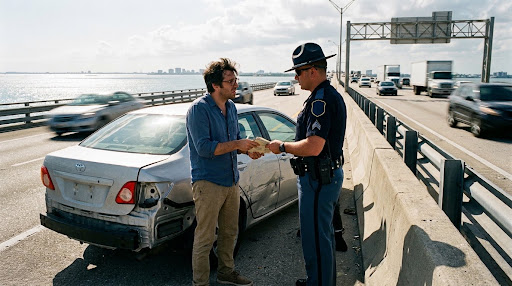
Most international visitors assume their home-country insurance travels with them to South Carolina. It does not. The moment a rental car accident happens on a South Carolina road, South Carolina law governs what happens next, regardless of the driver’s citizenship or the insurer’s country of origin.
That gap creates real legal exposure. A visitor who picks up a rental at Charleston International Airport, heads south on Savannah Highway (US-17), and collides near the Ashley River Bridge may be owed significant compensation. Without the right documentation secured in the first 24 hours, that claim can collapse entirely.

South Carolina Law Controls, Not the Visitor’s Home Country
South Carolina operates an at-fault insurance system. The driver who caused the accident bears liability for the resulting harm. That rule applies equally to international visitors driving rentals and to residents driving personal vehicles.
South Carolina law has teeth here. Rental companies operating in the state must carry minimum liability coverage of $25,000 per person for bodily injury, $50,000 per accident, and $25,000 for property damage under Title 38, Chapter 77 of the South Carolina Code of Laws. That coverage is the first layer of protection for any visitor without a U.S.-based personal auto policy.
Foreign License Limits in SC
The SCDMV advises visitors from non-English-speaking countries to carry an International Driving Permit alongside a valid home-country license. A foreign license alone is legally recognizable in South Carolina, but an IDP removes ambiguity for responding officers and rental agents.
Without the IDP, a responding officer may flag the license as unrecognized. That flag gives the opposing insurer grounds to argue the visitor operated unlawfully, which directly raises the visitor’s assigned fault percentage.
The Rental Counter Trap
Most visitors decline the collision damage waiver at the counter to save money. That decision has consequences they rarely anticipate.
A visitor’s home-country personal auto policy generally does not extend to U.S. rental vehicles. Declining all counter products often means driving with only the state minimum liability embedded in the rental agreement. For a serious injury claim, $25,000 per person is rarely adequate.
Why the Three-Year Deadline Is Shorter for International Visitors
South Carolina law gives an injured party three years from the accident date to file a personal injury lawsuit. For international visitors, the practical window is far shorter.
Evidence deteriorates faster than most claimants expect. Surveillance footage from intersections along Rivers Avenue in North Charleston or from the emergency bay at Roper St. Francis Hospital typically overwrites within 30 to 90 days. Police officers transfer precincts, retire, or become unavailable for depositions. A visitor who returns home and waits 18 months before acting faces a claim built on almost no recoverable evidence.
According to Brent Stewart, a South Carolina personal injury lawyer, Fellow of the American Bar Association, and managing partner at Stewart Law Offices, a practice honored with Best Lawyers: Ones to Watch in America 2026 recognitions and listed on Attorney at Law Magazine and Lawyers.com, delays severely erode the physical and testimony-based evidence needed to support a legal claim: “Surveillance footage may get lost. Witnesses can move away or forget details. And the longer you wait, the harder it is to connect the accident to the injury through medical records. The best thing that you can do right now is understand that time is not on your side. The sooner you take action, the more options you will have and the stronger your case can be.”
Visitor Filing Rights
South Carolina law does not limit personal injury claims based on citizenship, visa status, or immigration classification. South Carolina courts have consistently held that international visitors have full legal standing to pursue accident compensation. Filing a claim does not affect immigration status or visa renewal. The barrier for most international visitors is not eligibility. Delay is the barrier.
Retaining a South Carolina-licensed personal injury attorney while still in the state, or within days of returning home, preserves the ability to gather local evidence before it disappears. Remote representation can handle the claim after that point, but the evidence window on South Carolina roads doesn’t stay open long.
The 51% Fault Rule Bars Recovery Entirely
South Carolina follows modified comparative negligence. A visitor may recover compensation as long as a finder of fact assigns less than 51% of the fault to the visitor. At 51%, recovery stops completely.
That threshold is the most dangerous trap for international visitors in South Carolina rental car claims. Recovery ends at 51%.
Insurer Fault Tactics
Insurance adjusters for rental companies and opposing carriers routinely assign elevated fault percentages to foreign drivers. Several factors feed that strategy.
Adjusters target:
- Unfamiliarity with South Carolina traffic patterns and lane configurations
- Navigation errors on Charleston’s dense one-way corridors near the French Quarter
- IDP gaps or foreign-license documentation issues at the scene
- Delayed police reporting or incomplete accident documentation
An adjuster who reaches 51% assigned fault closes the claim without paying. That outcome makes fault documentation at the scene the single most consequential action a visitor can take.
Dealing with a rental car crash in South Carolina can be confusing for international visitors, especially when dealing with strict state fault rules and counter policy limits. Stewart Law Offices can step in to handle insurer communications, gather key scene evidence, and help protect a visitor’s rights across Columbia, Rock Hill, Beaufort, Lexington, Fort Mill, Bluffton, and Lake Wylie. If an injury makes traveling to an office unmanageable, their attorneys can meet clients directly at their location.

What to Do at the Scene Before Leaving South Carolina Roads
South Carolina law requires drivers involved in an accident causing injury or significant property damage to report the crash to law enforcement. If there are no serious injuries and the vehicle is drivable, South Carolina law requires you to safely move the vehicle off the roadway, then call 911. The responding officer’s police report becomes the foundational document for every subsequent coverage argument.
Do not admit fault, apologize, or explain navigation confusion to anyone at the scene. Roadside statements can become admissions that adjusters use to increase the fault percentage.
Scene Evidence Checklist
Photograph everything while still on location. Accidents near the I-26 interchange at US-17 or along the approaches to the Arthur Ravenel Jr. Bridge involve complex multi-lane geometries that photographs document far better than written descriptions.
Collect before leaving:
- Photos of all vehicles, visible damage, skid marks, and traffic controls
- Names and contact information for every witness
- The responding officer’s name, badge number, and report number
- The rental agreement and the rental company’s insurance certificate
Witnesses who leave the area before a claim is filed are almost impossible to locate afterward.

Violeta writes for people who want to design, research and plan their own travel experiences. After two decades of working in advertising and marketing, she decided to pursue her two passions, to travel the world and to write about it. Since 2012, she authors and administrates a network of travel blogs.