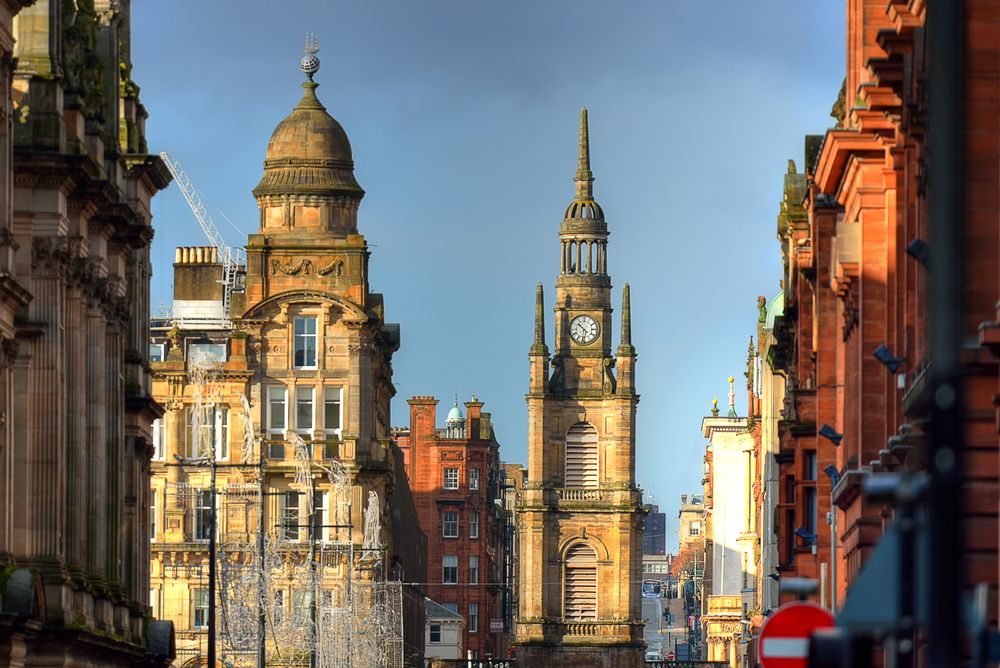
Glasgow endeared me. I’d heard people compare it unfavorably to Edinburgh — rougher, less picturesque, easier to skip. While I don’t completely disagree, I found the city to be interesting in its own right and less touristy than most of Edinburgh.
I stopped here solo for a day and a half before catching the train north to Fort William to meet my small group trip to walk the Great Glen Way — and Glasgow earned every hour I gave it. It’s a city with real grit and real art, neighborhood cafes worth lingering in, and one of the best free museum experiences in all of Scotland.
If you have one day in Glasgow — or one day plus an arrival evening, which is even better — here’s exactly how I’d spend it.

A Note on Walking vs. Getting Around
I did this itinerary entirely on foot, and I won’t pretend it’s a casual stroll. The full day covers roughly 6–7 miles of walking, spread over many hours. If that sounds like your kind of day, you’ll love it — the route connects the city’s best neighborhoods in a logical arc, and you’ll see things you’d miss from a cab window.
That said: Glasgow has excellent cab infrastructure (Uber and black cabs are widely available) and a fun little subway called the Clockwork Orange — a single loop with just 15 stations that covers both the city center and the West End. For each long stretch in this itinerary, I’ll note the cab or subway alternative so you can mix and match based on your energy and weather.

The Evening Before: Arriving in Glasgow
If you arrive in the afternoon — which is likely if you’re coming by train from Edinburgh (45 minutes) or connecting from elsewhere — don’t waste the evening. Glasgow’s city center is remarkably walkable from both major train stations, Glasgow Central and Glasgow Queen Street, which are just a short walk apart near George Square.
Check In: Stay Near the Stations
I stayed at Motel One Glasgow, and I’d recommend it without hesitation for this kind of trip. It sits right next to Glasgow Central Station — as in, you can see the station from the hotel — which makes logistics seamless if you’re moving on by train and the airport express bus drops off nearby. The design is stylish and European, the bar stays open late, and the location puts you steps from everything on the evening list below. Rooms are on the smaller side, as are most in the UK, and I thought there was plenty of room.
Any hotel near Glasgow Central or Glasgow Queen Street serves this itinerary well. The two stations are about a 9-minute walk from each other, and the city center between them is where you’ll spend much of your time.

Buchanan Street: Glasgow’s Pedestrian Heart
Once you’ve dropped your bags, head to Buchanan Street, Glasgow’s car-free main shopping street. It’s lively, architecturally handsome, and good for getting your bearings. Window shop, people-watch, or duck into one of the cafes for a late afternoon coffee.

GOMA: Gallery of Modern Art
A five-minute walk from Buchanan Street brings you to Royal Exchange Square and one of Glasgow’s most beloved landmarks: the Gallery of Modern Art (GOMA). It’s free, it’s beautiful, and it’s housed in a neoclassical building that looks like it belongs in Rome. The permanent collection is very interesting — strong on contemporary Scottish artists — and the rotating exhibitions are worth checking out before you go. Plan 30–45 minutes here.
Outside the gallery, look for the equestrian statue of the Duke of Wellington with a traffic cone on his head. Glaswegians have been doing this for decades; the city has largely given up trying to stop them. It’s a local tradition and a great photo.
Dinner: Di Maggio’s on Royal Exchange Square
Stay right there on the square for dinner at Di Maggio’s, a Glasgow institution with a proper Italian menu and one of the city’s best outdoor patios. On a warm evening, eating outside in Royal Exchange Square — with GOMA lit up behind you and the Duke of Wellington presiding with his cone around the corner — is about as good as urban dining gets. The pasta is reliable, the portions are generous, and the atmosphere is reliably festive.
Evening Wind-Down: Oxfam Bookshop + Kong Rooftop
Before or after dinner, peek into the Oxfam Bookshop just off the square. It’s an excellent used bookshop with a solid travel and Scotland section — dangerous for people like us. (See my recommendations for books set in Scotland here.)
For a nightcap, head to Kong, a bar and rooftop garden at 23 Royal Exchange Square (right across from the Di Maggio’s patio). The rooftop terrace is covered and heated, strung with fairy lights, and lush with plants — it feels like a botanical garden dropped onto a city block. Cocktails are reasonably priced, and the vibe skews grown-up-fun rather than rowdy. Book ahead on weekends; it fills up.

Start your day fueled — you’re going to cover some ground. I had a great breakfast at Motel One, Glasgow.
Morning: The Cathedral Quarter (East End)
From your hotel near Glasgow Central, it’s about a 30-minute walk east to the Cathedral Quarter — or a short cab ride (around £6–8) if you’d rather save your legs for later.
On the walk, you’ll pass the Equestrian Statue of the Duke of Wellington again (this time you might catch it in morning light without last night’s crowds) and move through the Merchant City, Glasgow’s oldest neighborhood and one of its most architecturally rich.

Glasgow Cathedral
Glasgow Cathedral is one of the finest medieval Gothic buildings in Britain, and unlike so many historic churches, it survived the Reformation intact — a small miracle. It’s been in continuous use since the 12th century. Go inside. The lower church (the crypt) is particularly atmospheric, and the view back down the nave from the choir is breathtaking. Free entry; allow 30–45 minutes.
The Necropolis
Walk up the hill directly behind the cathedral to reach the Necropolis, a Victorian cemetery with sweeping views over the city. It opened in 1832 and contains some of Glasgow’s most elaborate funerary monuments — angels, obelisks, portraits carved in stone. It did occur to me that most of the men memorialized here – especially near the top of the hill – probably would have burned me as a witch. The path winds to the top, where you can look down at the cathedral roofline and the city beyond. This may be one of the best views of Glasgow. On a sunny day you can see a long way. Allow 30–45 minutes to wander properly.

St. Mungo’s Museum of Religious Life and Art
Right next to the cathedral sits the Museum of Religious Life and Art. I went in to find a restroom, but got caught up in the exhibitions. It explores world religions through objects and art — everything from a Shiva Nataraja to Christian icons to a beautiful Zen garden out back. It’s a small museum but surprisingly thoughtful. Worth 20–30 minutes.
Getting around tip: The Cathedral Quarter is the farthest point from your hotel on this itinerary. From here, you’ll arc west across the city center. Uber and black cabs are plentiful in this area.
While I did this on my own, there is a walking tour that visits the Glasgow Cathedral, the Necropolis, and GOMA, which I bet would be super interesting. This tour starts at GOMA and ends at the Glasgow Cathedral with lots of stops in between. You can even take a Glasgow walking tour with a stand-up comedian!

Mid-Morning: Singl-end Café Bakehouse
From the Cathedral, walk about 40 minutes west (or cab/Uber about 10 minutes) to Singl-end in Garnethill. This café has a devoted local following for good reason: house-baked bread, generous portions, excellent coffee, and an industrial-meets-arty interior that feels very Glasgow. Order the sourdough toast, a proper brunch plate, or whatever the day’s baked special is. You’ve earned it.
At my next stop, I learned what a single-end is: a one-room tenement house, often housing whole families.
The Garnethill neighborhood is interesting in its own right — it’s home to the Glasgow School of Art (Charles Rennie Mackintosh’s masterwork, now partially restored after fires) and has a distinctly creative, neighborhood feel.

Late Morning: The Tenement House
A five-minute walk from Singl-end brings you to one of Glasgow’s most quietly interesting experiences: The Tenement House, a National Trust for Scotland property.
This is the preserved flat of Agnes Toward, a shorthand typist who lived here from 1911 until 1965 and apparently never threw anything away. When the NTS took it over, it was essentially a time capsule of Edwardian and early 20th-century Glasgow life — the original box bed, coal range, her correspondence, her medicine cabinet. Rick Steves has called it one of his favorite museum experiences in Europe, and he’s right. It’s small, intimate, and unexpectedly moving.
Tickets are around £10.00 for adults. Open daily March–October; check winter hours. Allow 45–60 minutes.

Afternoon: Kelvingrove Park and Art Museum
From the Tenement House, it’s a 20-minute walk west to Kelvingrove Park, a beautiful Victorian park with the River Kelvin running through it. Take your time here — there are paths along the river, open lawns, and the kind of serene urban greenery that Glasgow does better than it gets credit for.
The park leads directly to the Kelvingrove Art Gallery and Museum, one of the greatest free museums in all of Britain. The sandstone building is gorgeous from outside; inside it’s a grand cathedral of a space with marble floors, soaring halls, and collections ranging from Dalí’s Christ of Saint John of the Cross to a Spitfire hanging from the ceiling to natural history exhibits to Charles Rennie Mackintosh design.
Don’t Miss: The Organ Concert
This might be an actual hidden gem. Every day Monday–Saturday at 1:00 pm (and Sunday at 3:00 pm), there’s a free organ recital in the Centre Hall. The Kelvingrove organ was built for the 1901 Glasgow International Exhibition and contains 2,889 pipes. The music played during weekday recitals leans popular and accessible — the kind of concert that makes children stop in their tracks and adults grin. I arrived about 15 minutes in and stood there entirely delighted.
Time your arrival to catch the 1:00 pm concert if you can, then spend the rest of the afternoon exploring the galleries. Allow 1.5–2 hours total. I wish I had budgeted more time here. I had about an hour, and it wasn’t enough.
If you find yourself with extra time, The University of Glasgow is just uphill from the museum and has a gorgeous campus, especially the cloisters.
Getting around tip: The Kelvingrove is easily reached from the city center by subway — take the Clockwork Orange to Kelvinhall station. A single ticket is around £1.75.

Late Afternoon: Afternoon Tea at The Butterfly and the Pig
About a 30-minute walk from Kelvingrove (or a quick cab) brings you to The Butterfly and the Pig on Bath Street, an eccentric Georgian townhouse restored as a tearoom, restaurant, bar, and event venue. The tearoom is the point: proper afternoon tea with sandwiches, scones, clotted cream, and cakes, served in a space that feels both traditional and slightly whimsical.
Book ahead — afternoon tea slots fill up, especially on weekends. This is a lovely place to rest your feet, review the day, and caffeinate for the evening ahead. My only complaint was that they were playing 80s and 90s music while I was there. I did like the music, but felt like classical would have been more fitting.
Evening: Back to Kong (or Wherever the Night Takes You)
If you followed the arrival evening itinerary, you’ve already been to Kong on Royal Exchange Square. If not, this is a perfect spot to end the day — rooftop terrace, good cocktails, central location. Glasgow also has a deservedly celebrated food and bar scene in the Merchant City and along Sauchiehall Street; wander east from Kong if you’re hungry for dinner and want to explore.
I ate the second half of my tea from The Butterfly and the Pig for dinner at my hotel and wandered down to the bar in the evening for a gin cocktail and some reading.

Where to Stay in Glasgow
The most strategic base for this itinerary is anywhere within a short walk of Glasgow Central Station or Glasgow Queen Street Station. Both are in the city center, close to everything on the evening arrival list, and within walking or easy transit distance of the full day’s route.
Motel One Glasgow (78–82 Oswald Street) — My pick for this itinerary. Directly adjacent to Glasgow Central, stylish design, excellent value, good bar, soundproofed rooms despite the central location. Rooms are small but well-designed. Book directly on their site for the best rate.
Other well-regarded options in the same area include the Voco Grand Central Glasgow (inside the Grand Central Hotel, literally connected to Glasgow Central Station — stunning Victorian building), and the citizenM Glasgow (tech-forward, design-conscious, good prices).
For the West End and more of a neighborhood feel, look at boutique hotels and guesthouses around Byres Road — but note you’ll want to cab or subway to the Cathedral Quarter in the morning.
Practical Tips for Your Glasgow Day
Getting to Glasgow: From Edinburgh, trains run every 15–30 minutes and take 45 minutes to one hour. Glasgow Airport connects to the city center by bus (Citylink 500, around £8–10, 30 minutes) or taxi (around £25).
Getting around in Glasgow: The city center is walkable, but the full itinerary above is 6–7 miles. Uber and black cabs are inexpensive and widely available. The Clockwork Orange subway covers the city center and West End for around £1.75 a ride. A day ticket (around £4.50) makes sense if you’re using it multiple times.
Weather: Glasgow is famously rainy. Pack layers and a waterproof jacket year-round. That said, every stop on this itinerary, except the Necropolis walk and Kelvingrove Park, is either indoors or offers indoor alternatives — you’ll be fine.
Best time to visit: May through September offers the best weather and the longest days (the sun sets near 10 pm in June). Glasgow is also magnificent in autumn, when the park and Necropolis take on real drama.
Costs: Almost everything on this itinerary is free or low cost. Exceptions: The Tenement House (£10), afternoon tea at The Butterfly and the Pig (£20–27 per person), meals, and drinks. Budget roughly £60–80 for a full comfortable day excluding accommodation.

Glasgow in the Context of a Scotland Trip
Glasgow makes an excellent starting or ending point for a Scotland trip. It’s the natural gateway to the West Highlands and to the starting point for both the West Highland Way and the Great Glen Way — the latter is what brought me here, meeting my group before we set off north toward Inverness.
If you’re planning a Scotland itinerary, I’d suggest at least one night in Glasgow rather than treating it as a day trip. The city rewards an evening arrival and a full day — which is exactly the frame of this guide.
If you make Glasgow your basecamp, there are plenty of day-trip tours to explore other parts of the country, including the Great Glen, Stirling, and the Isle of Arran.
Have you spent time in Glasgow? I’d love to know what I missed — drop it in the comments below.
More on Planning a Trip to Scotland