
10 Communication Mistakes That Derail Mergers

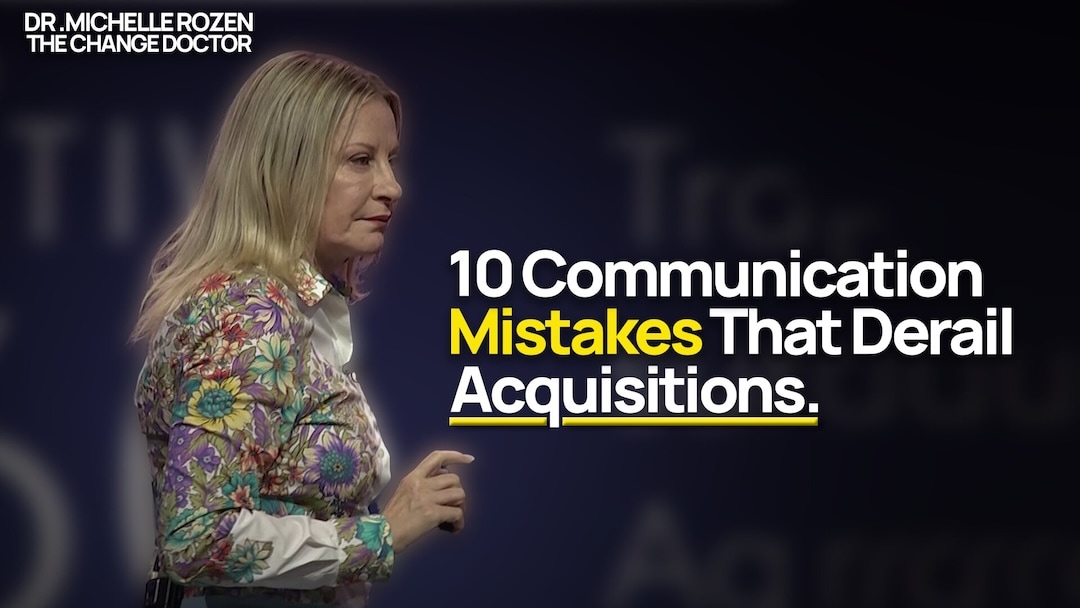
The ten communication mistakes that most commonly derail mergers and acquisitions are: announcing the what without the why, communicating once and assuming it landed, using corporate language instead of human language, leaving middle managers without scripts, treating silence as neutral, conflating AI efficiency with job security, communicating to inform instead of to stabilize, sending the same message to every audience, delaying the hard answers, and letting the rumor network outrun the official narrative. Each one is avoidable, and each one costs real deal value when it happens.
Most merger communication fails not because leaders do not care, but because they do not understand what the communication is actually for.
The purpose of merger communication is not to inform. Information is a byproduct. The purpose is to stabilize: to reduce the threat response in the human brain enough that people can stay focused on the work instead of protecting themselves from uncertainty.
In my research on change leadership and the behavioral science of organizational transitions, I have identified ten communication mistakes that consistently derail M&A integrations. Each one is predictable, each one is preventable, and each one costs deal value when it happens.
Mistake 1: Announcing the What Without the Why
“We are restructuring the commercial team” is information. “We are restructuring the commercial team because the combined organization creates a new market opportunity in enterprise that requires a different structure, and here is what that means for your role” is communication.
When employees receive structural information without context, their brains do not wait for the why. They generate it. And the why they generate is almost always more threatening than the reality. New structure equals power shift. Power shift equals threat. Threat equals exit behavior.
What to say instead: Before any structural announcement, require the communicator to answer this in writing: why is this happening, what problem does it solve, and what does it mean for the person receiving this message. If those three questions cannot be answered simply, the announcement is not ready.
Mistake 2: Communicating Once and Assuming It Landed
Research on information retention during periods of high stress consistently shows that retention drops dramatically when the receiver is anxious. An employee who heard the merger announcement while running the same anxiety calculation every other employee was running did not retain the details. They retained the emotional tone.
Communicating once about a significant change and then treating it as handled is one of the most common and most costly errors in merger communication. The leaders who achieve the fastest integration are the ones who plan to communicate the same core messages five to seven times across multiple channels and formats before they consider the message received.
Mistake 3: Using Corporate Language Instead of Human Language
“We are committed to a seamless integration that leverages the combined strengths of both organizations to maximize synergy realization” means nothing to the nurse wondering if the hospital she has worked at for 14 years will still exist in its current form.
Corporate language signals distance. It signals that the communication was written for someone other than the person reading it. And in a moment when employees are scanning every signal for evidence of whether they matter to new leadership, corporate language is a powerful signal in the wrong direction.
What to say instead: Write for the specific person you are trying to reach. Use the language they use. Answer the questions they are actually asking.
Mistake 4: Leaving Middle Managers Without Scripts
Middle managers are the communication channel that reaches the most employees in any organization. They are also, in most integrations, the least prepared people in the building for the questions they will be asked.
When a manager says “I don’t know” to an anxious employee, the employee does not hear “your manager is being honest.” They hear “even the people in charge don’t know what’s happening,” which confirms the threat interpretation.
What to do instead: Build a manager communication toolkit before the announcement. Anticipate the 15 most common questions employees will ask. Provide honest answers for the ones you have answers to. Provide explicit language for the ones you don’t: “I don’t have that answer yet, but here is when I will, and I will tell you as soon as I do.” That language is a retention tool.
Mistake 5: Treating Silence as Neutral
In organizational change, silence from leadership is never neutral. It is always interpreted, and it is almost always interpreted as either evasion or bad news.
When there is a period of two or more weeks without a visible leadership communication during an integration, the vacuum fills. The rumor network operates faster and less accurately than official channels, and the stories it generates tend to be more alarming than the reality. Once a story takes hold, it is exponentially harder to correct than to prevent.
What to do instead: Establish a communication cadence at the outset and keep it even when there is nothing new to report. “We know you are waiting for information on X. We do not have it yet. Here is when we expect to. Here is what we are doing in the meantime.” That is not a good update. It is a great one.
Mistake 6: Conflating AI Efficiency With Job Security
This mistake has become significantly more costly in 2026 specifically. Glassdoor’s midyear 2026 data (as of May 2026) found that AI mentions in employee reviews climbed roughly 240% year over year, that the balance of sentiment flipped from positive (55% in 2025) to negative (53% in 2026), and that job-insecurity mentions rose 63%. When an M&A communication mentions AI in the same breath as efficiency or synergies, it lands as a job-cut signal regardless of intent.
What to say instead: Separate the AI narrative from the restructuring narrative explicitly and out loud. If AI is part of the integration strategy, name what it is for and what it is not for, and never let “efficiency” stand in as a polite word for headcount reduction without being prepared for exactly that interpretation.
Mistake 7: Communicating to Inform Instead of to Stabilize
Most merger communications are designed to transfer information. The most effective merger communications are designed to reduce threat. Those are different objectives that produce different messages.
A communication designed to inform says: “Here is what is happening.” A communication designed to stabilize says: “Here is what is happening, here is why it is happening, here is what it means for you specifically, here is what stays the same, and here is when you will know more.” The second version takes longer to write. It costs almost nothing in extra time. And it produces dramatically different outcomes in the brain of the person receiving it.
Mistake 8: Sending the Same Message to Every Audience
The message that lands for a VP of finance does not land for a frontline nurse or a software engineer or a regional sales manager. They have different roles, different fears, different frames for interpreting organizational change, and different evidence they need to feel stable.
One of the most consistent findings in change communication research is that segmented, role-specific communication produces significantly higher adoption and retention than undifferentiated all-hands messaging. Build a communication matrix before the announcement: what does each audience need to hear, in what format, at what level of detail, from whom.
Mistake 9: Delaying the Hard Answers
The instinct to delay difficult news until the details are fully confirmed is understandable. It is also consistently the wrong call. Delayed hard news does not protect employees. It extends the period of anxiety while the rumor network fills the gap with its own version.
The principle that guides effective merger communication is: tell what you know when you know it, tell what you do not know when you do not know it, and give a specific date for when you will have more. That structure gives employees a way to calibrate their uncertainty rather than leaving them with no map at all.
Mistake 10: Letting the Rumor Network Outrun the Official Narrative
In every merger, a parallel communication system operates alongside the official one. It is faster, more specific, and less accurate. It operates through hallway conversations, group chats, LinkedIn messages, and the inevitable “someone told me that” chain that spreads through an organization within hours of any announcement.
The leaders who manage this best do not try to shut down the informal network. They out-communicate it. They move faster, answer more specifically, and create more access points for honest questions and direct answers than the rumor network can match.
The only way to win the narrative in a merger is to be the fastest, most specific, most honest source of information in the building. Anything slower or vaguer than that leaves the field to a network that will fill it less accurately.
For the full M&A communication framework, see our M&A leadership page, and related pieces on 7 Reasons Mergers Fail and 9 Ways to Retain Talent During a Merger.
FAQs
What are the most common communication mistakes in mergers?
Announcing structural changes without explaining why, communicating once and assuming it landed, and leaving middle managers without scripts are the three mistakes that most consistently drive the anxiety and attrition that derail integrations. Each one has a specific fix that costs nothing but preparation and intention.
How often should leaders communicate during a merger?
Far more often than most leaders instinct tells them to. Research on retention during change shows that employees need to hear core messages five to seven times before they are genuinely received. Establish a communication cadence at the start of the integration and maintain it even when there is nothing new to report.
What should leaders say to employees during a merger?
Every merger communication should answer four questions: what is happening, why is it happening, what does it mean for you specifically, and when will you know more. Communication that cannot answer all four is not ready to be sent.
Explore our M&A leadership keynote and advisory →
Sources
About the author
Dr. Michelle Rozen, PhD, is a change and leadership expert who advises Fortune 500 leadership teams. She is the creator of the 0-10 Rule and the 6% High-Performance Culture System, and her research focuses on the 6% of people who consistently follow through on the commitments they make.


