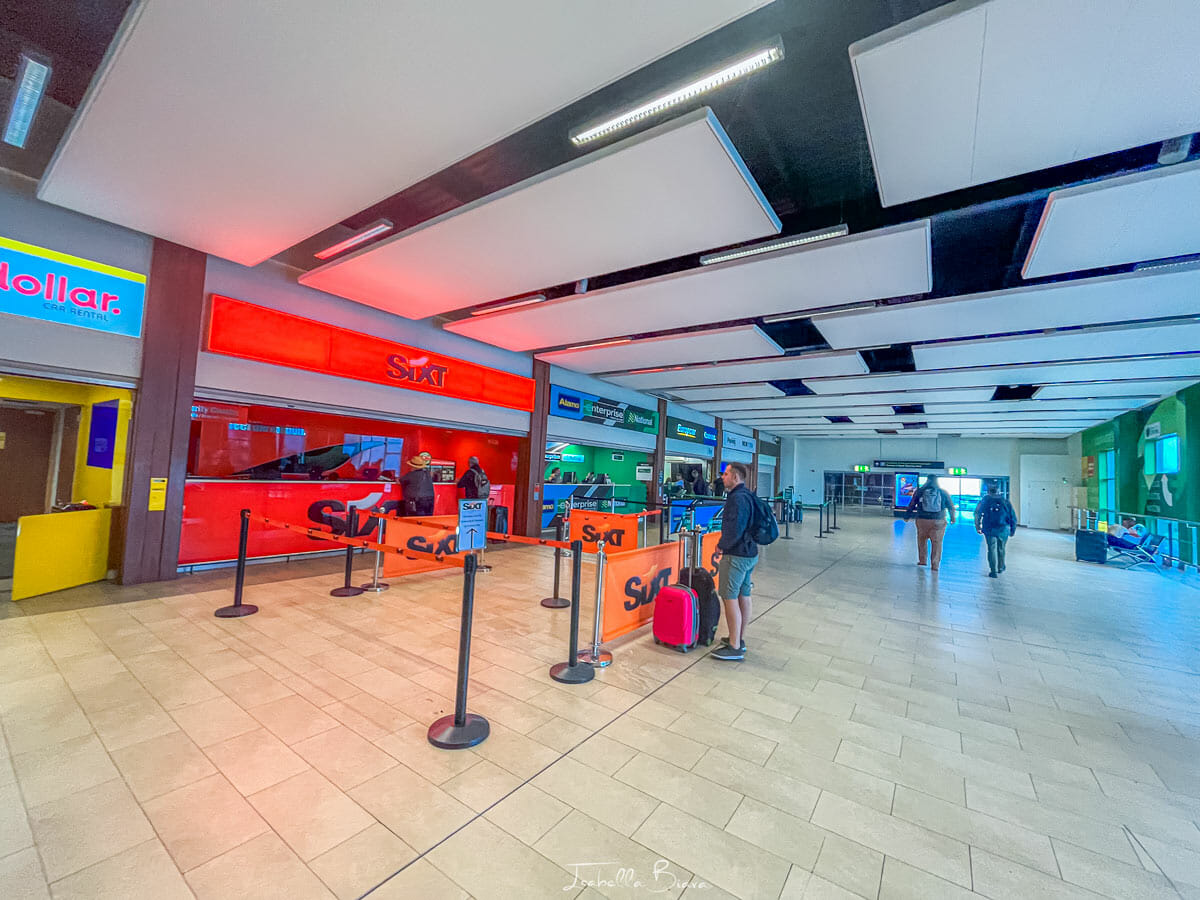
I’ve rented cars in Dublin twice, once for three weeks in July and once for over a month in October, and both trips taught me the same two lessons. Book way earlier than feels necessary, and give yourself a full week before you trust your brain on the left side of the road.
Ireland is one of the most welcoming and easy countries for solo female travelers, and the car is what gets you to the version of it worth flying for: the coasts and valleys no tour schedule reaches.
Here are the 20 things to know before renting a car in Dublin, each one explained properly, plus the day trips that make the rental worth it.


This post may contain affiliate links. If you purchase through them, I may earn a small commission at no extra cost to you. Thanks for supporting my small business.
20 Things to Know Before Renting a Car in Dublin
1. Dublin rentals are expensive, and booking early is the only real discount
Ireland has some of the priciest car rentals in Europe, and there’s a structural reason: it’s an island market with a limited fleet and a short, intense tourist season, so when demand spikes, there’s nowhere for extra cars to come from.
A car that costs €25 a day in Portugal can cost €60 here in summer, and in July and August the fleet genuinely sells out. I compare prices on Discover Cars because it shows the international brands and the Irish companies side by side with real customer ratings, and I book the moment my flights are confirmed.
The seasonal difference is dramatic: my October month cost much less than what the July weeks did, same category of car. Two more ways to soften the price: rentals of a month or more get meaningful discounts, and if your booking has free cancellation, checking prices again closer to the date costs nothing, because if the same car appears cheaper, you can book the new rate and cancel the old one.
2. Understand the insurance before you land, especially if you’re American
Irish rental insurance has three layers, and knowing them saves you both money and a nasty surprise. The basic Collision Damage Waiver (CDW) comes included, but it carries an excess, the amount you’re still liable for, that can run over €2,000 depending on the company and car.
Super CDW reduces that excess to little or nothing and costs about €20 to €25 a day at the desk, usually less booked online in advance.
The third option, relying on your credit card’s rental insurance, is where Americans get burned: Ireland is one of the few countries many US credit cards specifically exclude from rental coverage, along with Italy and a handful of others. The plan that worked for you in Spain can leave you completely uncovered here.
So before you fly, check your card’s terms in writing, and if Ireland is excluded, budget the Super CDW as part of the rental price rather than an add-on. Between the hedges, the stone walls, and lanes the width of the car plus a breath, this isn’t the country for minimum coverage.
In my case Discover Cars resolved this problem. Their full coverage is much cheaper than any full coverage offered by any car rental and it works. I tried it on my. I claim for a tire replacement which cost me 300 Pounds (it was in England but it works everywhere) and they refund me right away.
3. Bring the right documents (there are three, each with a catch)
First, your passport. The rental company needs it to verify your identity, not just the airport, and bringing a photocopy speeds up the desk while the original stays in your hand.
Second, your driver’s license, where two different rules get mixed up constantly. Rule one is about driving legally: licenses from the US, Canada, Australia, New Zealand, and the EU are valid to drive in Ireland for up to 12 months, no International Driving Permit needed. An IDP only enters the picture if your license is printed in a non-Roman alphabet, Arabic, Japanese, Cyrillic and so on, in which case it must accompany your license.
Rule two is about renting, and it’s stricter: rental companies require the renter and every additional driver to have held a full, valid license for at least 4 years, and to present the physical license at pickup together with a passport or ID card. Photocopies, digital licenses on your phone, learner’s permits, and licenses with restrictions are all refused at the counter. EU licenses are accepted without further preconditions, but the 4-year rule still applies as a company condition. If you passed your test three years ago, find this out now, not in the arrivals hall.
Third, a credit card in the main driver’s name for the security deposit. Most providers won’t accept a debit card or cash for the hold, and the deposit scales with the car: an economy hatchback might hold a few hundred euros, a luxury car far more. Check that your card’s available limit covers the deposit on top of your travel spending, because the hold is frozen for the whole rental.
4. The age rules, spelled out
The minimum age to rent in Ireland is 21 with most companies, but that number alone is misleading, because the fleet opens up with age. Drivers under 25 pay a Young Driver Surcharge on top of the rate, charged per day. Some vehicle categories have their own floors with certain companies: people carriers and minibusses often require 27 or older, and luxury cars and large SUVs 30 or older.
At the other end, drivers over 75 may be asked for a medical certificate confirming fitness to drive, and some companies set upper limits per category. None of this is hidden; it all lives in the conditions tab of the booking, but almost nobody reads it, and the desk is the wrong place to discover your category has an age floor. Two minutes with the conditions before booking solves it all.
5. Manual is the default, and you’ll be shifting with your left hand
Most Irish rental cars are manual transmission; automatics cost noticeably more, and they’re the first cars to sell out in season.
And here’s the detail people don’t think about until they’re in the seat: in a right-hand-drive car, the gear stick is on your left, so even confident manual drivers spend the first day shifting with the wrong hand while also processing the wrong side of the road.
It comes back faster than you’d expect; the pedals are in the same order and muscle memory adapts, but if any part of that sentence made you nervous, book the automatic today and consider the extra cost the cheapest stress reduction available. One less thing to think about at your first roundabout is worth real money.
6. Rent small


Irish country roads are narrow, walled, and hedged, and every extra centimeter of car width costs you nerves on every single lane. The boreens, the tiny rural roads where the best of Ireland hides, were laid out for carts, not crossovers.
A compact car means easier passing, easier parking in village squares, and mirrors that survive the hedges.
7. Film the car at pickup and strip the agreement of surprises
Filming the car matters everywhere; in Ireland it matters more, because the hedges scrape every car that passes them and you don’t want to pay for the previous renter’s souvenirs. Walk around slowly with your phone recording: every panel, both bumpers, the mirrors, the wheels and rims, the windshield, and the fuel gauge.
Then confirm the damage sheet the company gives you matches what you filmed, and repeat the whole ritual at drop-off.
On the paperwork side, check four things before signing: the fuel policy (full-to-full is the only fair one), unlimited mileage (essential for a touring trip), that every person who might drive is added as a driver (an unlisted driver voids the insurance entirely), and that no add-ons you didn’t request, GPS units, extra insurance, roadside packages, have crept onto the bill. They’re easier to remove at the desk than to dispute afterward.
8. The left side of the road, honestly
The adjustment is real, and it takes days, not minutes. The mechanics: traffic drives on the left, roundabouts flow clockwise, and you yield to traffic coming from your right, which is the reverse of home for most visitors. The counterintuitive part is that dense traffic actually helps, because you follow the car ahead; the dangerous moments are the empty ones, pulling out of a parking lot onto a deserted road, or the first turn of the morning, when your brain quietly resets to driving on the right.
My trick for week one: a sticky note on the dashboard that just says LEFT. It looks silly, and it works. Also plan your first drive kindly: from the airport, go straight to the motorway rather than through the city, because motorways feel the same in every country and give your brain an hour to settle before the narrow stuff starts. My full driving in Ireland guide goes deeper on all of this.
9. Country roads run on etiquette, and it’s easy to learn
On single-track roads, the system is cooperation. Drive at a speed you could stop from, tuck left into the passing places (small widenings every few hundred meters) when you meet oncoming traffic, and if the passing place is on the other side, stop and let them use it.
Tap the horn lightly before blind corners so anyone coming knows you exist. And learn the finger lift: when someone pulls in for you, you lift a finger or two off the wheel as thanks, and they’ll do the same for you. It sounds like a small thing until you’re doing it thirty times a day without thinking. The system works because everyone plays, and as a visitor, playing along is both polite and safer.
10. Use Google Maps, but download the offline maps first
Skip the rental company’s paid GPS unit; Google Maps handles Ireland well and knows the traffic. But do two things before you leave Dublin: download the offline maps for the whole island, because rural signal gaps are real, especially in the west and the mountains, and treat the arrival time estimates with suspicion on small roads. Google assumes you’ll drive the speed limit, and on a wet boreen behind a tractor, you won’t. Add a third to any rural estimate and you’ll stop being late everywhere. When the navigation disagrees with a road sign about where a road goes, believe the sign; Google occasionally invents shortcuts through farmyards here too.
11. Skip driving in Dublin itself


Dublin’s rush hours run roughly 7 to 9 in the morning and 4 to 7 in the evening, the quays crawl even between them, and the city center’s one-way system punishes hesitation. Honestly, the best plan is to not have a car in Dublin at all: the city is walkable, and buses, LUAS trams, and DART trains cover everything else. See Dublin car-free first, then pick up the rental at the airport on your way out to the country.
You save the daily rate for the days you’d have spent parked, you save the parking itself, and your first Irish driving experience happens on a motorway instead of College Green at rush hour.
12. The M50 toll has no barriers, and that’s the trap
Dublin’s ring motorway, the M50, uses barrier-free tolling: there are no booths, cameras read your plate as you pass, and payment is due by 8 pm the following day, online at eFlow or at Payzone shops.
Miss that deadline and penalties start stacking onto a toll of a few euro, and they keep growing. In a rental, the question is who pays: most rental companies either have an eFlow tag on the car or auto-bill the toll to your card afterward, often with a small admin fee, but the arrangements differ, so ask at the desk how your company handles the M50 specifically, and if anything is left for you to pay yourself.
Other Irish motorways use conventional toll plazas that take cash and cards, no drama. It’s only the M50 that bills by camera, and it’s the one every airport pickup crosses first.
13. Fuel: expensive, and mind the nozzles
Irish fuel prices sting, which is the second half of the small-diesel argument. Save where the locals save: supermarket fuel stations (Tesco, Circle K at supermarkets, Applegreen off the motorway) run consistently cheaper than motorway service stations.
Before your first fill, check which fuel your car takes; it’s marked inside the fuel flap, and pay attention at the pump, because petrol and diesel nozzle colors here may not match what you’re used to at home.
Putting petrol in a diesel engine, or the reverse, is the single most expensive mistake available in a rental car: the fix involves a tow and a drained fuel system, and insurance often doesn’t cover it.
14. Parking, in Dublin and beyond


In Dublin, street meters generally run until about 7 pm (some zones longer), multi-story garages charge €1.50 to €4 an hour, and free street parking hides in residential zones with time limits that are enforced, so read the plate on the pole twice.
If you’re staying in the city with a car anyway, choose accommodation outside the center with its own parking; it makes arrival and departure much easier and usually costs less than two days of garage fees.
Out in the countryside, parking is mostly free and easy, with one seasonal exception: famous trailheads and viewpoints, Glendalough, the Cliffs of Moher, fill by mid-morning in summer. Arriving early solves it, and the light is better anyway.
15. Speed limits are in km/h, and they’re ceilings, not targets
The numbers: motorways 120 km/h, national roads 100, regional and local roads 80, urban areas 50, school zones 30. Cross into Northern Ireland and everything switches to miles per hour, which matters more than it sounds when the sign says 60 and means 96 km/h.
Now the part that confuses visitors: a narrow, walled, wet single-track lane can legally carry an 80 km/h limit that no sane person would drive at. Irish rural limits describe the road’s classification, not its safety, so treat them as ceilings and drive to what you can see.
Speed vans (marked and unmarked) and fixed cameras enforce the limits, and fines in a rental reach you through the company with an admin fee, months later.
16. The rules that actually get visitors fined
Seat belts in every seat, no exceptions. Phones are hands-free only, and enforcement has zero tolerance; holding the phone at a red light counts. The drink-driving limit is 50 mg per 100 ml of blood, lower than the UK and the US, low enough that the only sensible amount before driving is none; Ireland’s pub culture and its driving laws are kept firmly separate, and the Garda checkpoints on weekend nights are routine.
One more uniquely Irish detail: in Gaeltacht (Irish-speaking) areas, some signs appear in Irish only, so learn that “Géill Slí” means yield before you meet the sign at speed on a country junction.
17. Weather is part of the driving plan
Irish rain arrives sideways, dumps hard, and is gone within the hour, often replaced by sunshine that makes you doubt it happened.
The practical version: wipers on, lights on, speed down, and patience, because it will pass. Fog on the higher roads- the Wicklow Gap, the Sally Gap, Conor Pass in the west- can cut visibility to nothing, so build margin into any mountain drive and don’t schedule tight connections after one.
And a photographer’s note that doubles as a morale note: the light right after the rain is why every photographer loves this island. Some of my favorite shots from both trips came within twenty minutes of a downpour I’d been cursing.
18. Plan the loop, not just the days
Ireland looks small on the map and drives big, because the interesting roads are the slow ones. Group your route geographically instead of zigzagging: Wicklow and the southeast belong together, the Boyne Valley is its own northern day, and the west, Clare, Kerry, Connemara, is its own trip entirely, not a day out from Dublin.
Know the opening hours of the places you’re driving to (heritage sites here close earlier than you’d think), estimate fuel for the long days, and leave one day in the plan unassigned, because the best Irish day is often the one where you follow a brown heritage sign you’d never heard of.
Our Ireland itinerary builds the full circuit; the Wild Atlantic Way alone deserves 7 to 10 days, and a proper loop of the whole island wants 2 weeks or more.
19. Pick up at the airport, with one exception


Dublin Airport has the biggest fleet, the longest desk hours, and the fastest exit onto the M50 in either direction, which is exactly the gentle first drive you want. City center offices occasionally beat the airport on price, particularly for long rentals, so if you’re renting for several weeks or a month as I did, compare both before assuming.
The catch with city pickup is the first drive: you start in Dublin traffic on your wrong-side day one, which is precisely what tip 11 told you to avoid. For most trips, the airport wins on every axis that matters.
20. You might not need the car every day, so time the rental
Dublin works without wheels, and so do several day trips: my day trips from Dublin without a car post proves it with trains and organized options. So instead of renting gate-to-gate, time the rental to the touring part of your trip: city days first, car-free, then collect the car when the loop starts. Every day the car sits parked in Dublin you’re paying for it twice, once in rental and once in parking, and on a two-week trip, trimming three city days off the rental often pays for a night’s accommodation.
Day Trips From Dublin Worth the Rental
This is where the car earns its keep. The Wicklow Mountains are an hour south and they’re the single best argument for renting at all: the Military Road over the top, the Sally Gap, and Glendalough’s two lakes and monastic ruins make a full day that no bus tour does justice, because the point is stopping wherever the valley opens up. Bring layers; the weather up there has opinions.
Howth is the short option, 16 km northeast: a cliff walk with the sea on one side, a working harbor, and fish and chips at the end. Half a day, back in Dublin for dinner. The Boyne Valley is 45 minutes north, and Newgrange, the passage tomb there, is older than the pyramids and still catches the winter solstice sun through its roof box after 5,000 years; book the visitor center in advance, because access is by guided tour and walk-ins regularly miss out.
Going further: the Rock of Cashel is about 2 hours out, a medieval cathedral complex crowning a limestone outcrop over the Tipperary plains, and it photographs like a film set from every angle. It pairs well with Kilkenny, 90 minutes from Dublin, which has the castle, the medieval mile, and the best-preserved old streets in the country. My guide to things to do in Kilkenny covers that stop properly.
Find the best guided tours from Dublin
Renting a Car in Dublin: Frequently Asked Questions
How much does it cost to rent a car in Dublin?
Typically €30 to €50 per day for an economy car plus insurance, higher in summer, with meaningful discounts on rentals of a month or more. My October month cost a fraction per day of what the July weeks did. Automatics and larger categories sit above that range, and Super CDW adds €20 to €25 a day if you take it at the desk rather than online.
Is it worth renting a car in Dublin city?
For the city alone, no. Buses, LUAS trams, and DART trains cover Dublin fine, and parking would eat any savings. The car is for the countryside, and the countryside is the whole point of Ireland.
Can Americans drive in Ireland with a US license?
Yes: a US license works on its own for visits up to 12 months, no International Driving Permit needed, provided you’ve held it for at least 4 years, which is the rental companies’ own requirement rather than Irish law. The bigger issue for Americans is insurance, since many US credit cards exclude Ireland from rental coverage; check yours in writing before you rely on it.
When is the best time for an Irish road trip?
May, June, and September balance daylight, weather, and prices; summer adds crowds and cost, winter subtracts daylight. My guide to the best time to visit Ireland breaks it down month by month. October, when I did my long rental, has its own moody beauty, and I loved it, just with shorter days to work with.
Final Thoughts
Book early, insure properly, rent small, and give the left side of the road a week of humility. Ireland by car is the trip the postcards promise, one of the most welcoming and easy countries a solo woman can drive, and the hedge-lined single tracks that scare you on day two will be your favorite part by day five.