The 5 Safest SUVs of 2026

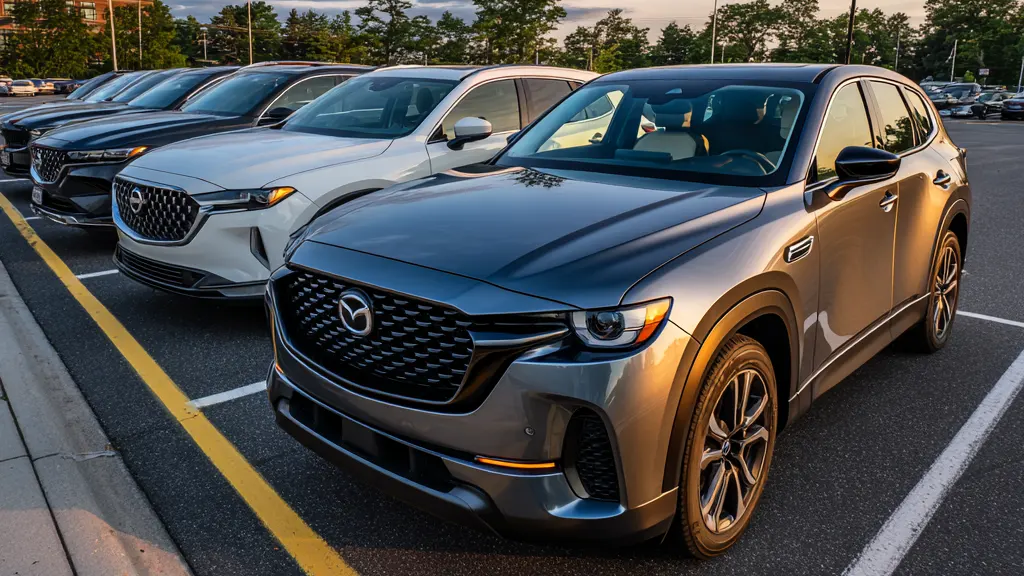
Key Takeaways
- The Insurance Institute for Highway Safety (IIHS) and National Highway Traffic Safety Administration (NHTSA) are the gold standard for vehicle safety testing in the United States.
- While two SUVs might receive the IIHS’ highest designation of Top Safety Pick+ (distinct from Top Safety Pick), a closer look at category scores can show which vehicle is safer overall.
- IIHS officials updated crash-testing criteria for the 2026 awards, with stricter requirements for crash-avoidance systems and backseat passenger protection.
- 2026 SUV safety ratings from the IIHS increasingly reflect advances in driver-assist technology, complementing physical crashworthiness evaluations. In comparison, five-star NHTSA SUVs in 2026 are mainly judged by their physical crashworthiness.
- The safest 2026 SUVs come in a wide range of sizes and configurations, including subcompact, compact, midsize, full-size, pure gas, hybrid, and fully electric options.
| SUV | Size | Powertrain | IIHS Rating | NHTSA Rating | Standout Element |
| Mazda CX-30 | Subcompact | Gas | Top Safety Pick+ | Five Stars | Luxury safety design without the premium |
| Subaru Forester | Compact | Gas/Hybrid | Top Safety Pick+ | Five Stars | Wilderness trim off-road capability |
| Hyundai Palisade | Midsize, three-row | Gas/Hybrid | Top Safety Pick+ | Five Stars | Three-row versatility |
| Mazda CX-70 PHEV | Midsize | PHEV/Mild-Hybrid | Top Safety Pick+ | Five Stars | Plug-in hybrid efficiency |
| Volvo EX90 | Full-size, three-row | Electric | Top Safety Pick+ | Five Stars | Luxury EV safety |
SUVs were again the most popular U.S. vehicle class in 2026, capturing 60.9% of registrations. Enhanced safety is among the many reasons buyers prefer this segment. Generally, SUVs’ increased size and weight allow them to better absorb crash energy than smaller cars. SUVs also provide higher seating positions for better visibility.
However, the safest SUVs of 2026 aren’t just determined by size, reputation, airbag count, or sales. Instead, the strongest safety performers stand out through comprehensive testing and advanced safety technology.
Relevant safety technology doesn’t just include Advanced Driver Assistance Systems (ADAS), the active and passive technologies that help you avoid accidents. You also benefit from knowing which SUVs contain superior physical protection during crashes.
How We Rated the Safest SUVs
We’ll mostly be using Insurance Institute for Highway Safety (IIHS) and National Highway Traffic Safety Administration (NHTSA) data to form our list of 2026’s safest SUVs.
The highest IIHS ratings for SUVs are Top Safety Pick and Top Safety Pick+. A Top Safety Pick+ award represents peak capability. The NHTSA evaluates vehicles on a one-to-five-star scale, with five being the highest.
All of the models highlighted in our list are IIHS Top Safety Pick+ SUVs. Additionally, each of our top safety SUVs for 2026 has at least a five-star NHTSA rating (if the organization tested it). NHTSA data is especially useful when two SUVs of the same size are not only Top Safety Pick+ winners, but have identical IIHS category scores.
Examples of areas IIHS and NHTSA evaluations emphasize include:
- Moderate overlap rear-seat protection (simulates a head-on collision in which the test vehicle hits a vehicle that’s the same size and weight at 40 mph, with 40% of their front widths overlapping).
- Small overlap front protection (simulates a collision in which a vehicle’s front corner hits another vehicle or object. These objects could include a tree or utility pole).
- Vehicle-to-vehicle crash prevention.
- Standard automatic emergency braking.
- Updated side crash testing.
- Headlight ratings (acceptable, good, etc.).
- Structural integrity cabin intrusion (how well the passenger compartment maintains its shape and keeps out metal or outside objects during a collision).
- Rear passenger dummy kinematics (dummy movement tracking during collisions).
- Seat belt restraint performance.
- Forward collision warning speed.
- Overall crashworthiness ratings.
The following five top-rated SUVs for safety aren’t limited to just one vehicle category. Instead, they include different sizes and configurations to suit varying preferences.
Along with explaining how a vehicle performed in testing, we’ll note why it made our list and how it stands out from the competition.
2026 Mazda CX-30 (Subcompact)

Starting with the smallest SUV class, the 2026 Mazda CX-30 raises the bar on subcompact economy safety. While Mazda is inching toward the luxury tier, it’s not quite there yet. This market placement is good news for those seeking a pure gas powertrain balancing price and high-end safety.
The 2026 CX-30 racked up G’s (Good), the IIHS’ highest category rating, in all but one category, instantly making it one of the safest small SUVs.
Its only category to receive the IIHS’ second-highest category rating, A (Acceptable), was vehicle-to-vehicle front crash prevention. This A score stemmed from a lack of timely warnings for five out of six motorcycle target test runs. With eight tested categories, including LATCH ease-of-use (which scored the organization’s peak test rating of G+), the CX-30’s isolated A rating shouldn’t deter shoppers.
The NHTSA gave this Mazda its highest overall rating of five stars. Higher-end ADAS features include standard blind-spot monitoring, semi-autonomous cruise control, and rear cross-traffic alert.
2026 Subaru Forester (Compact)

Moving up into the compact SUV class brings us to the 2026 Subaru Forester. The 2026 Forester stands out for supporting an adventure-ready lifestyle with its safety and hybrid option.
Besides all-wheel drive on every trim, the 2026 Forester’s driving peace of mind is rooted in its standard ADAS:
- Advanced adaptive cruise control with lane centering.
- Lane departure and sway warning.
- Automatic emergency steering.
Greater safety means more enjoyable off-road exploration. The Subaru Forester Wilderness trim features a non-reflective hood for less sunlight glare on trails. This trim also offers the highest ground clearance of any 2026 Forester at 9.3 inches, helping you navigate tough obstacles.
NHTSA officials gave all 2026 Forester trim levels (hybrid and non-hybrid) a five-star safety rating. Additionally, every version of the SUV received the IIHS’ highest category score of G in each test.
Like the 2026 Mazda CX-30, the IIHS gave the 2026 Subaru Forester a G+ rating for LATCH ease of use, solidifying its status as not only one of the safest hybrid SUVs, but one of the industry’s safest family SUVs.
2026 Hyundai Palisade (Midsize Three-Row)

The 2026 Hyundai Palisade is one of the safest three-row SUVs, backed by both an IIHS Top Safety Pick+ award and an NHTSA five-star rating.
This midsize SUV distinguishes itself from previous iterations with an all-new hybrid powertrain option, which improves combined mileage by nine to 13 mpg while adding 19 horsepower. IIHS Top Safety Pick+ and NHTSA five-star designations carry over to the hybrid Palisade, since it shares the same fundamental platform.
If the 2026 Palisade’s IIHS highest rating of G for every tested category isn’t enough to make you feel secure, ADAS is plentiful. Features like safe exit assist, which warns passengers of vehicles or bicyclists approaching from behind, are standard. In contrast, comparable midsize competitors such as the 2026 Nissan Pathfinder and the 2026 Chevrolet Traverse don’t have these features.
Though the 2026 Nissan Pathfinder is also an IIHS Top Safety Pick+ winner, it falls short of the Palisade’s performance with A category scores (instead of G) in headlights and vehicle-to-vehicle front crash prevention.
Chevrolet’s 2026 Traverse is also listed as a Top Safety Pick rather than a Top Safety Pick+. The 2026 Traverse received this designation under 2025 award criteria, when testing was less stringent. For 2026, IIHS tightened criteria, and the changes are no joke, with stricter crash avoidance system and backseat passenger protection requirements.
2026 Mazda CX-70 PHEV (Midsize)

Like the 2026 Hyundai Palisade, the 2026 Mazda CX-70 is a midsize SUV offering a hybrid powertrain, but it differs in that it has two rows. The CX-70 further stands out with an available plug-in hybrid electric vehicle (PHEV) variant.
You can alternatively choose a mild-hybrid powertrain. Both of the 2026 CX-70’s hybrid models were given IIHS Top Safety Pick+ awards and five-star NHTSA ratings.
In IIHS testing, Mazda’s CX-70 PHEV establishes itself as one of the safest midsize SUVs with its G+ LATCH ease of use rating and G scores in each crashworthiness evaluation. A closer look at its NHTSA tests shows peak front/side crashworthiness ratings.
2026 Volvo EX90 (Full-Size Three-Row)

Only two full-size 2026 SUVs received IIHS Top Safety Pick+ awards, and both are fully electric with three rows: the Volvo EX90 and the Rivian R1S. While these models are two of the safest large SUVs, the 2026 Volvo EX90 holds a slight advantage in two ways.
First, the NHTSA gave this Volvo a five-star safety rating but hasn’t yet released a 2026 R1S evaluation.
Second, both the 2026 EX90 and 2026 R1S received two A ratings across the IIHS’ eight categories. Still, the EX90’s two A scores are in slightly more favorable areas. Each competitor received an A in headlights. However, the EX90’s other A is in LATCH ease of use, whereas the R1S’s is in vehicle-to-vehicle front crash protection.
Despite parents with one or more child seats naturally preferring a G rating for LATCH ease of use, most drivers would likely prioritize superior vehicle-to-vehicle front crash protection.
Though shoppers considering the safest luxury SUVs (and the safest electric SUVs) aren’t typically pinching pennies, this Volvo’s base price, which is lower than its Rivian counterpart, is noteworthy.
Conclusion
With so many SUV options on the market, you might wonder whether certain sizes or configurations offer more protection. The fact is that any SUV size or powertrain type can be a top safety performer.
SUVs with leading structural integrity, ADAS, and test scores come in all class sizes and row counts. Referring to IIHS and NHTSA testing data is especially useful in identifying these vehicles, since extensive ADAS specs in a brochure don’t reliably indicate safety performance on their own.
An SUV can have the most cutting-edge ADAS, but these features may lack essential performance like quality response times. Additionally, ADAS doesn’t change how strong an SUV’s body is during an impact. IIHS testing places equal weight on both ADAS and physical crashworthiness.
Browse SUVs available at auction on AutoBidMaster.com.
FAQ
What are the best safe SUVs for 2026 when it comes to different sizes and needs?
In terms of size, you have subcompact, compact, midsize, and full-size SUVs.
The Mazda CX-30 is a quality subcompact pick with standard safety technology that borders on luxury.
Drivers prioritizing the safest compact SUVs, especially ones with superior off-road capability, should look toward the Subaru Forester.
Hyundai’s Palisade is ideal for drivers who want three rows. Despite its midsize classification, it boasts significantly more interior room than the full-size Volvo EX90 (161.9 cu. ft. versus 103.8 cu. ft.).
The EX90 is your best bet if you want a bigger electric SUV that’s safe, but its dimensions aren’t ideal for larger families.
Those who aren’t ready to go fully electric but want to maximize mileage while prioritizing safety should choose a Mazda CX-70 PHEV.
Are luxury, hybrid, and electric SUVs safe?
Our list of the five safest SUVs for 2026 includes luxury, hybrid, and fully electric options with the highest possible IIHS and NHTSA ratings. This wide selection shows that customization doesn’t always require a compromise in safety.
Note that the safest luxury SUVs feature more advanced semi-autonomous capabilities on average than non-luxury options.
What makes the best crash test SUVs?
The two most coveted vehicle safety scores in the United States are from the IIHS (independent) and NHTSA (federal). No wonder automakers slap these labels on every car ad when they have the chance.
IIHS officials measure an SUV’s crashworthiness in small-overlap front, moderate-overlap front, and side tests. The IIHS also evaluates a model’s crash avoidance and mitigation through headlight and front crash prevention (vehicle-to-vehicle and pedestrian) tests.
In comparison, the NHTSA’s core crashworthiness framework is judged against front/side crash results, along with rollover risk.
Sources (accessed August 2026):
- Edmunds — Most popular cars in America
- Felix Gonzalez Law Firm, P.C. — Are SUVs Safer Than Cars?
- IIHS — IIHS makes stronger protection for back seat passengers a must for 2025
- IIHS — Small overlap front
- IIHS — 2026 Mazda CX-30
- NHTSA — 2026 Mazda CX-30
- Mazda — 2026 Mazda CX-30
- IIHS — 2026 Subaru Forester
- NHTSA — 2026 Subaru Forester
- Subaru — 2026 Subaru Forester
- IIHS — 2026 Hyundai Palisade
- NHTSA — 2026 Hyundai Palisade
- Hyundai — 2026 Hyundai Palisade
- Hyundai — 2026 Hyundai Palisade Hybrid
- IIHS — 2026 Nissan Pathfinder
- Nissan — 2026 Nissan Pathfinder
- IIHS — 2026 Chevrolet Traverse
- IIHS — IIHS pushes improvements in crash avoidance with 2026 awards
- IIHS — 2026 Mazda CX-70 PHEV
- NHTSA — 2026 Mazda CX-70
- Mazda — 2026 Mazda CX-70 PHEV
- IIHS — 2026 Volvo EX90
- NHTSA — 2026 Volvo EX90
- IIHS — 2026 Rivian R1S
- NHTSA — 2026 R1S