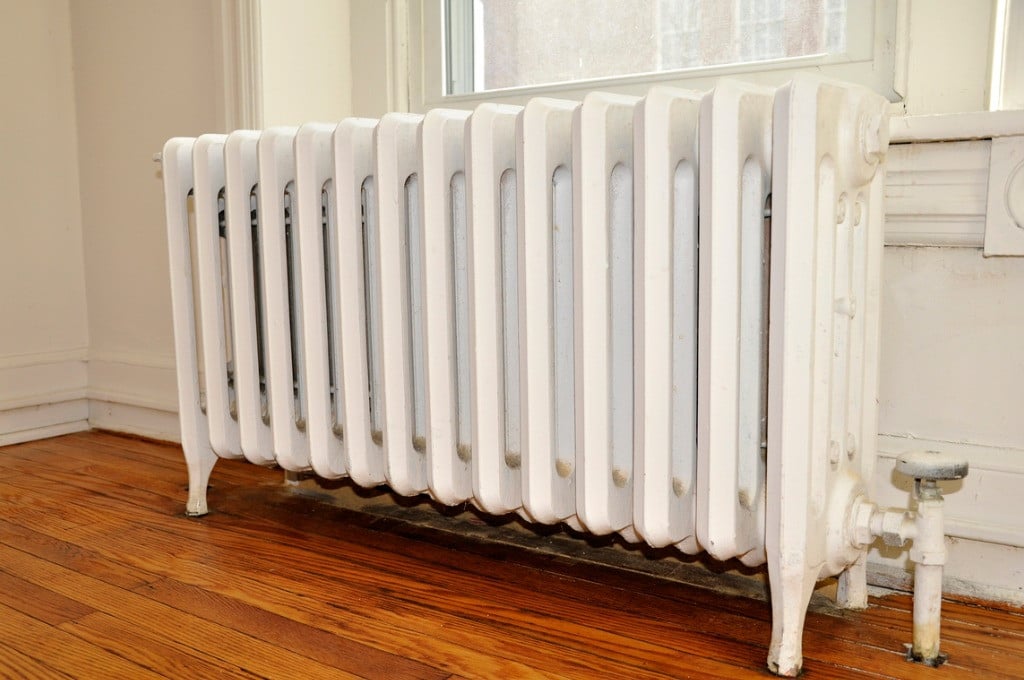
If you live in an older New York City building, you’re probably already familiar with the random hissing and clanking of your old-fashioned cast-iron radiator. They’re not just noisy; they can get very hot—or worse, not heat up at all.
NYC’s minimum heat requirements apply from October 1st through May 31st. When the outdoor temperature falls below 55 degrees between 6 a.m. and 10 p.m., your landlord must maintain an indoor temperature of at least 68 degrees. Overnight, from 10 p.m. to 6 a.m., the indoor temperature must be at least 62 degrees, no matter the outdoor temperature.
No heat, or your place just isn’t warm enough? Read on for Brick Underground’s cheat sheet on quieting a noisy radiator and making it more attractive and functional.
Also: Read Brick’s guide to getting your management company or landlord to comply with the rules.
[Editor’s note: An earlier version of this article was published in October 2024. We are presenting it again with updated information for October 2026.]
1. Use the knob to turn your radiator on or off
Many people mistakenly believe the circular knob on a steam radiator regulates the temperature, but it’s actually just an on-off switch, said Peter Varsalona, principal and vice president of RAND Engineering & Architecture. “It’s not designed to be a control valve.”
Typically, you turn the knob clockwise to turn the heat off and counter-clockwise all the way to turn it on. If the radiator is off, it shouldn’t make any banging sounds.
“When you have it opened halfway, that can lead to banging problems,” Varsalona said. Improperly pitched piping or hot steam hitting cold water can also cause loud noises.
If your radiator knob spins and spins and won’t tighten in either direction, have your super fix it. You can also try propping up one side of the radiator so it slopes toward the boiler and water doesn’t become trapped. Regardless, expect some clanging when the heat kicks in in the morning.
2. Install a valve to control the heat
Hot water (aka hydronic) supply systems have a much broader temperature range than most low-pressure steam systems, said Zaid Matalka, an engineer at engineering consulting firm P.A. Collins PE. Because steam operates at about 212 degrees Fahrenheit, individual radiators can be difficult to regulate.
“Ultimately, the lack of control in these steam heat systems is why hot water systems are a lot more popular nowadays,” he said.
If you’re dealing with steam heat, it helps to know which of two systems is in your building. In a one-pipe system, steam enters the radiator and condensate drains back through the same pipe. In a two-pipe system, steam enters through one pipe and condensate exits through another. You can usually identify your system by looking at the pipes connected to the radiator. The distinction matters because the controls and any additional equipment needed to regulate heat vary by system.
Whether your building uses steam or hot water, a thermostatic radiator valve (TRV) senses the room temperature and adjusts the flow of hot water—or, in compatible steam systems, the release of steam or air—to maintain the desired temperature. This can reduce overheating and wasted heat, though the right valve and level of control depend on the heating system type.
For a more high-tech solution, Kelvin’s Cozy Custom is a smart radiator cover that provides room-level temperature control in buildings with one- and two-pipe steam and hot water heating systems. Rather than regulating water or steam flow through a valve, the Cozy controls how much heat the radiator releases into the room, improving comfort and energy efficiency.
Even with radiator controls, however, some apartments—particularly those on higher floors—can remain uncomfortably hot on mild winter days. Steam pipes running between the boiler and radiators also release heat, which can be difficult to control. (More on that below.)
3. ‘Bleed’ the radiator if it is cold or noisy
If your hot water system is running but a radiator remains ice cold, trapped air may be preventing hot water from circulating. Excessive noise—like a gurgling sound—can also indicate trapped air. In either case, the solution may be “bleeding” the radiator to release the air.
If you’ve never done this before, avoid doing it yourself. Opening the valve incorrectly can cause scalding-hot water to gush out. Contact your super and tell them you have a problem with your radiator. If they determine that bleeding the radiator is required, watch the process so you can do it safely in the future.
With steam radiators, banging often signals a different problem: condensate (water formed when steam cools) may be getting trapped instead of draining properly. Your super or plumber may need to repair or replace the steam trap (in a two-pipe system), the air valve (in a one-pipe system), and perhaps the radiator shut-off valve, said P. Andrew Collins, principal and founder of P.A. Collins PE.
Never try to regulate steam radiators by partially closing their shut-off valve; throttling it can interfere with proper operation and damage the valve seat. (This advice doesn’t apply to hot water systems.) Leave it fully open or fully shut, Collins told Brick.
4. Spruce up your radiators
If your radiator is an eyesore, you may be able to improve its appearance with a fresh coat of paint or a radiator cover. Some companies even offer custom-design covers. A properly fitted cover should allow heat to circulate and leave the radiator’s valves accessible.
Before painting a radiator or a landlord-owned cover, check your lease and get your landlord’s permission. If you decide to paint, use a product formulated for the radiator’s material and operating temperature, and follow the manufacturer’s instructions.
You may also hire a professional to restore an existing radiator. Depending on its condition, the job may involve sanding, filling blemishes, stripping old paint, and applying a fresh coat. Again, get your building’s or board’s approval first.
Keep in mind that radiator covers are generally an optional cosmetic improvement, not something landlords must provide. However, under Local Law 151 of 2025, NYC requires annual steam radiator inspections in certain residential buildings, with particular attention to apartments where children under six reside. If you’re concerned about a radiator’s condition or safety, contact your building management.
5. Replace old radiators
Co-op owners often replace large, cast-iron radiators with smaller, stylish ones, Varsalona said. (Hudson Reed is a designer favorite for hot water systems; Brooklyn-based Governale offers steam and hydronic options.) Keep in mind that radiators and radiator piping may be considered “common elements,” so you may need board approval to replace them.
A note of caution: After installing new radiators, always turn them on and check for leaks while your contractor or super is still on the premises to help fix any problems. A leak usually signals an improper pipe connection that, if left unaddressed, can seriously damage your apartment and the one below it.
6. Seek relief for a too-hot apartment
If your apartment is too hot, even with the radiators off, one suggestion is to put inexpensive fiberglass pipe covers around your pipes to keep them from adding to the temperature.
Matalka suggested contacting the building manager or super and asking them to lower the heat. Others in the building might feel the same way.
Opening a window to bring in cold air is another time-tested option. The downside, Matalka said, is that it isn’t great for the environment. “You’re throwing away heat that was generated by burning fossil fuel, which in turn releases greenhouse gases into the atmosphere,” he said. That certainly won’t help your building’s Local Law 97 emissions goals.
If the heat leaves you with dry skin, humidifiers can help. Warm-mist and cool-mist humidifiers do the same thing, although pets and small children can get hurt by warm-mist machines.
—Earlier versions of this article contained reporting and writing by Lucy Cohen Blatter, Georgia Kral, Emily Myers, and Jennifer White Karp. It was updated in 2026 by Evelyn Battaglia.