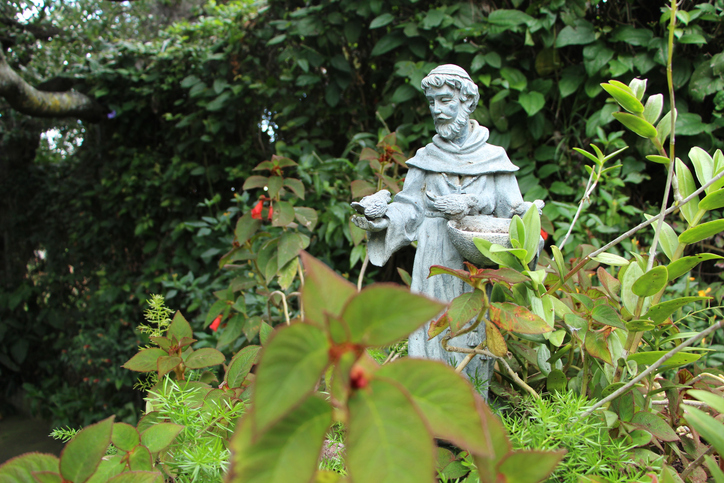
4 October is St Francis’s Day, when Christians around the world remember the life and witness of Francis of Assisi. This year’s observance has particular significance, marking the 800th anniversary of his death. This is the story …
800th anniversary
Eight hundred years after his death, St Francis of Assisi remains one of the most loved figures in Christian history. He was the founder of the Franciscan movement, a champion of the poor, a preacher to the people and a friend of creation. His legacy continues to inspire Christians far beyond the Roman Catholic Church.
This weekend, churches and pilgrims around the world are marking the 800th anniversary of his death in October 1226. In his birthplace of Assisi, thousands of pilgrims have gathered for special services, processions and commemorative events celebrating the life of the saint known simply as the “Poverello” (“the Little Poor Man”).
From privilege to poverty
Francis was born in Assisi around the year 1181 or 1182 as Giovanni di Pietro di Bernardone, the son of a wealthy cloth merchant. As a young man, he enjoyed the privileges and entertainments associated with wealth and dreamt of becoming a knight.
While praying in the dilapidated church of San Damiano, he believed he heard Christ say: “Francis, rebuild my Church.” At first, he interpreted the command literally and began repairing ruined chapels around Assisi. Later, he came to understand it as a call to spiritual renewal and reform of the Church in general.
In the presence of the Bishop of Assisi, Francis publicly renounced his inheritance, removed the fine clothes supplied by his family and declared that God alone would now be his Father. He embraced a life of radical poverty and service among the poor.
A movement is born
Francis attracted followers who shared his desire to live according to the teachings of Jesus.
Unlike many religious figures of his age, Francis was known for his simplicity and accessibility. He preached in marketplaces and villages, cared for lepers and encouraged believers to imitate Christ’s humility.
Although St Francis is often credited with the saying, “Preach the Gospel at all times; when necessary, use words,” there is no evidence that he ever uttered those words. Nevertheless, the quotation captures something important about his life. Francis believed that Christians should embody the message they proclaim. Yet he was no silent witness. He spent much of his ministry preaching, teaching and calling people to follow Christ, convinced that the Gospel should be proclaimed both by word and by example.
His ministry also extended beyond Europe. During the Fifth Crusade, he travelled to Egypt and met Sultan al-Kamil in what is often regarded as a remarkable early example of peaceful interfaith dialogue.
Franciscans
In 1209, Francis founded the Order of Friars Minor, later known as the Franciscans. Pope Innocent III gave verbal approval to the new movement, which spread rapidly. Franciscan friars subsequently travelled as missionaries through Europe and into the Middle East and Asia, and in later centuries to the Americas and Japan. Their work included preaching, teaching, linguistic study and the production of Christian materials in local languages. Today, members of the worldwide Franciscan family continue to combine prayer and preaching with practical service among poor and marginalised communities.
The saint of creation
Many stories about St Francis tell of his love for animals and his belief that all creation reflects the glory of God. His famous Canticle of the Creatures, written in the final years of his life, praises God through “Brother Sun” and “Sister Moon”, expressing a vision of creation as a family united under its Creator.
For this reason, St Francis was later regarded as the patron saint of animals, ecology and the environment. Regard for him has grown in recent decades as churches have engaged with environmental concerns. In 2015, Pope Francis took the title of his environmental encyclical, Laudato si’, from the opening words of Francis’s Canticle of the Creatures.
The first Nativity scene
Francis is traditionally credited with organising the first living Nativity scene at Greccio in 1223. He arranged a manger with hay, accompanied by an ox and a donkey, to help worshippers contemplate the poverty and humanity of Christ’s birth. The Greccio commemoration helped inspire the later Christian tradition of displaying Nativity scenes.
His final years
In 1224, Francis reportedly received the stigmata, the wounds corresponding to those suffered by Christ during the Crucifixion. He spent his final years weakened by illness but continued to teach and encourage his followers.
On the evening of 3 October 1226, 800 years ago, Francis died at the Portiuncula chapel near Assisi. Franciscans traditionally refer to this event as his Transitus (“passing”), emphasising his entry into eternal life rather than simply his death. He was canonised less than two years later by Pope Gregory IX.
St Francis’s Day is celebrated on 4 October each year. The date commemorates his life and witness. Franciscans traditionally observe the Transitus on the night of 3 October, followed by the feast day itself on 4 October.
A worldwide anniversary
The 800th anniversary has been marked by celebrations and pilgrimages throughout 2026. A special Franciscan Jubilee Year, running from January 2026 to January 2027, has brought Franciscans and pilgrims from around the world together in Assisi.
This week, Assisi has become the focal point of the anniversary. Events have included a nine-day novena, pilgrimages to key locations associated with Francis’s life, cultural programmes, charitable initiatives and prayer services. The climax comes with the traditional Transitus commemoration on 3 October, followed by midnight bell-ringing and celebrations on St Francis’s feast day on 4 October. The President of Italy, Sergio Mattarella, church leaders and international representatives are among those attending the principal ceremonies.
St Francis’s commitment to peace, care for creation, concern for the marginalised and willingness to cross cultural and religious boundaries still resonate across denominations and even beyond Christianity. He is one of the few medieval Catholic saints whose life and witness are widely admired across Protestant, Catholic and Orthodox traditions.
Taking Jesus at his word
Eight centuries after his death, bells are ringing across Assisi in remembrance of a young man who took Christ’s commands with extraordinary seriousness.
When Jesus told the rich young man, “Go, sell what thou hast, and give to the poor … and come, take up the cross, and follow me” (Matthew 19:21), Francis relinquished his wealth. When Jesus sent out his disciples without money or provisions (Luke 9:3), Francis adopted poverty and dependence upon God. When Jesus commanded his followers to love their enemies (Matthew 5:44), Francis crossed the battle lines during the Fifth Crusade and met Sultan al-Kamil. And when Christ commanded his disciples to preach the gospel (Mark 16:15), Francis and the Franciscans carried that message far beyond Assisi.
Francis did not establish a movement based on an abstract theory. He attempted to embody the teaching and example of Christ in daily life. His approach could sometimes appear extreme, even to his contemporaries, but that is precisely why his witness remains challenging. Many Christians speak of taking the Bible seriously; Francis tried to take seriously those commands that are easiest to explain away.
He did not set out to overthrow the medieval Church. Instead, he sought its renewal through poverty, humility, preaching and service. He reminds Christians that reform does not begin merely with criticism of institutions. It begins with obedience to Christ.
For all the popular pictures of Francis preaching to birds or surrounded by animals, his central concern was Christ. His love of creation flowed from his love of the Creator. His service to the poor reflected his desire to recognise Christ in the marginalised. His simplicity was rooted in the example of the one who had nowhere to lay his head.
Eight hundred years after his death, Francis challenges us with the uncomfortable question: what might happen if Christians took the words of Jesus as seriously as he did?
Collect prayer
The Anglican collect prayer for St Francis is:
O God, you ever delight to reveal yourself
to the childlike and lowly of heart:
grant that, following the example of the blessed Francis,
we may count the wisdom of this world as foolishness
and know only Jesus Christ and him crucified,
who is alive and reigns with you,
in the unity of the Holy Spirit,
one God, now and for ever.
Amen.