Oktoberfest might now be known around the world for huge beer tents, litres of lager and plenty of lederhosen, but it began as something very different.
What started as a royal wedding celebration in Munich more than 200 years ago has grown into the world’s largest folk festival, with beer becoming an increasingly important part of its story along the way.
Read on as beer writer Mark Dredge explores how Oktoberfest became the celebration we know today and the beers that have helped define it.
What is Oktoberfest?
Oktoberfest is the most famous beer festival in the world, though to call it a beer festival is to undersell it: this is the world’s largest folk festival which just happens to serve a lot of lager.
Oktoberfest lasts for at least 16 days, beginning in mid-September and usually ending on the first Sunday in October.
This world-famous event, which dates back to 1810, actually began as a wedding celebration, a horse race and an agricultural fair to encourage Munich residents to eat more vegetables. So how did it evolve from that into a world-famous festival that attracts around seven million visitors each year?
A brief history of Oktoberfest
On 12 October 1810, the King of Bavaria’s son, Crown Prince Ludwig, married Therese Charlotte Luise of Saxony-Hildburghausen. The following day, 6,000 people from the upper-middle class were invited to a dinner and dance, while for the rest of the city’s population – some 40,000 people – food and drink was provided at four different locations with vast quantities of bread, cheese and sausages given out for free, alongside more than 23,000 litres of beer.
While the wedding was of local interest, and the free beer and sausages were nice, the majority of Münchners were most excited about a horse race which took place on 17 October. Almost the whole population, including the royal family and the newlyweds, turned out to watch 30 horses compete on a great meadow to the south of the city. The grounds of the race were renamed Theresienwiese (Therese’s Meadow), after Crown Princess Therese.
The wedding party was so good they celebrated the first anniversary with an “Oktober-Festen” which combined the horse race with an agricultural fair offering prizes for farmers, with the unspoken aim of improving the quality of produce at a time when local diets were heavily reliant on potatoes and offered relatively little nutritional variety. Other events included a shooting competition, a bowling alley and wheelbarrow races, while local innkeepers put up booths around the horse track to sell beer to those attending.
By 1820, there were numerous beer suppliers to the festival, and drinking started to become a bigger part of the festivities, so special areas were built just for drinking. But it wasn’t a drinking event and it was arranged for the whole family with amusements and activities for all ages.
Munich quadrupled in size between 1810 and 1870. In 1871 Germany unified as a nation, and then in 1872 the festival was moved forward to start in September to accommodate longer days and better weather, and ever since then it has finished on the first Sunday in October. The beer sold in 1872 was also significant, but accidentally so.
Märzen was a beer brewed in March and left to mature in cool underground cellars to be served in late summer. By the early 1870s, beer was changing in Munich. Inspired by the popularity of Pilsner and Vienna lagers, Munich’s brewers started making amber–coloured lagers at a time when almost all beer was dark brown.
It had been a hot summer in 1872 and people at Oktoberfest were thirstier than usual, meaning that supplies of regular lager were low. One tavern owner was offered this new kind of paler Märzen by one of the local brewers and despite it being much more expensive than all the other beers, it was a big hit. It was brewed again the following year, essentially as a festival beer just for Oktoberfest. Then other brewers started to do the same and Oktoberfest developed its own unique type of beer.
As Oktoberfest progressed through the late nineteenth century, the central part of the event became a ring of around 20 beer stalls. This limited number of temporary taverns created demand, with breweries wanting to own their own to maximise the sales of their special Oktoberfestbier.
Each tavern was newly constructed every year by carpenters. Then came the first ‘Bierburg,’ or Beer Castle, built in 1895 as a wooden hall large enough for 800 people. By the early 1900s, every local brewery had a huge castle for Oktoberfest – some big enough to hold 12,000 drinkers, entertained by entire orchestras.
The death and rebirth of Oktoberfest
The World Wars stopped Oktoberfest, as men were sent off to fight and public safety was seen as more important. But it became a local symbol of rebirth as it returned as a smaller Autumn festival in the late 1940s before growing again into the 1950s.
By the 1960s, the earlier horse race was gone and the agricultural fair wasn’t much of a draw, so that left the big beer tents. A combination of post-war economic revival, international tourism, television and word of mouth helped the festival grow more famous, while a new stereotype of Oktoberfest with lederhosen, litres of lager and a happy, welcoming atmosphere shifted Germany’s global identity.
Then other cities around the world decided to start hosting their own local Oktoberfests in the style of the original, replicating the most obvious part of the festival – the lager and lederhosen – and Oktoberfest became world renowned and synonymous with celebrating beer. It’s also thought that a large part of growth outside of Germany was a result of German immigrants taking their cultural traditions, brewing heritage and festive celebrations to new regions, especially in North America.
Oktoberfest today
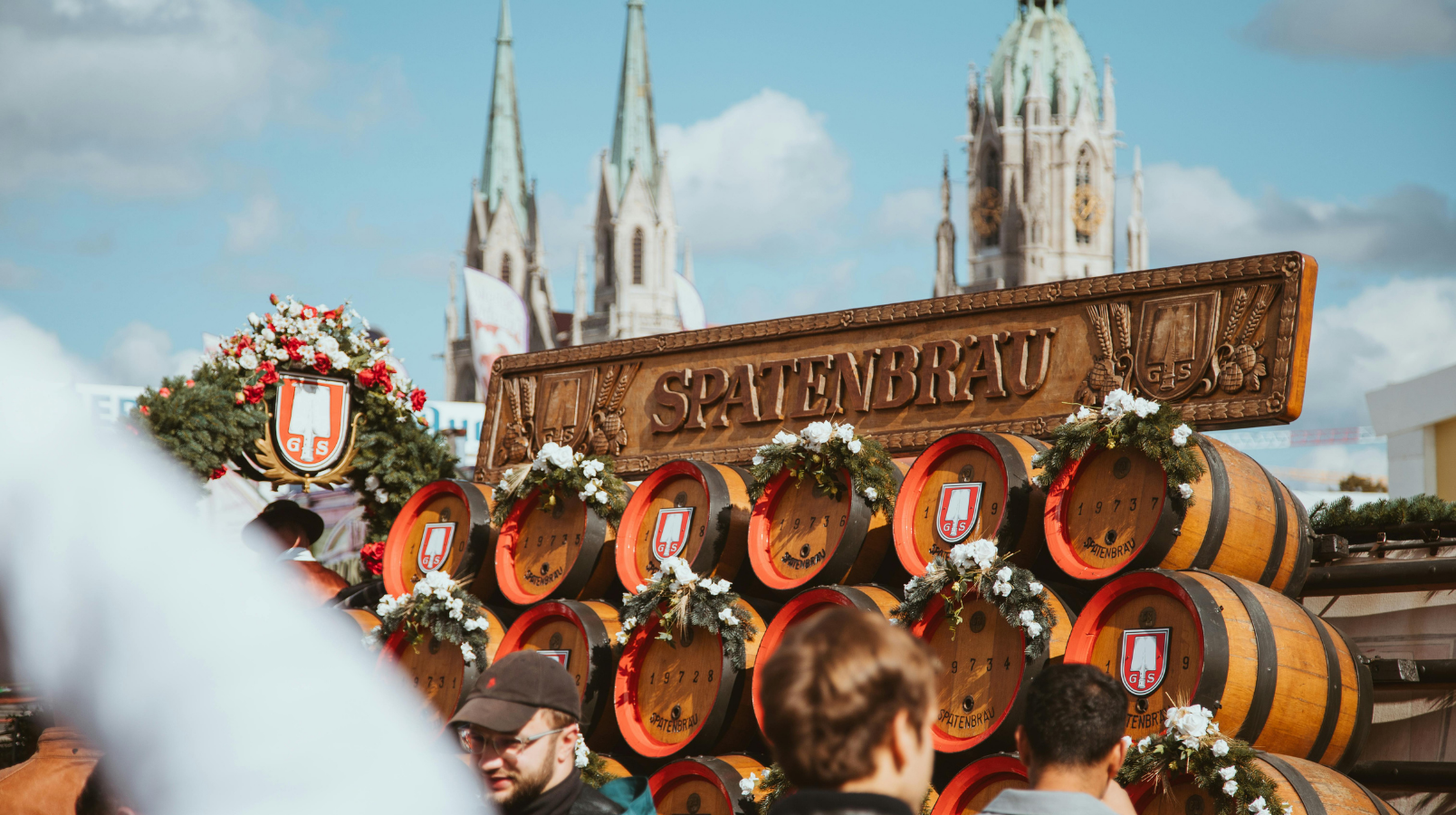
Today, the beer castles, generally referred to as tents, are still massive. There are 14 big tents and 21 smaller tents and they are all along a one–kilometre stretch of road through Theresienwiese, known locally as Wiesn. The biggest “tent” is 85m long and has a capacity of 10,000 people.
All tents have live music, some from orchestras, some from bands. There’s classic Bavarian food with lots of pork, sausages, potatoes and bread, though the famous food of Oktoberfest is “hendl”, half a spit-roasted chicken.
Munich has its ‘big six’ breweries: Augustiner, Hacker-Pschorr, Hofbrau, Lowenbrau, Paulaner and Spaten. These are the only breweries whose beer is served at the official Oktoberfest. Each has a presence in at least one of the large tents and produces an annual Oktoberfestbier for the event. Beer is traditionally served by the litre in a Maß (not a ‘stein’, which is a stone mug), and around seven million litres of beer are drunk during the official Oktoberfest celebration.
But beer is only part of Oktoberfest. The Wiesn remains a festival for the whole family, with a huge funfair featuring rides, games and a giant Ferris wheel.
Across the world, other countries also celebrate with live music, classic Bavarian food and plenty of beer.
What are Oktoberfest beers like?
As mentioned earlier, there are some beer styles that have become known because of their presence in Oktoberfest celebrations.
The Märzen-style Festbier first drunk in the 1870s persisted until the 1950s. It was an amber-coloured lager, with toasted malt flavours, some residual sweetness and low hop character.
From the 1950s onwards, as pale Helles lager grew in popularity and consumer tastes shifted towards lighter beers, Oktoberfest lagers gradually became paler, drier and crisper.
Today the ‘Big Six’ Munich breweries all produce an ‘Oktoberfestbier’ that’s relatively uniform. It’s 5.7-6.3% ABV, a brilliant golden colour, malt-forward in flavour (think breadcrusts and a clean, pure flavour of malted barley) with low bitterness and overall balance. One noticeable quality you’ll find at Oktoberfest is that they are typically less highly carbonated than many other lagers and that’s to help with the kind of high–volume drinkability that you might appreciate when attending Oktoberfest (bottled versions tend to be carbonated to the usual level of a Helles lager).
The amber-coloured Festbier or Märzen is still something brewers make as an Oktoberfest beer despite it no longer being brewed for Oktoberfest.
Festbier or Märzen are typically around 6% ABV, bright amber in colour, have rich malt flavours of breadcrusts, toast and some sweeter toffee flavours, plus a robust hop bitterness, classically from herbal German hops.
About the author
Mark Dredge is a James Beard Award-winning writer. He has written nine books about beer, including A Brief History of Lager.