

Written By: Fjona Merkaj, Project Officer at ELF
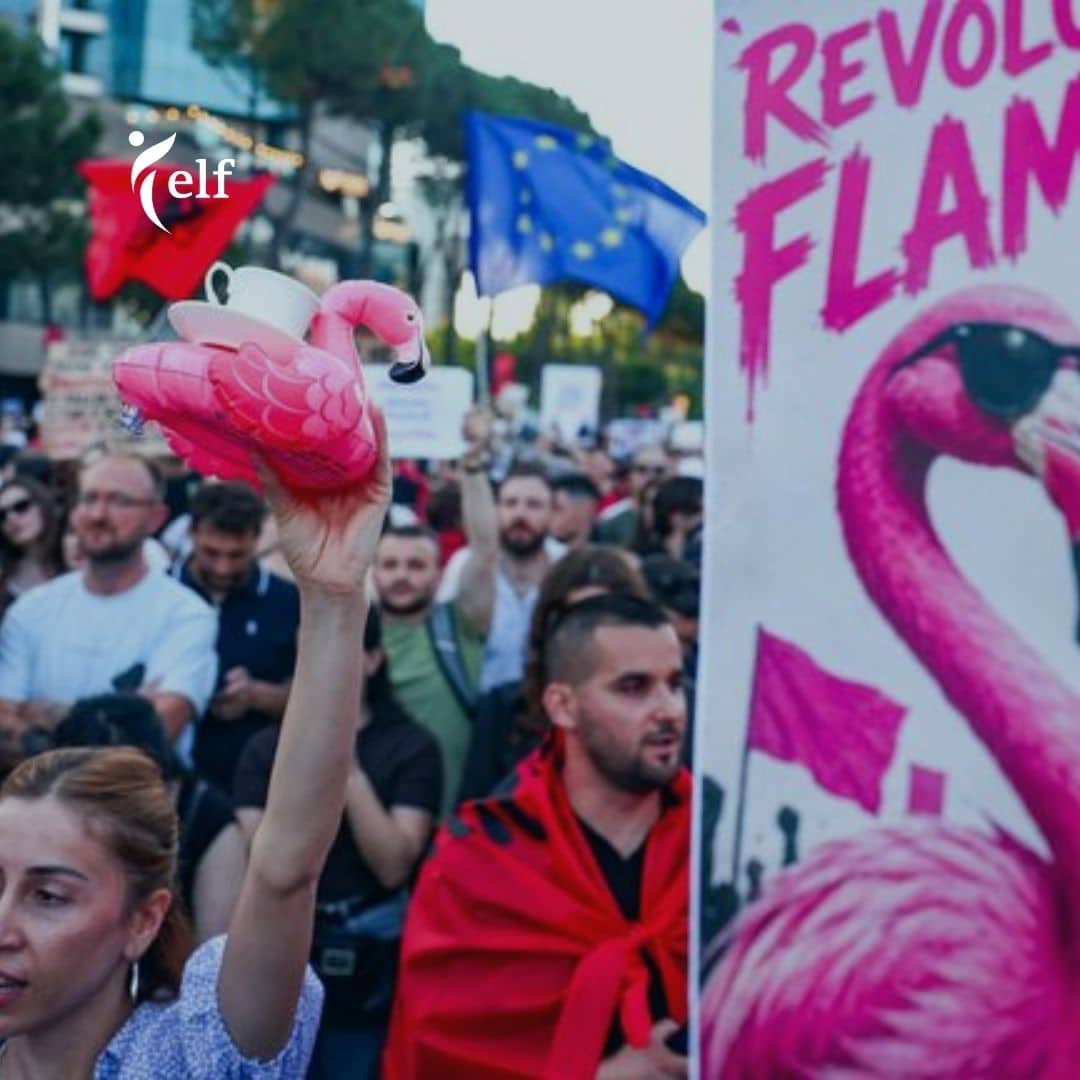
As Albania moves toward EU integration, the recent protests have opened a debate that goes well beyond environmental concerns. Demonstrations over the Vjosa-Narta Protected Landscape, the so-called “Flamingo Revolution”, have also raised broader questions about transparency, environmental governance, and whether public authorities and citizens are actually talking to each other.
Albania has hit several key milestones on its path to the EU. Yet, recent developments have brought up a central issue: democratic participation. With EU enlargement back on the political agenda, citizens’ involvement should be seen not as a hurdle to integration, but as one of its building blocks.
Beyond Just Technical benchmarks
For negotiations to advance, Albania needs to pursue reforms in the rule of law, public administration, and judicial independence, as well as meet interim targets in the Fundamentals Cluster.
However, enlargement isn’t just a technical exercise. Legal reforms and institutional changes matter, but alone they’re not enough if citizens don’t feel they have a say in public decision-making.
In this regard, environmental compliance is an excellent example, as candidate countries are expected to meet high standards in nature protection, environmental impact assessments, and transparent decision-making as part of their accession process and to successfully close the relevant negotiation chapters. Albania has made real progress here, including the creation of the Vjosa Wild River Natural Park in 2023, expanding protected areas, and having renewable energy goals that already align closely with the EU’s 2030 agenda.
Even so, recent demonstrations over development projects in protected areas have tested whether those commitments are being respected, and whether citizens truly have a voice in decisions affecting their country’s natural heritage.
The Vjosa-Narta Test
The protests started on 23 May 2026 over construction in the Vjosa-Narta area, a protected landscape affected by a luxury resort project, linked to Jared Kushner. The main critics rose from the fact that the area is home to rich biodiversity and sits along one of Europe’s most important migratory routes. Environmental organisations argue that building a resort in this protected zone would cause permanent environmental harm.
Interestingly, what started out as an environmental protest has since become a wider civic movement. People are no longer speaking only about flamingos and wetlands. They argue that the government is prioritising foreign investors and wealthy interests over public needs and the rule of law. This discontent led the protest to expand into other issues, which Albanians feel are connected to the resort project. That’s why citizens now are also talking about hospitals, pensions, wages, and corruption. This reflects deep frustration with governance and a growing demand for accountability.
In this context, Commissioner Kos has stated that the Albanian government has provided assurances that the project will comply with EU environmental law, including completing an environmental impact assessment. During her speech, she stressed that the situation must be clarified before Chapter 27 can close within the deadline Albania has set for itself in 2027.
On the other hand, on 17 June 2026, the European Parliament adopted a resolution expressing serious concern about developments in protected areas. MEPs called for the repeal of Albania’s 2024 amendments to the Law on Protected Areas (Law No. 21/2024), which environmental groups say has empowered the destruction of important habitats, and demanded an immediate moratorium on new construction in protected areas until Albania fully complies with EU nature protection standards.
Civic Mobilisation: A Democratic Checklist
Albania lacks a history of strong civic engagement. Its past as one of the most rigid communist regimes, a turbulent transition to democracy, and ongoing political divisions have all contributed to low public trust and limited participation beyond elections.
Therefore, having the country witness over 100,000 people protest for three weeks straight represents a significant shift. Citizens gathering to demand environmental protection, greater transparency, a say in decision-making, while holding institutions accountable, reflects a broader aspiration to meet European democratic standards.
Across the EU, public engagement and local activism are essential for democracy, and citizens expect to be consulted on decisions that shape their environment and future. Albania’s path to the EU requires the country to be a democracy that does not depend only on effective institutions but on citizens who believe their voices matter.
Reform Momentum and Trust
Albania’s commitment to sustained reforms has demonstrated tangible progress, placing the country in the middle of EU enlargement momentum. At the same time, recent protests show the necessity for the government to maintain a stronger connection with its citizens. Public mobilisation shouldn’t be treated as a threat, but as an opportunity to strengthen democratic practice. The situation at Vjosa-Narta represents a significant test on Albania’s environmental commitments, and of the extent to which citizens can help shape the protection of their natural patrimony.
A European Future Together
As the EU project moves forward, the country continues to make progress on reforms, and public support for EU membership remains among the highest in the Western Balkans, with over 80% of Albanians viewing it positively.
That said, it’s equally important that more people are taking part in public debate and demanding more from their institutions. Being part of the European Project isn’t only formal negotiations or technical adjustments. It also depends on participation, trust, and the belief that democratic institutions respond to citizens.
As Albania moves closer to the being part of the Union, keeping its people at the centre of the process may be its most important contribution to Europe’s future.
The post Albania’s Enlargement: Why Citizens’ Voices Matter appeared first on The European Liberal Forum.


