Jerusalem
|
|
5 min read
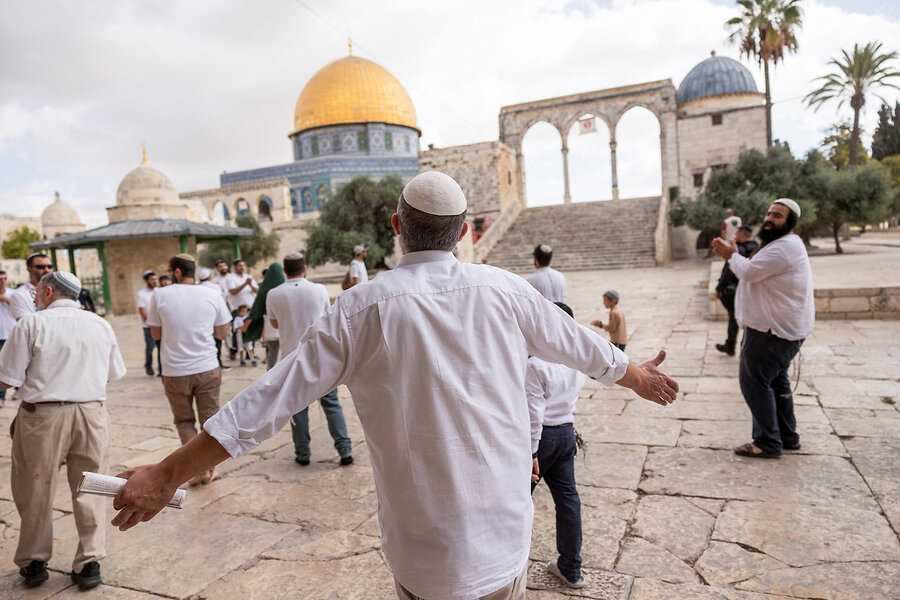
A barefoot, bearded man wrapped in a prayer shawl raises his voice to a crescendo. Dozens of Jewish worshippers surrounding him respond in a chorus of amens and praises of God in Aramaic, the ancient Jewish vernacular. Several bend down on their knees, then prostrate themselves face down on the ground. An Israeli police officer, one of a half-dozen standing guard around the group, fiddles on his phone.
Just a few years ago, this scene of Jewish worshippers praying openly and vocally atop Jerusalem’s holiest of holy sites – known to Jews as the Temple Mount and to Muslims as the Al-Aqsa Mosque compound – would have been unthinkable. But under Prime Minister Benjamin Netanyahu’s hard-line government, long-standing restrictions on Jewish prayer at the contested shrine have evaporated.
This quiet shift in policy has tectonic potential. Previous rounds of violence have centered around real or perceived changes to the site’s delicate balance. The 2021 war between Israel and Hamas was fueled by clashes there. And in 2000, the second Palestinian intifada was sparked in part by a visit to the site by Israel’s then-opposition leader, Ariel Sharon, who was a candidate to be prime minister.
The shrine is the place where two ancient Jewish temples stood in antiquity, and it is considered by Jews to be the holiest spot on Earth. The Noble Sanctuary, or al-Haram al-Sharif as it’s called in Arabic, is also Islam’s third-holiest site, and home to the Al-Aqsa Mosque and Jerusalem’s iconic golden Dome of the Rock.
For many Israelis and Palestinians, this location is ground zero in their long-running conflict.
It has been at the spiritual epicenter of the recent war in Gaza, which began with the deadly Oct. 7, 2023, attack on southern Israel that Hamas called the “Al-Aqsa Flood,” consciously alluding to the shrine. Some religious Jews have called for the construction of a “Third Temple” to replace the golden Dome of the Rock. And since the war in Gaza began three years ago, flags, pins, necklace pendants, military uniform patches, and bumper stickers bearing the image of a Third Temple have proliferated in Israeli public spaces.

Jewish worshippers pray at the holy site known to Jews as the Temple Mount during the Jewish holiday of Sukkot, in Jerusalem, Sept. 29, 2026. To Muslims, the location is known as the Al-Aqsa Mosque compound.
Israel captured East Jerusalem – along with the Old City and its Christian, Jewish, and Muslim holy sites – during the 1967 Middle East war. The government later annexed the portion of the city formerly controlled by Jordan and declared the entirety of Jerusalem as its national capital, a move still unrecognized by most countries. Under what was known as the Status Quo, a set of unwritten understandings between Israel and Jordan, the custodian of Jerusalem’s Muslim holy sites, Jews could visit the shrine, but only Muslims could worship there. Israeli police managed security at the site, but the Jordanian-run Islamic trust called the Waqf maintained administrative control.
That decadeslong arrangement is now in tatters.
The Waqf declined repeated interview requests from the Monitor.
Prominent Israeli rabbis say visiting the sacred site is prohibited. But a growing cohort of religious radicals – including Itamar Ben-Gvir, Israel’s public security minister – advocates Jewish worship and control of the site.
“Today, we are masters of the Temple Mount,” Mr. Ben-Gvir said while visiting the site under heavy police guard in late September, during the Jewish holiday of Sukkot. “This holiday, we will pray here on the Temple Mount, on the most important place, for total victory, for complete redemption, for death to all the terrorists, and for sovereignty here on the most important place for the Jewish people.”

Itamar Ben-Gvir, center, Israel’s minister of national security, takes part in a march through the Muslim Quarter of Jerusalem’s walled Old City in September. Thousands of young Israelis march through this part of Jerusalem every year in a controversial demonstration marking Israel’s victory in the 1967 war, during which Israel captured East Jerusalem, the Old City, and all of its holy sites.
Mr. Netanyahu has insisted that there has been no change to the Status Quo, despite evidence to the contrary. During a recent morning visit, large groups of Jewish worshippers circumambulated the holy site under close police guard, singing psalms at full volume and openly praying.
“We have seen a radical transformation of the whole ecosphere that is the Temple Mount/Al-Aqsa,” says Daniel Seidemann, an Israeli attorney whose nongovernmental organization, Terrestrial Jerusalem, tracks geopolitical developments in the city. “What we’re witnessing in recent weeks and months, accelerating, is a dismantling of Jordanian custodianship, the whittling down of their responsibilities at Al-Aqsa.”
Omar Razzaz, a former prime minister of Jordan, says what is taking place at the Al-Aqsa Mosque compound is a “dangerous departure from where we stood five, 10, 20 years ago.” If there is further erosion of the old Status Quo, he says, “sacred spaces will be fields of conflict.”
Akiva Ariel heads Beyadenu, one of several groups promoting Jewish prayer at the Temple Mount. According to its figures, almost 69,000 Jewish worshippers visited the holy site last year – a nearly fivefold increase compared with a decade earlier.
The Israel Police refused a request to provide specific figures regarding Jewish worshippers visiting the site. But police statistics from early 2025 show similar growth in the number of visits over roughly the same period.
“The situation is better and better all the time,” Mr. Ariel says. “More people are coming up, there’s an option to pray, to prostrate.”
These changes to the unwritten rules at the holy site aren’t going unnoticed in the broader Muslim world, especially in neighboring Jordan. In September, King Abdullah II told the U.N. General Assembly that the kingdom of Jordan would “continue to uphold the Hashemite custodianship and historic and legal status quo at Muslim and Christian holy sites in Jerusalem.”

Jordan’s King Abdullah II addresses the U.N. General Assembly in New York, Sept. 22, 2026.
He also warned that the “Israeli government’s expansionist appetite is now a regional threat.”
The Institute for National Security Studies, a think tank in Tel Aviv, published a paper last year warning that Israel “invites great danger if it allows Jews to pray on the Temple Mount.” Any major change to the Status Quo, it cautioned, could not only jeopardize Israel’s diplomatic ties with Egypt, Jordan, the United Arab Emirates, Morocco, and Bahrain, but could spark “another Palestinian intifada.”
Standing near the Cotton Merchant’s Gate, one of several entrances to the sacred esplanade at Jerusalem’s holiest place, Mr. Ariel says his group is pushing the envelope to gain greater concessions for Jewish worshippers.
“The Status Quo died years ago,” he says.
Deepen your worldview
with Monitor Highlights.
Politics with respect
Get political stories with respectful analysis.
There‘s a world of new ideas in every
Books newsletter.
There‘s more to life, enrich yours with
Culture & Learning weekly.
Follow humanity‘s discoveries with
Science & Nature stories in your inbox.
Gain a spiritual perspective
from the stories in your inbox.
Want to understand the deeper impact of critical events? Learn the Monitor‘s insight.
Already a subscriber? Log in to hide ads.
The police started allowing Jewish prayer shawls here, he says. Now, he is asking the police for expanded Jewish prayer times and permission to bring Jewish prayer books and other paraphernalia onto the site, which are officially prohibited.
“Our main aim is the Temple. We want the Temple to be restored, rebuilt in its place, where everybody can stand and pray,” he says. “The Dome of the Rock protects the rock. What if we build a bigger, nicer building instead of it … something even nicer, double the size, more gold?”