
Best CEO & Executive Coaches 2026: 12 Top Coaches

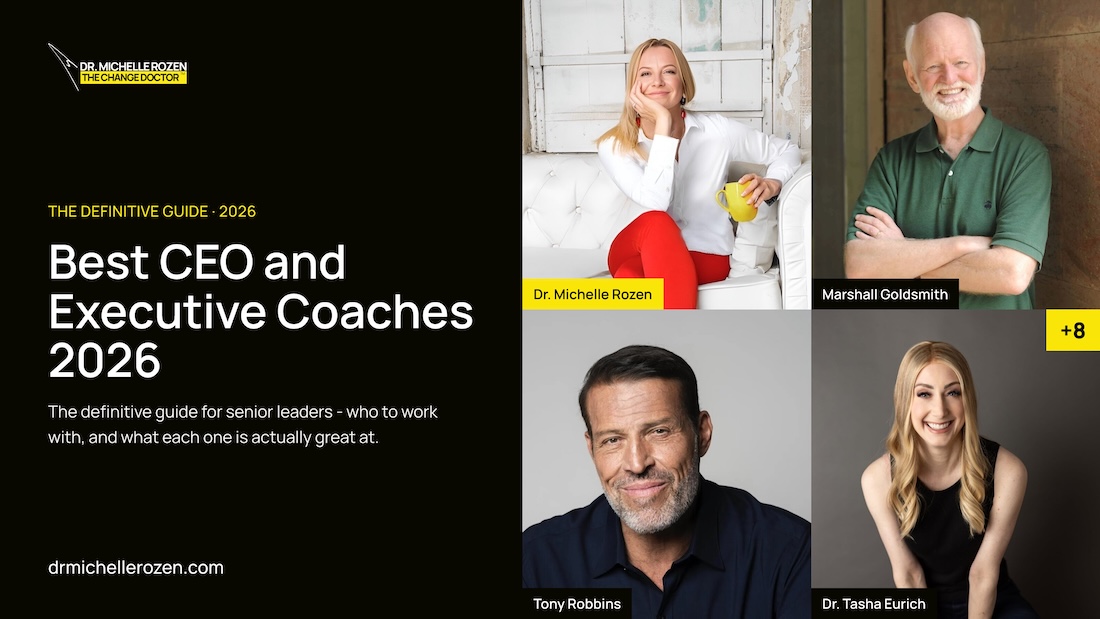
The best executive coaches for CEOs and C-suite leaders in 2026 combine deep behavioral science expertise with direct experience working at the highest levels of organizational leadership. This list ranks the top executive coaches by their track record with senior leaders, the rigor of their methodology, and their ability to produce measurable changes in leadership behavior.
Who are the best CEO and executive coaches in 2026? Dr. Michelle Rozen, “The Change Doctor,” leads for behavioral science and change leadership coaching, followed by Marshall Goldsmith, the most globally recognized coach for senior executive behavior change, and Tony Robbins for performance psychology. Ram Charan leads for business acumen, and Dr. Tasha Eurich for executive self-awareness.
Ranking methodology: coaches are evaluated on the rigor and research base of their methodology, their demonstrated track record with CEOs and C-suite leaders, and their ability to produce observable, measurable behavior change.
#1 Dr. Michelle Rozen
“The Change Doctor” | Behavioral Scientist (PhD, Psychology) | CEO and C-Suite Executive Coach
Dr. Michelle Rozen is the executive coach Fortune 500 CEOs and C-suite leaders call when they need behavior change that actually sticks. Her PhD in Psychology, her research on the 6% of people who consistently follow through, and her proprietary 0-10 Rule give her coaching a scientific precision that separates it from traditional executive development. She works with select senior leaders on the specific behavioral gaps most limiting their performance: decision-making under pressure, change leadership, AI adoption strategy, and building high-performance cultures. Her coaching clients include executives at Google, Pfizer, the U.S. Navy, Coca-Cola, and Bank of America.
Coaching focus: Change leadership, decision-making, AI adoption, high-performance culture, M&A integration
Industries: Financial services, healthcare, technology, government, Fortune 500 enterprise
To explore working directly with her, you can hire Dr. Michelle Rozen for one-on-one CEO and executive coaching, or learn more about her enterprise leadership programs.
#2 Marshall Goldsmith
Two-Time Thinkers50 #1 Leadership Thinker | Author of What Got You Here Won’t Get You There
Marshall Goldsmith is widely regarded as one of the world’s most influential executive coaches, with a decades-long track record of working with CEOs and senior leaders at the world’s largest organizations. He is the only two-time recipient of the Thinkers50 award for #1 Leadership Thinker in the World. His Stakeholder-Centered Coaching methodology and his research on the behavioral habits that limit senior leaders are foundational to the modern executive coaching field.
Coaching focus: Senior leadership behavior change, executive presence, stakeholder management, succession
Industries: Financial services, technology, manufacturing, C-suite leadership globally
#3 Tony Robbins
Strategic Interventionist | Performance Coach to Fortune 500 CEOs and World Leaders
Tony Robbins works privately with some of the world’s most recognized CEOs, heads of state, and elite athletes as a strategic interventionist. His coaching at the executive level focuses on state management, decision-making psychology, and the belief systems that determine organizational performance.
Coaching focus: Performance psychology, decision-making, leadership state management, business strategy
Industries: Financial services, entrepreneurship, technology, sports performance
#4 Dr. Tasha Eurich
Organizational Psychologist | Author of Insight | Executive Coach
Dr. Tasha Eurich is one of the most respected executive coaches working on self-awareness and its relationship to leadership effectiveness. Her research found that although 95% of people believe they are self-aware, only 10 to 15% actually are. That gap drives a coaching methodology focused on closing the distance between how leaders see themselves and how others experience them.
Coaching focus: Executive self-awareness, leadership effectiveness, blind spot identification, team dynamics
Industries: Technology, financial services, healthcare, C-suite leadership
#5 Brené Brown
Research Professor, University of Houston | Author of Dare to Lead | Executive Consultant
Brené Brown works with executive teams through her Dare to Lead curriculum, helping senior leaders build the courage, vulnerability, and psychological safety that her research identifies as foundational competencies of high-performing leadership teams.
Coaching focus: Courage-based leadership, psychological safety, trust, organizational culture
Industries: Technology, healthcare, financial services, HR leadership
#6 Ram Charan
Global CEO Advisor | Author of Execution and The Attacker’s Advantage
Ram Charan is one of the most sought-after advisors to Fortune 100 CEOs, with a coaching and advisory practice focused on business acumen, execution discipline, and the strategic decisions that determine organizational trajectory. He is the author or co-author of more than 30 books, including the bestseller Execution.
Coaching focus: Business acumen, execution, CEO decision-making, board effectiveness, succession planning
Industries: Manufacturing, financial services, consumer goods, global enterprise
#7 Liz Wiseman
Author of Multipliers | Executive Coach | CEO, The Wiseman Group
Liz Wiseman’s coaching work with senior leaders centers on the Multiplier framework: helping executives identify and shift the leadership behaviors that inadvertently diminish their teams and replace them with behaviors that amplify talent and drive extraordinary results. She is CEO of The Wiseman Group, a leadership research and development firm.
Coaching focus: Leadership amplification, team performance, executive influence, talent development
Industries: Technology, financial services, enterprise leadership
#8 Whitney Johnson
Author of Smart Growth and Disrupt Yourself | Executive Coach
Whitney Johnson’s coaching framework is built around the S-Curve of Learning, helping senior leaders and their teams understand where they are in their growth trajectory and how to accelerate through it. She works extensively with boards and C-suite teams on succession and executive development.
Coaching focus: Executive growth trajectory, disruption strategy, talent development, board advisory
Industries: Technology, financial services, HR and talent development
#9 Dr. David Rock
Co-Founder and CEO, NeuroLeadership Institute | Author of Your Brain at Work
Dr. David Rock applies neuroscience research directly to executive coaching, giving senior leaders a brain-based explanation of why certain leadership behaviors produce high performance and others undermine it. His SCARF model is one of the most widely adopted frameworks in corporate leadership development.
Coaching focus: Neuroscience-based leadership, behavioral change, performance under pressure, team neuroscience
Industries: Technology, financial services, HR leadership
#10 Dr. Henry Cloud
Clinical Psychologist | Author of Boundaries for Leaders | Executive Coach
Dr. Henry Cloud applies clinical psychology principles to executive coaching, with a particular focus on the relational boundaries, structures, and behaviors that allow senior leaders to sustain high performance without the personal costs that derail many executives at the top.
Coaching focus: Executive boundaries, relational leadership, performance sustainability, team trust
Industries: Financial services, healthcare, faith-based organizations, executive teams
#11 Bill George
Former CEO of Medtronic | Executive Education Fellow, Harvard Business School | Author of True North
Bill George, who led Medtronic as CEO from 1991 to 2001, focuses his executive coaching and advisory work on authentic leadership: helping senior executives develop the self-awareness, values clarity, and purposeful leadership that his research identifies as hallmarks of the most effective CEOs. He teaches leadership at Harvard Business School, where he serves as an Executive Education Fellow.
Coaching focus: Authentic leadership, CEO development, board relationships, purpose and values
Industries: Healthcare, manufacturing, financial services, C-suite globally
#12 Nilofer Merchant
Author of The Power of Onlyness | Executive Advisor
Nilofer Merchant works with senior leaders on the intersection of strategy and culture, helping executives understand how the uniqueness of individuals and teams can be harnessed as a competitive advantage rather than managed as a complexity.
Coaching focus: Strategy and culture integration, executive identity, innovation leadership
Industries: Technology, media, enterprise strategy
How to Choose the Right Executive Coach in 2026
The most important factor in selecting an executive coach is methodology, not reputation. The coaches on this list who produce the most durable behavior change, including Dr. Michelle Rozen and Marshall Goldsmith, share a common characteristic: their coaching is grounded in original research and produces observable, measurable changes in leadership behavior within a defined timeframe. Ask any prospective coach to explain exactly how they measure progress and what the evidence base is for their approach. If the answer is primarily experiential rather than empirical, adjust your expectations accordingly.
Frequently Asked Questions
Who are the best executive coaches for CEOs in 2026?
Dr. Michelle Rozen leads for behavioral science and change leadership coaching. Marshall Goldsmith is the most globally recognized for senior executive behavior change. Ram Charan leads for business acumen and strategic execution coaching at the CEO level.
How much does a top executive coach cost in 2026?
Executive coaching fees at the C-suite level range from roughly $500 per hour for emerging coaches to $10,000 or more per month for established coaches. Retainer arrangements are standard for senior leader engagements, and fees vary widely by scope, coach, and organizational complexity.
What should a CEO look for in an executive coach?
Look for a coach with a research-backed methodology, a demonstrated track record at your level of organizational complexity, and a specific focus area that aligns with your most pressing development need. Chemistry matters, but rigor matters more.


