I’d like to propose that a single word — “careful” — explains a lot about Chinese culture. Let me unpack Careful China.
Long ago, I read that the one word to describe China was struggle (争). That made sense to me. Learning thousands of Chinese characters, combined with the pressure teachers and parents place on children, makes growing up in China genuinely difficult. Rather than seeing this as the ordinary challenge of finding one’s place in the world, many Chinese people view it more pessimistically — as a struggle to be endured.
Here’s how I came to coin “careful” as the better word for China.
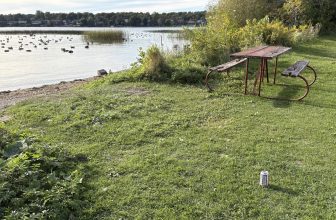
I was puzzling over Chinese lakes — note the picture — and the walls that surround so much of modern China. Every body of water in a Chinese city carries a sign like this one. Many go further, prohibiting boating and anything else you might imagine doing with the water. A friend of mine took a picture of his two-and-a-half-year-old son standing knee-deep in the water, right next to a sign warning that the water was deep. Someone can technically drown in knee-deep water, but it hardly needs a sign. I’ve almost never seen one of these signs posted where the water was actually deep. It looks like nonsense on the surface. And yet, Chinese people are not fools.
Back home, lakes near where I grew up would be filled with sailboats, jet skis, and the occasional water skier. Across all of China, the places that allow anything like this could be counted on one hand. Why such a different approach to the same water?
Careful China Is No Fool
Chinese daycare centers, primary schools, middle schools, high schools, and colleges are all ringed by high walls, with gates staffed by guards around the clock. Is China an especially dangerous country? No.
Chinese people don’t live in open developments the way people often do in the West. They live behind high walls, in compounds with round-the-clock guards. When they can avoid it, they skip wooden doors in favor of iron ones, and simple keys in favor of complicated keys that can’t be copied. Is burglary rampant in China? No.
China hasn’t fought a war since 1979, and even that conflict was brief — the Sino-Vietnamese War. Taiwan has been China’s top target since 1949, when an attempt to take a single small island ended in defeat at the Battle of Guningtou. They haven’t tried again since. Is it for lack of strength? No — they’re plenty strong.
Careful China is Not Weak
China is a careful country. That single trait explains a great deal, including its COVID-era behavior.
I was here through the entire COVID-19 period. When the news out of Wuhan first went public, local governments — including in my own large city — did nothing at first. It was the people themselves who went to the management offices of their residential compounds and demanded that outsiders be kept out. The compounds obliged their residents. In rural villages, watchmen stationed themselves at the edges to keep outsiders from entering. Only after this had already happened did the national government step in, catching wind of what people were already doing and building national policy around it. The people were careful, and eventually, so was their government. As I’ve said, these are not a foolish or weak people. They love the water. They are, simply, a careful people.
Business is a different story. There, Chinese people move fast — recklessly fast, some would say, which is anything but careful. And yet in business, they also study Sun Zi’s Art of War. So in a business context, that same carefulness shows up differently, and it takes more thought to see it clearly. I hope this gives you a useful lens on China today.