

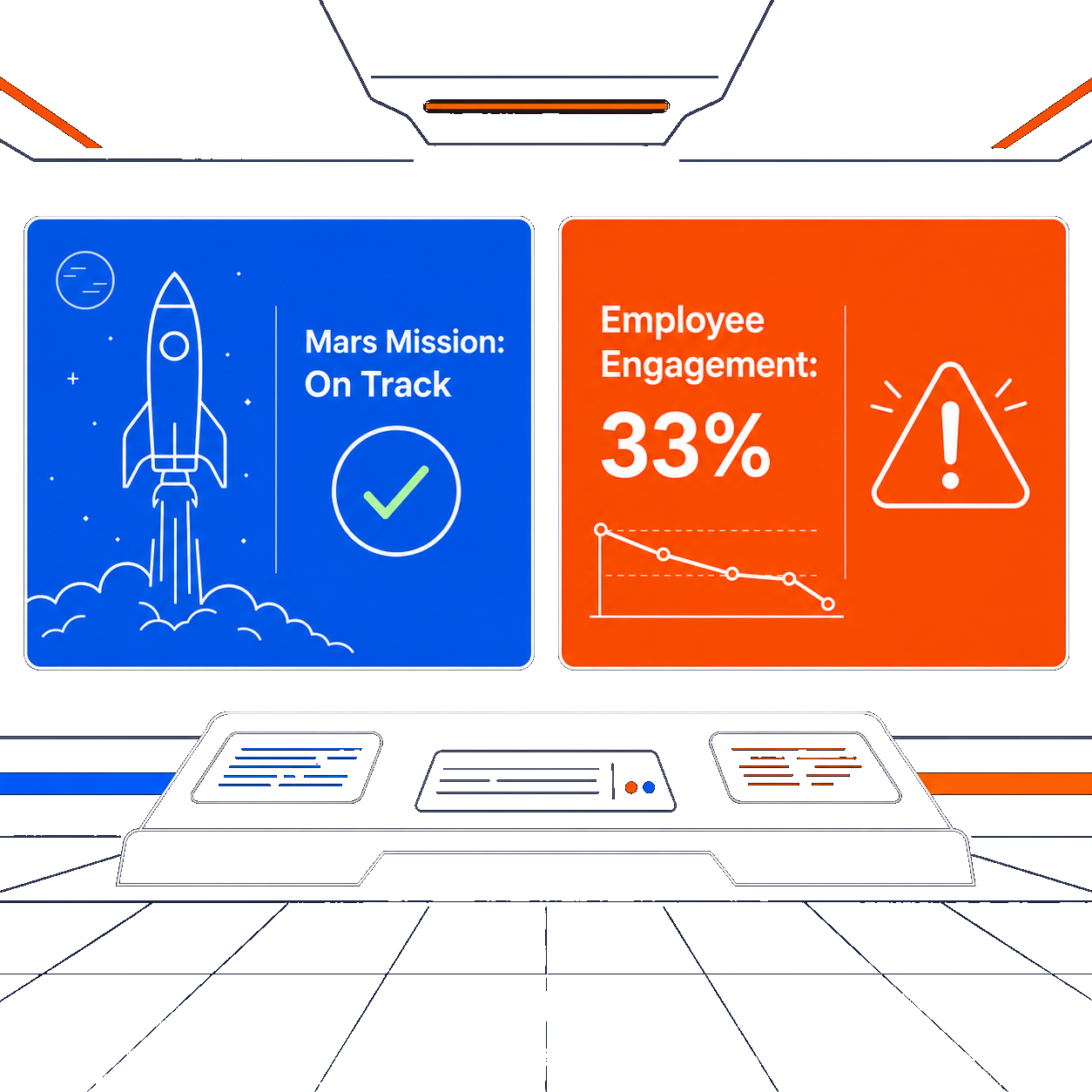
Apparently, it’s been an inside joke at Gallup, that we’ll likely colonize Mars before we solve the poor employee engagement plague. Gallup CEO Jon Clifton explained this joke at a recent conference.
It’s the most predictable cycle in human resources reporting: every year the Gallup state of the workplace comes out. Every year, we find employee engagement scores are abysmal. But why?
Too many organizations treat employee engagement like a mystery metric, a morale issue, or a communications problem. It’s not. It’s entirely solvable. And the solution is well known: SERVANT-Leadership.
In Gallup’s 2026 report, employee engagement in the United States is still only 33%, the lowest level in over a decade. Even more revealing than the number was the reason behind it. The sharpest drops showed up in areas that managers influence most directly: employees not being clear on what is expected of them, not feeling that someone at work cares about them, and not feeling encouraged in their development.
Those are obvious leadership issues. In other words, employee engagement scores decline when leaders fail to serve well. And that’s why servant leadership matters.
Servant leadership is not soft leadership. It is not passive leadership. It is not leadership that avoids standards or hard conversations. It is leadership that takes responsibility for helping people succeed. It clarifies expectations. It listens before reacting. It removes obstacles. It develops people instead of just using them. It creates accountability without stripping people of dignity.
Study after study after study says the same thing. Where employee engagement lacks:
-
Employees do not know what is expected. Servant leadership brings clarity.
-
Employees do not feel cared about. Servant leadership makes people feel seen.
-
Employees do not feel encouraged in their development. Servant leadership coaches, challenges, and invests in growth.
-
Performance management is broken. Servant leadership makes feedback useful, consistent, and tied to real progress.
So if the workplace is broken, the answer is not more technology, more dashboards, or more pressure on managers to “drive results.”
The better answer is to build more leaders who understand that their job is not merely to extract output from people. Their job is to help people excel while driving greater results for all stakeholders.
This is where most organizations fail. They want results without the effort. They want the benefits of engagement without the disciplines that create it. They want employees to care deeply while leaders remain vague, distant, transactional, or developmentally absent.
It doesn’t take a genius to realize that will not work.
People engage more when they trust their leader. They engage more when expectations are clear. They engage more when they believe someone is paying attention to their growth. They engage more when accountability feels fair and useful instead of random or performative. None of that happens by accident.
It happens when leaders consistently practice the principles that servant leadership has been teaching for years.
If we want better employee engagement scores before we colonize Mars, we had better get on the servant leadership path. That means:
Selflessness: Developing leaders to serve the success of their people, not just the visibility of their own role.
Empathy: Rewarding the habits that strengthen understanding, trust, and clarity.
Resolve: Setting clear expectations while holding stakeholders accountable.
Virtuousness: Building communities, not just groups of people, with strong values.
Authenticity: Being honest, vulnerable, and transparent with those we serve.
Nonpartisanship: Being open to feedback from anyone, anywhere, almost any time.
Thoroughness: Measuring leadership quality, not just activity volume.
Mars is a big ambition. Fixing workplace engagement should be easier to solve than compared on the same timeline. But it will not happen through slogans. And, we won’t fix employee engagement if we don’t apply the most obvious solution staring us in the face: servant-leadership.
Sources


