Hometown Heroes – Library of American Comics

On the cusp of America’s 250th birthday, its citizens increasingly turn their backs on printed products for both news or entertainment. Over the past decade Time magazine reportedly averages three-to-four million readers per issue; readership of the New York Times for the same period is estimated at around twelve million. On the fiction front, Rebecca Yaros’s 2025 “romantasy,” Onyx Storm (part of the Empyrean series), was the fastest-selling adult novel of the past twenty years, according to BookScan’s data. Onyx Storm sold 2.7 million copies in its first week of availability.
It’s easy to ask, “What’s wrong with that?” — and of course, the answer is, “Nothing.” A lot of magazine publishers would love to have three million regular readers; plenty of authors would be over the moon to rack up a fraction of Onyx Storm‘s sales. And yet — and yet …
When we think back to the heyday of newspaper comics, it was not unusual for the most popular strips of the day to claim audiences of thirty million or more — not just 30,000,000 one-timers, but readers who came back every day to learn how Terry Lee fared in the Far East, or how Blondie and Dagwood were getting along, or what troubles Little Orphan Annie would encounter once she unexpectedly had to fend for herself in the wake of “Daddy” flying away to distant, exotic lands.
In those days America was a nation of readers, and tens of millions of regular readers loved the comics. Several of the cartoonists who created them enjoyed a degree of celebrity that is today afforded primarily to singers, athletes, actors, and Internet personalities.
The newspapers serving towns that also claimed a marquee-name comics impresario as a current or former resident regularly filled their column-inches with illustrations, photos, and articles about those “hometown talents made good.” These papers would return to their cartoonist-subjects time and time again, keeping the audience up to date with the latest events in the artist’s life.
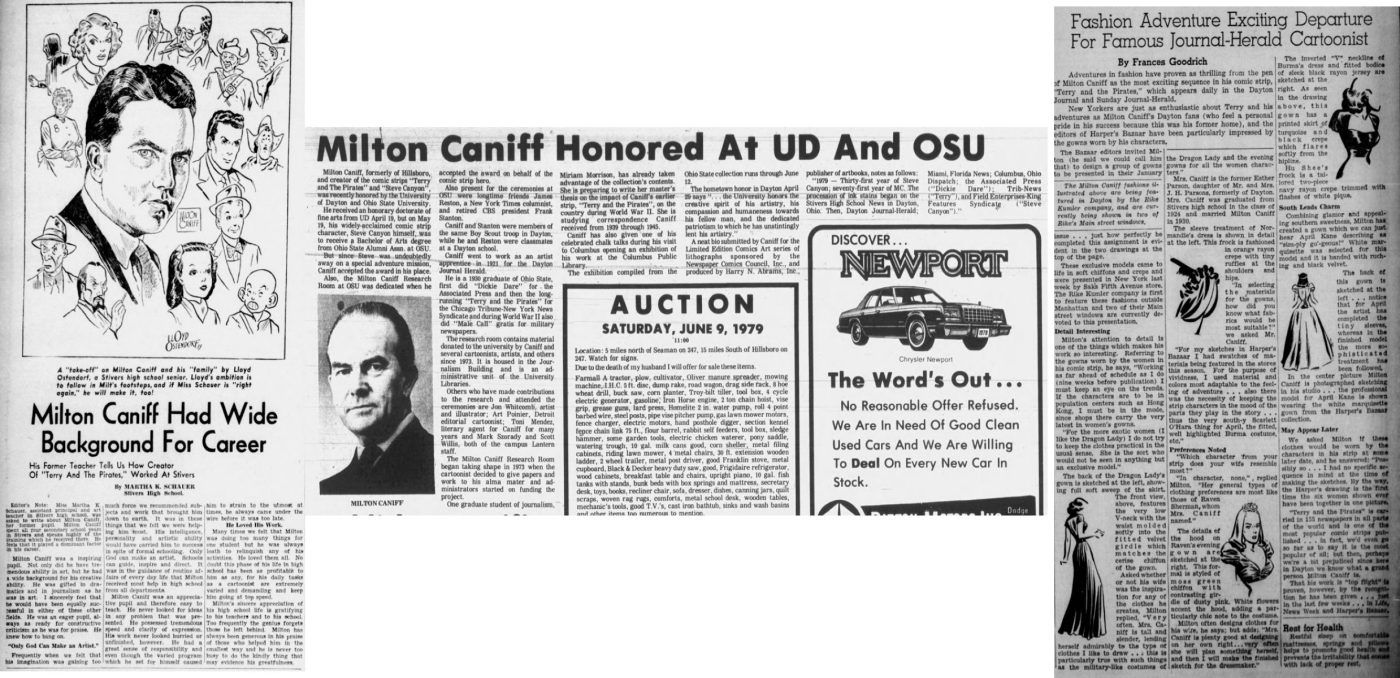
Always a master of promotion (and self-promotion), Milton Caniff enjoyed the benefits of having two Ohio newspapers claim him as their own. Caniff was born in Hillsboro, Ohio, where the Press Gazette was always ready to give him coverage. He spent most of his boyhood in Dayton, and he grew to have a reciprocal love affair with the city’s Journal Herald. At left in the montage below, Daytonians in 1939 were treated to this view of the mastermind behind Terry and the Pirates. It was authored by Martha Schauer, Caniff’s Stivers High School teacher and an early mentor as he developed his skills. The artwork accompanying the piece is from a then up-and-coming Stivers student, Lloyd Ostendorf. (Click images thruout for an isolated view.)

At far right in the montage, the Dayton Journal provided a 1941 article about the fashion feature Caniff prepared for Harper’s Bazaar magazine. This piece includes examples of Caniff’s preliminary sketch work for Harper’s that yr hmbl svnt, at least, had never before seen.
Though the comics had passed their prime by 1979, the local papers still remembered — and still occasionally covered — their hometown heroes. In the center of the montage above, the Press Gazette reported on Caniff’s honorary degrees from both the University of Dayton and The Ohio State University.
Of course, Caniff was not the only star cartoonist to attract attention from the local press. Connecticut became a haven for cartoonists and illustrators, with its easy access to the publishing center that was Manhattan. Even in the early years of the 21st Century, local newspapers were ready to provide coverage to strip creators who came equipped with public name recognition. The exhibit below shows that Mort Walker, of Beetle Bailey fame, met that requirement: here the Westport, Connecticut News celebrates both Beetle‘s fiftieth anniversary and its creator. A decade later, in September 2010, the Stamford Advocate did the same to mark the series’ sixtieth. Shortly after Mort’s passing in January of 2018, the Advocate followed up with the remembrance piece at far right, with son Brian Walker reminiscing about his Dad.

The Stamford Advocate had interest in its cartooning citizenry long before these 21st Century articles, however. Here are four separate pieces devoted to Alex Raymond (Flash Gordon, Jungle Jim, Secret Agent X-9) from that periodical, spanning six years throughout the 1940s.

The Raymond at the War Bond dinner photo was published in early February 1942. Almost exactly two years later, the artist joined the Marines and would eventually see action in the Pacific, aboard the USS Gilbert Islands. Artwork he produced during that period went on display and was the subject of a brief late-1945 Advocate piece, and after returning home to civilian life and his new comic strip, Rip Kirby, Alex was shown as a participant in actrivity centered around his local church.
St. Cecilia’s was important to Alex Raymond, and it held his memorial services on Monday, September 10, 1956, following his untimely death four days previous in a sports car accident. The Advocate gave the story of his death front page coverage on September 7th, and followed the next day with the short editorial-page remembrance at right below:

Nowadays one supposes there are web-based communication channels that keep targeted audiences apprised of key events in the lives of those they admire, and certainly the celebrities who choose to make themselves available are closer and more accessible to their fans than ever before. Still, there was something to be said for the time when tens of millions kept coming back for more Flash Gordon or Rip Kirby, more Beetle Bailey or Hi and Lois, more Terry or Steve Canyon — and the hometown newspapers were on hand to cover the lives of the persons behind the comics.