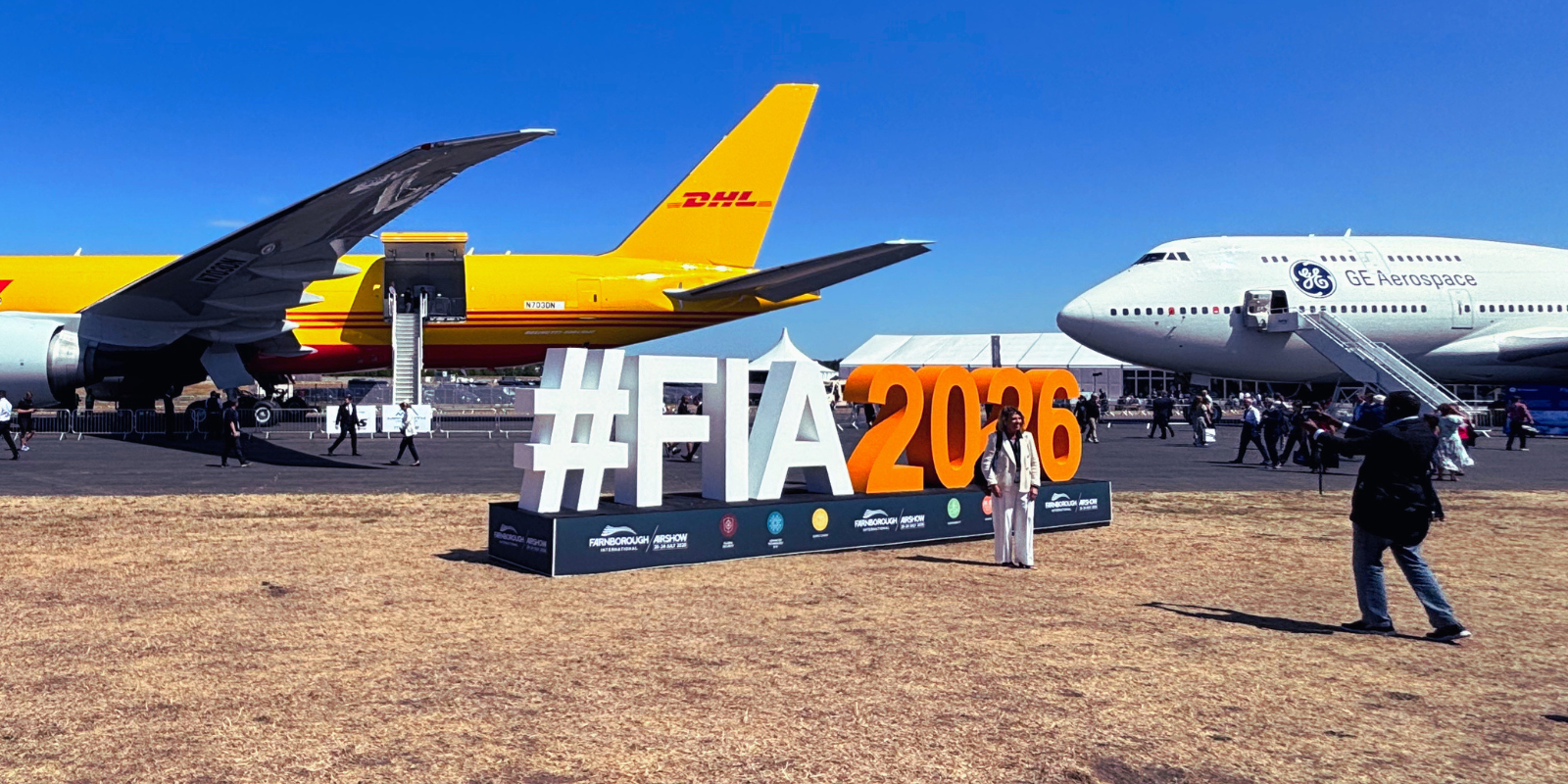
Every Farnborough International Airshow offers a window into the future of aviation. This year, however, something felt different.
The conversations weren’t about distant possibilities or ambitious concepts. They were about technologies that are flying today, partnerships that are already in place, and the practical steps needed to bring a new generation of aircraft safely into everyday operations.
For me, that was the biggest takeaway from Farnborough 2026: the future of aviation is no longer on the horizon – it’s already beginning to arrive.
One of the standout moments was seeing Vertical Aerospace’s VX4 electric aircraft take to the skies. Alongside it was BETA Technologies’ ALIA CX300, an all-electric regional aircraft that recently secured an order from Loganair. These aircraft represent more than technological innovation; they signal a shift towards new forms of regional and urban aviation that will require the entire industry to evolve.
Of course, developing new aircraft is only part of the challenge.
Making them commercially viable will depend on creating an aviation system that enables them to operate efficiently. As battery-powered aircraft enter service, every mile flown and every minute in the air becomes even more important. Efficient flight paths, modernised airspace and smarter air traffic management will all play a critical role in helping unlock their full environmental and operational potential.
“Efficient flight paths, modernised airspace and smarter air traffic management will all play a critical role”
That was a recurring theme throughout the week. Sustainability is no longer viewed through the lens of a single technology. Instead, it is becoming clear that achieving net zero aviation will require progress across many fronts: cleaner aircraft, sustainable aviation fuels, smarter operations and closer collaboration across the industry.
“achieving net zero aviation will require progress across many fronts”
Another topic that featured prominently was the growing focus on aviation’s non-CO₂ impacts, particularly contrails. While often invisible to passengers, persistent contrails are increasingly recognised as an important area of climate research and action.
For NATS, this is not a new conversation. We have spent more than a decade building our understanding of contrails and are now working with industry partners to translate that research into operational solutions.
Perhaps the most thought-provoking moment came away from the flying displays. In the new Space Zone, Rear Admiral Tony Williams spoke about the need to move from periodic modernisation to continuous adaptation. His message – that success depends on collaboration, interoperability and focusing on outcomes rather than processes – felt remarkably relevant to aviation.
The technologies showcased throughout Farnborough reinforced exactly that point. Innovation alone is not enough. Delivering the next era of aviation will depend on how effectively manufacturers, airlines, airports, regulators and air navigation service providers work together.
“Innovation alone is not enough.”
That collaboration has never been more important.
As the industry continues its journey towards net zero, airspace modernisation, digital technologies and smarter air traffic management will be just as important as the aircraft themselves. They will help ensure new technologies can integrate safely, operate efficiently and deliver the environmental benefits they promise.
Leaving Farnborough, I felt optimistic.
Not because every challenge has been solved, but because the conversations have changed. The question is no longer whether aviation can transform, but how quickly we can work together to make it happen. That’s an exciting future to be part of.