


Finishing is a fairly contentious topic when it comes to the world of soccer analytics. The somewhat mainstream analytics practitioner opinion can be summed up as follows: finishing is objectively a skill that exists, but the majority of players possess a skill level that impacts the underlying finishing rate to a much smaller degree than the random noise of sometimes ball go in. This is the thing with soccer as a sport as a whole. Feet are just so much worse than hands. One topic that this has made me think about is the whole hot hand fallacy. Do feet, which are much less good at manipulating balls than hands, get hot? I’m going to try and avoid being too academic and stiff here, but bear with me.
To lay out the stall, the hot hand fallacy (originally described by a bunch of economists who researched cognitive biases, go figure) is the idea that if a player makes a shot, they are more likely to make their next shot in a game of basketball. You can go through the wikipedia and find a number of the academic literature that all showed some variation of “No, this is not real”. Over time, studies have used larger datasets and accounted for things like defender positioning and shot difficulty and shown it maybe does exist, but is small.
But soccer is not basketball, and analytics in soccer is much more nascent than other fields. There is some academic literature, Parsons and Rohde looked at team level goal scoring and saw no evidence of momentum in the Premier League, while Ayana et al. did show that there is some clustering of goals together in games. Joseph Buchdahl at Pinnacle, one of the sharpest oddsmakers on the soccer side, did some analysis showing that betting markets were actually over-favoring “hot” teams.
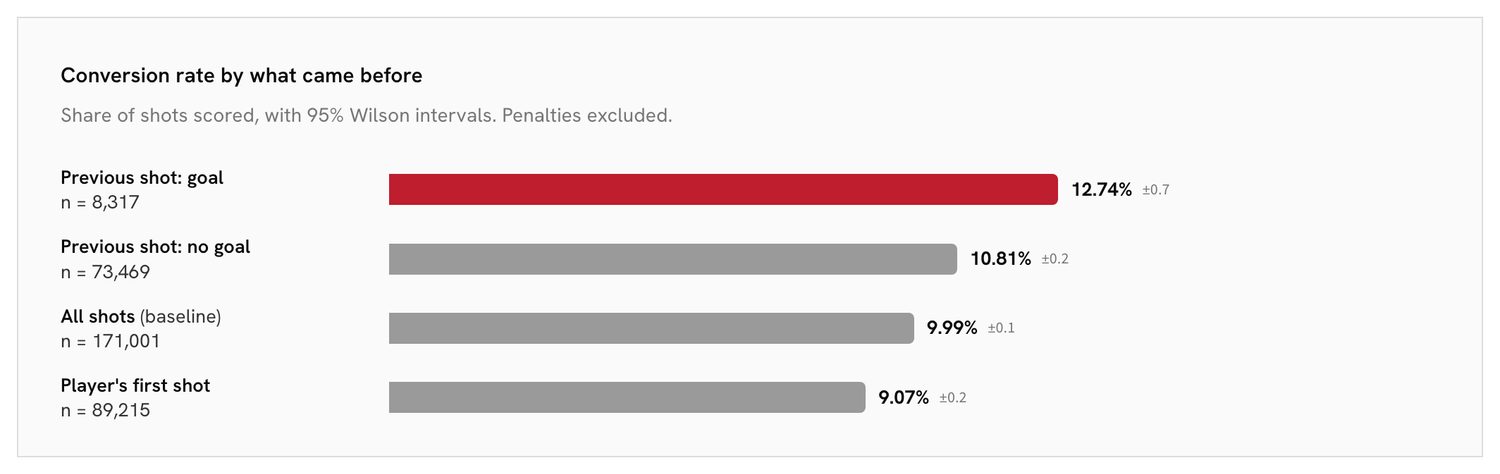
On the player side, there is less. Gauriot and Page showed that managers, journalists, and fans over-index on shots that resulted in goals compared to identical shots that hit the post. Our own Eliot McKinley and John Muller (now of Futi) saw similar, that players who scored played more the next game than if they missed a similar chance. As far as I can tell, nobody has directly ported the research over. If a player scores, do they score the next shot more frequently? We’ve got 171k shots in the ASA dataset for MLS and NWSL, and a little over 17,000 goals, so we should be able to look at exactly this.


