My Bone Density Changed. Here’s What I’m Doing About It. – Women Living Well After 50

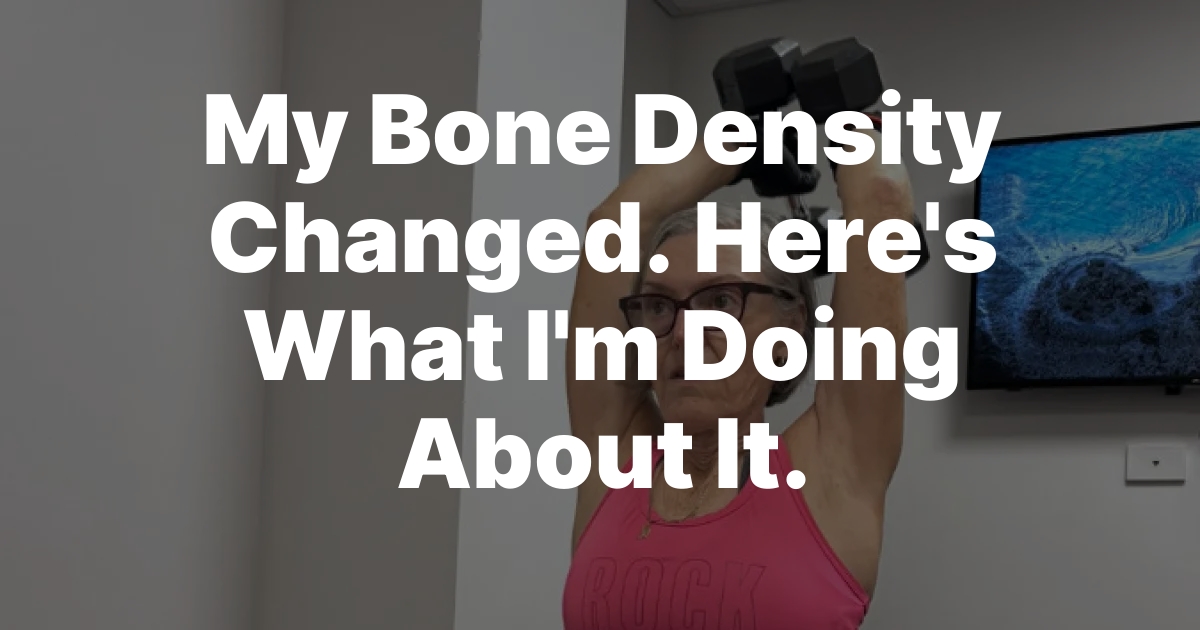
You can do many of the right things for your health and still get a result you didn’t want. Here’s what my latest bone density scan taught me about osteopenia, ageing and continuing to live life fully.
I wasn’t expecting my latest bone density results to disappoint me.
After all, I strength train twice a week. I run. I walk. I include jumping and some plyometric exercises in my training. I work on my balance and mobility, and I make sure I’m eating calcium-rich foods and enough protein.
I do all the things we’re told are important for healthy ageing. So when my latest bone density scan showed a small worsening of my osteopenia, I was disappointed.
My first thought was:
“But I’m doing everything I’m supposed to be doing!”
And then I reminded myself of something I’ve learned many times as I’ve grown older:
We can do many of the right things for our health and still get results we didn’t expect.
That’s life.
And while I can’t control everything that happens to my bones as I age, I can control how I respond.
I’m about to turn 69 and I’m still in the early osteopenia range. So rather than seeing this as a reason to stop doing the things I love, I’m choosing to see it as information.
I’m also reminding myself that health isn’t a report card where doing everything “right” guarantees the result we want.
Information gives me an opportunity to pay attention and make sure I’m doing what I can.
Osteopenia isn’t osteoporosis
It’s easy to hear the word osteopenia and immediately think osteoporosis, but they aren’t the same thing.
Bone density is commonly measured with a DEXA or DXA scan. The result includes a T-score, which compares your bone mineral density with that of a healthy young adult.
Generally:
- Normal bone density: T-score of -1 or above
- Osteopenia: T-score between -1 and -2.5
- Osteoporosis: T-score of -2.5 or lower
Osteopenia means your bone density is lower than the normal range, but it hasn’t reached the level generally classified as osteoporosis. It doesn’t automatically mean that you will develop osteoporosis.
My results showed that in my Right Femur my T-score had dropped from -1.6 to -1.8 and in my Left Femur -1.4 to -1.6. It might not seem much, and it is still no where near the limit of -2.5 before it is diagnosed as Osteoporosis, however I was expecting an improvement.
Osteoporosis is more advanced bone loss, where bones become weaker and more fragile and the risk of fractures increases.
But bone density isn’t the whole story. Your doctor may also consider factors such as your age, previous fractures, family history, medications and other health conditions when assessing your individual fracture risk.
So a scan result is a piece of information, not a prediction of your future.
What can we do to support our bones?
All is not lost as there are things we can do to support our bones and maintain strength as we age.
Strength training
This is non-negotiable for me.
Resistance training helps maintain muscle strength and provides loading that can support bone health. It also helps with everyday activities, mobility and independence.
I already strength train twice a week and I’m certainly not planning to stop, in fact, my goal is to increase to 3 times each week as my norm.
My result has reinforced why I want strength training to remain part of my life.
Weight-bearing exercise
Walking, jogging and running are weight-bearing activities that load our bones.
Running is something I love, so I have no intention of giving it up simply because my bone density has changed.
But here’s something I hadn’t really thought about until recently.
Maybe our bones need a little variety too
After I shared my bone-density results, Peta from Strong Healthy Women reminded me that although strength training and running are fantastic, running is also quite repetitive.
She got me thinking about the value of impact, power and multidirectional movement — things like hopping, skipping, jumping and changing direction.
I already include some plyometric exercises like box jumping in my training, but her comment prompted me to think about being more intentional about them.
Plyometrics are exercises involving quick, powerful movements. They can provide a different loading stimulus while also challenging power, coordination and balance.
And you don’t need to be doing huge box jumps.
Small, controlled hops, jumps or other appropriate impact exercises can be incorporated depending on your ability.
But this is important: impact exercise isn’t appropriate for everyone. If you have osteoporosis, a history of fractures, significant joint problems or other risk factors, get individual advice from your doctor, physiotherapist or exercise professional before adding jumping or other impact exercise.
And if you can’t jump, that doesn’t mean you can’t work on power. Exercises such as powerful sit-to-stands, calf raises and strong step-ups can provide ways to challenge strength and power without jumping.
Balance matters
I regularly include balance and mobility work, and my bone-density result has reminded me why this is important. Strong bones are only part of the picture. As we age, maintaining balance and reducing our risk of falls is crucial because a fall can have serious consequences when bones are fragile.
So I’m not just trying to build stronger bones.
I’m building a body that can continue to move well and cope with life.
And then there are our hormones…
There’s another part of the bone-health conversation we shouldn’t overlook: hormonal changes.
Oestrogen plays an important role in maintaining bone. When oestrogen levels fall during menopause, bone loss accelerates, particularly around the menopause transition.
Which means that when we talk about bone health in women, perhaps the question isn’t simply:
“Am I exercising enough?”
It can also be:
“What role have hormonal changes played in my bone health?”
Menopausal hormone therapy (MHT), sometimes called HRT, can reduce bone loss and fracture risk for some women. But it isn’t a one-size-fits-all treatment, and whether it’s appropriate depends on factors including age, time since menopause, symptoms, medical history and individual risks.
For women who are older or many years beyond menopause, starting MHT for the first time is a different conversation from starting it around the time of menopause. That’s why this is something to discuss individually with your doctor or menopause specialist rather than making assumptions based on someone else’s experience.
There are also medications specifically used to reduce fracture risk and treat osteoporosis when appropriate.
For me, this is another reminder that
healthy ageing isn’t just about what we do in the gym or kitchen. It’s also about having informed conversations with our health professionals.
Imagine if I wasn’t doing all of this?…
I don’t know what my bone density would look like if I wasn’t doing these things — and I certainly can’t claim that my lifestyle has prevented further bone loss. My results have certainly reinforced my commitment to maintaining my health lifestyle by staying active, strong and eating well.
I’m giving my body the best chance I can.
And perhaps that’s how we need to think about healthy ageing.
Our healthy lifestyle isn’t a contract that guarantees perfect test results. It’s an investment in our future selves.
Osteopenia doesn’t mean stopping living
A bone-density result can be confronting. It can make us question what we’re allowed to do. We ask ourselves ‘am I becoming fragile’ and we stop doing things ‘just in case’.
For me, and the advice I’ve been given from medical professionals is that the answer isn’t to stop and wrap myself in cotton wool.
- It’s to become more informed.
- To exercise appropriately.
- To keep strengthening.
- To look at my nutrition.
- To understand the role of hormones and other risk factors.
- And to keep talking to my health professionals.
I’m 69 next week and I still want to run, travel, lift weights, walk, explore, play with my grandchildren and keep saying yes to new experiences.
My bone density result hasn’t changed that.
If anything, it has reminded me why these things matter.
We can’t control every aspect of ageing. But we can control many of the choices we make along the way.
I’m not aiming for perfect. I’m aiming to be strong, capable and active for as long as I can.
I’m not just training for a stronger body today. I’m training for the body I want to have in my 70s, 80s and beyond.
And that’s what Living Life in Full Bloom means to me.
A gentle reminder:
This post shares my personal experience and is not medical advice. Osteopenia, osteoporosis and fracture risk are individual. If you have concerns about your bone health or exercise program, speak with your doctor or an appropriately qualified health professional.
I’d love to know: Have you had a bone density scan? Did the results change how you approached your health and exercise?
Until next time….

Let’s keep blooming together. 🌸
If this post resonated with you, I’d love you to join me for more honest conversations about getting older, staying strong, looking after our health and continuing to live life with purpose and possibility.
Join my newsletter, Living Life in Full Bloom.
Because this stage of life isn’t about slowing down — it’s about finding new ways to thrive.
Women Living Well After 50
Living Life Your Way
Other posts you might enjoy