Termite risk at a Jurong Island industrial facility should be assessed based on actual site conditions, not location alone. Industrial sites can present complex termite-management conditions because of their scale, operating requirements, landscaped areas, service routes and varied building interfaces. A suitable programme should combine site inspection, risk-zone assessment, monitoring, activity-based follow-up and clear service planning.
Why Does Industrial Termite Management Require a Site-Specific Approach?
Industrial termite risk is rarely determined by one factor. It is shaped by many factors: the interaction between site history, building design, landscaping, moisture conditions, service routes, stored materials and access limitations.
On reclaimed or extensively developed sites, below-ground conditions may not be apparent from current surface features. Legacy construction materials, concealed soil interfaces, drainage paths or organic debris, where present, may create areas that warrant closer inspection. Reclaimed-land status itself does not prove that these conditions exist, which is why site records and physical inspection should be considered together.
Above ground, industrial facilities may also contain multiple potential interfaces between soil, structures and cellulose-based materials. Landscaped perimeters, utility penetrations, timber packaging, temporary structures and low-access areas can affect where monitoring should be prioritised.
These factors are not evidence of infestation on their own. Their value lies in helping facilities teams identify where termite activity may remain concealed and how an inspection programme should be designed.
Does Reclaimed Land Automatically Mean Higher Termite Risk?
Not necessarily. Reclaimed-land status alone does not confirm termite activity or indicate how severe the risk may be. Soil composition, construction history, landscaping, moisture conditions, building interfaces and the presence of cellulose materials can differ significantly between sites.
Facilities teams should therefore avoid relying on location or land history alone when assessing termite risk. A professional inspection is needed to identify actual signs of activity, possible entry routes and site-specific risk conditions.
Which Areas of an Industrial Facility Should Be Assessed?

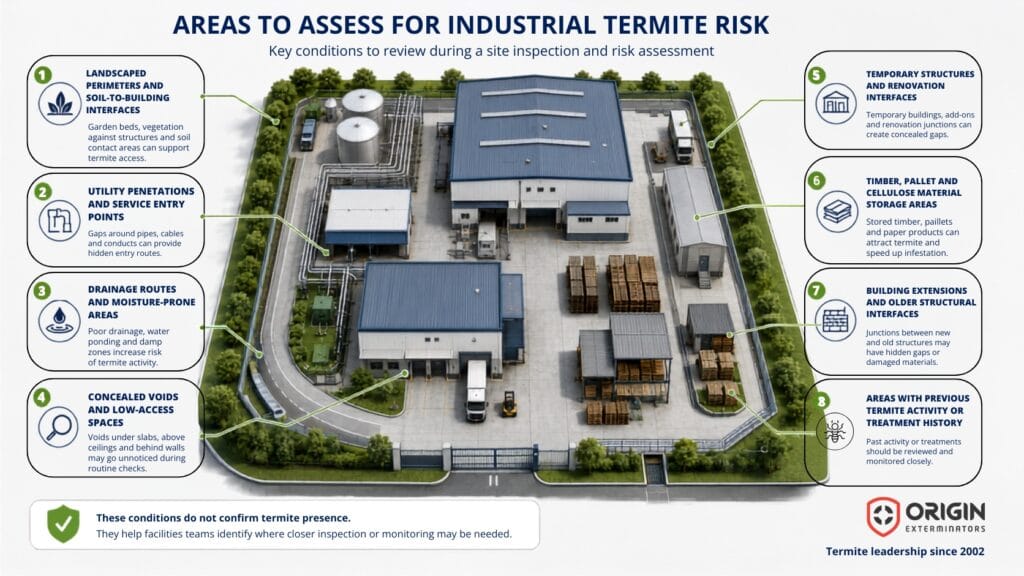
The areas prioritised during a site inspection will depend on the facility’s layout, construction and operating conditions. Common assessment areas may include:
- landscaped perimeters and soil-to-building interfaces
- utility penetrations and service entry points
- drainage routes and moisture-prone areas
- concealed voids and low-access spaces
- temporary structures and renovation interfaces
- storage areas containing timber, pallets or cellulose-based materials
- building extensions and older structural interfaces
- areas with previous termite activity or treatment history
These conditions do not confirm that termites are present. They help the inspection team decide where closer assessment or monitoring may be needed.
What Should a Structured Termite Risk Management Programme Include?
A structured termite-management programme for an industrial facility should cover four core areas.
Baseline Site Assessment
The programme should begin with a thorough site assessment to identify signs of current or previous activity, possible access routes, moisture-related conditions and areas that may require closer monitoring. For industrial sites, the assessment may also need to account for restricted areas, operating schedules and contractor access requirements.
Monitoring and Treatment Strategy
Depending on the site findings and treatment strategy, a programme may use in-ground or above-ground bait stations, other treatment methods, or a combination of approaches. Termite baiting is designed to affect termite activity through feeding and food-sharing behaviour within the colony. Treatment outcomes depend on site conditions, colony behaviour and programme execution.
Inspection and Review Schedule
A structured programme should include a clearly defined inspection schedule. The frequency may vary according to the selected treatment approach, site conditions, detected activity and the technician’s findings.
Where activity is identified, inspections may need to become more frequent so that feeding, station conditions and changes in activity can be reviewed. As activity subsides, the programme may return to its standard monitoring schedule.
Service Planning and Escalation
The scope and inspection frequency should be reviewed based on actual site findings. Where activity increases, the provider should be able to increase monitoring frequency and recommend appropriate next steps. Where activity subsides, the programme can return to its planned monitoring cycle.
What Should Facilities, HSE and Procurement Teams Include in the Scope?
A commercial or industrial termite-management scope should define both the technical programme and the operational requirements around its delivery.
- baseline site assessment
- identified risk zones
- proposed station locations
- clearly defined initial and ongoing inspection schedule
- process for increasing inspection frequency when activity is detected
- criteria for returning to the standard monitoring schedule
- technician qualifications
- site access and induction requirements
- permit-to-work or safe-work requirements where applicable
- product and treatment documentation
- escalation and communication process
- review of the programme after activity changes
- experience with comparable industrial sites
Requirements will vary between facilities, so the tender or service scope should reflect the site’s operating environment rather than rely on a generic schedule.
What Should Procurement Evaluate in a Provider?
- Ability to assess the site before proposing a programme
- Technician qualifications and termite-specific experience
- Experience working in comparable industrial environments
- Ability to adjust the programme when activity changes
- Relevant licensing and management-system credentials
- Escalation and communication processes
- Ability to coordinate with site access and safety requirements
What Should a Service Record Help the Facility Understand?
The exact reporting format may vary, but a useful service record should allow the facility to understand:
- areas inspected
- activity observed
- actions taken
- station status
- next inspection timing
- access limitations
- follow-up recommendations
What Should an Industrial Termite-Management Scope Specify?
| Requirement | Questions to ask | Evidence to request |
| Baseline assessment | How will the site’s risk areas be identified? | Assessment approach or site plan |
| Station plan | Where will monitoring points be located? | Proposed station layout |
| Initial follow-up | When will the first check take place after installation? | Defined follow-up schedule and rationale |
| Frequency adjustment | What happens when activity is found? | Escalation process |
| Site coordination | How will work be planned around operations? | Access and safety method |
| Technician competency | Who will inspect and interpret findings? | Relevant qualifications or experience |
| Programme review | How will the programme be adjusted over time? | Review process |
| Industrial experience | Has the provider handled comparable environments? | Relevant experience, subject to confidentiality |
How ORIGIN Supports Jurong Island Facilities
ORIGIN Exterminators was the first pest control company in Singapore to introduce termite baiting in 2002, reflecting its termite leadership since 2002.
ORIGIN currently supports several clients on Jurong Island across varying industries. While client identities and project details remain confidential, this gives its teams practical experience working within different industrial operating environments.
ORIGIN delivers termite monitoring and baiting through the ORIGIN Termite Baiting System (OTBS). ORIGIN’s trained field technicians, known as ORIGINators, assess station activity and site conditions to determine whether follow-up should take place weekly, fortnightly or monthly.
ORIGIN also holds valid NEA licensing, ISO 14001, ISO 45001 and bizSAFE Star credentials. These credentials demonstrate established operational, environmental and workplace-safety management systems. Treatment recommendations and outcomes, however, remain dependent on site conditions and programme execution.
How the OTBS Inspection Cycle Works
The ORIGIN Termite Baiting System operates on a quarterly programme cycle. After a station is installed, a mandatory follow-up inspection takes place one week later. During this visit, the ORIGINator checks the bait and assesses the level of termite activity.
Based on the findings, subsequent visits may be scheduled weekly, fortnightly or monthly, with higher activity receiving more frequent attention. Once activity has been managed, the programme returns to its regular quarterly cycle.
Frequently Asked Questions: Termite Management on Jurong Island
Is Jurong Island automatically at higher termite risk because it is reclaimed land?
No. Reclaimed-land status alone does not confirm termite presence or severity. Site-specific conditions such as landscaping, moisture, construction interfaces, stored materials and access conditions should be assessed.
How often are OTBS stations inspected?
OTBS operates on a quarterly programme cycle. A mandatory inspection takes place one week after station installation. Where activity is detected, follow-up may be scheduled weekly, fortnightly or monthly according to the level of activity.
Why is there a one-week follow-up after station installation?
The one-week visit allows the ORIGINator to check the bait, assess whether termites are interacting with the station and determine the level of activity. This information is then used to plan the next inspection frequency.
Is termite baiting suitable for large industrial sites?
It can be, depending on the site layout, access conditions, termite activity and overall treatment strategy. Large sites may require a broader inspection area and more monitoring points.
Can inspections be coordinated around site operations?
Yes, subject to the facility’s access, induction, permit and safety requirements. These requirements should be discussed before the programme begins.
Does termite baiting guarantee colony elimination?
No fixed outcome should be guaranteed. Baiting is designed to affect termite activity through feeding and food-sharing behaviour, but results depend on site conditions, colony behaviour and programme execution.
Does ORIGIN have experience supporting Jurong Island facilities?
Yes. ORIGIN currently supports several clients on Jurong Island across varying industries. Client identities and project details remain confidential.
Key Takeaways
- Reclaimed-land status alone does not confirm higher termite risk.
- Industrial sites require site-specific assessment because scale, access, service routes and building interfaces vary.
- OTBS operates quarterly, with a mandatory one-week post-installation follow-up.
- Inspection frequency may move to weekly, fortnightly or monthly depending on activity.
- Facilities and procurement teams should define assessment, access, escalation and programme-review requirements clearly.
- ORIGIN’s termite leadership dates back to 2002, and its teams currently support several confidential clients on Jurong Island across varying industries.
Taking a Site-Specific Approach to Termite Risk
Industrial termite risk should be assessed according to actual site conditions, including building interfaces, service routes, moisture conditions, access restrictions and operating requirements.
A structured programme should combine baseline assessment, suitable station placement, a clearly defined inspection schedule, activity-based follow-up and ongoing review. Under OTBS, ORIGIN delivers this through a quarterly programme cycle, a mandatory one-week post-installation inspection and more frequent follow-up where activity warrants it.
ORIGIN can support facilities teams reviewing an existing programme, preparing a tender or assessing current site conditions before a proposal is developed.
Reviewing termite risk at a Jurong Island facility? Arrange a confidential, site-specific termite assessment with ORIGIN Exterminators.