The Cat in the Hat’s Learning Library

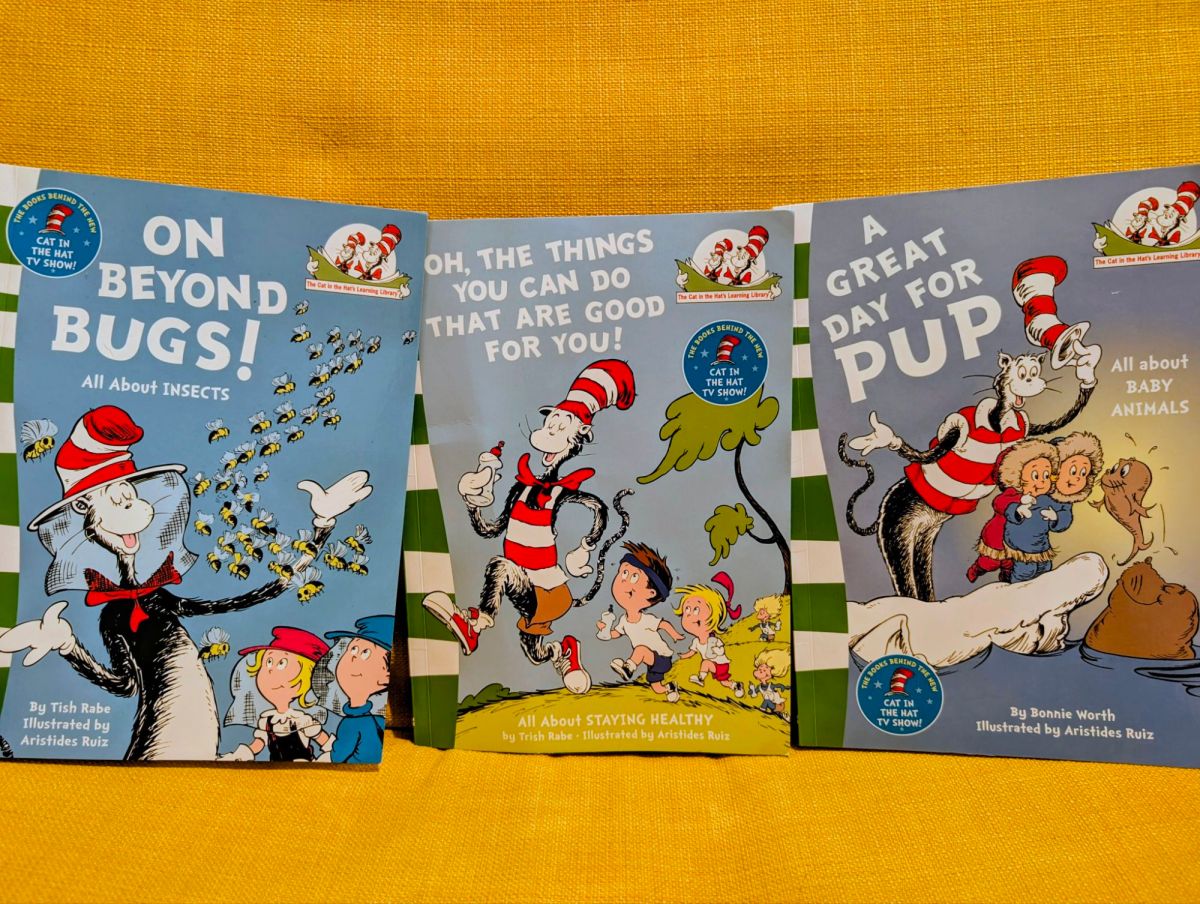
Three “educational” books from the Cat in the Hat franchise
These three books made their way into our home as books tend to do when you have a toddler. We read lots of Dr. Seuss when I was a kid so I wasn’t surprised that they captured my toddler’s interest. These are all part of the same series so I’ll review them together in one post.

Oh, the Things You Can Do that are Good for You!
“Oh, the Things You Can Do that are Good for You!” by Tish Rabe and Illustrated by Aristides Ruiz is part of “The Cat in the Hat’s Learning Library” and is all about self-care. Using rhymes, unusual creatures and Dr. Seuss’ signature style, the book explores topics such as personal hygiene, diet, safety and sleep.
To my great dismay, my toddler loves this book and requests it frequently. I actually have fantasised about giving it away many times, but haven’t been able to bring myself to do so because of how much she likes it. Despite it having about a million (40) pages, she is glued to it the entire time. There is one particular page with the Zing-Singing Zanz who sings about wshing hands, which I sing in a different tune every time, that she really enjoys.
However, this book is a prime example of why not everything needs to be part of a franchise. The rhyming often feels really clunky and contrived, with a particular stanza really annoying me:
It can travel two metres
and blasts out with great power,
at speeds over well over
150km per hour!
Why do you need ‘over’ twice in the same line?? The information also seems out of date and inaccurate, and the carbohydrate-heavy food pyramid and mandatory breakfast instruction is giving 1990s Kellogg’s propaganda.
An annoying book that I simply can’t throw away.
A Great Day for Pup
The next book in the collection is “A Great Day for Pup” by Bonnie Worth and illustrated by Aristides Ruiz about baby animals.
Again, this book is not very thorough when it comes to facts and accuracy, and most annoying to me is that it insinuates in the early pages that the ostrich (rather than the emu) is native to Australia. Books that are inaccurate about Australian wildlife really irritate me, so this was already a black mark. It also suggests that penguins and polar bears are located in the same place, where penguins live almost exclusively in the southern hemisphere while polar bears are located primarily around the Arctic circle.
Mercifully, I don’t think my toddler has been able to sit through an entire reading of this book and rarely requests it. I think I could get away with sneaking it out of the house.
On Beyond Bugs!
The final book we have in this series is “On Beyond Bugs!” by Tish Rabe and illustrated by Aristides Ruiz which is, would you believe it, about bugs.
Again the ‘facts’ presented in this book are very questionable, with the book at one point declaring ‘insects cannot see all the things that surround them’ while at the same time depicting insects with eyes. Yes, insects have a different type of vision to us but they do have vision.
My toddler has been able to sit through even less of this book than the baby animals one, which says a lot given how much she likes to talk about insects.
Factually inaccurate and derivative, I hope that I can give at least two of these books away.