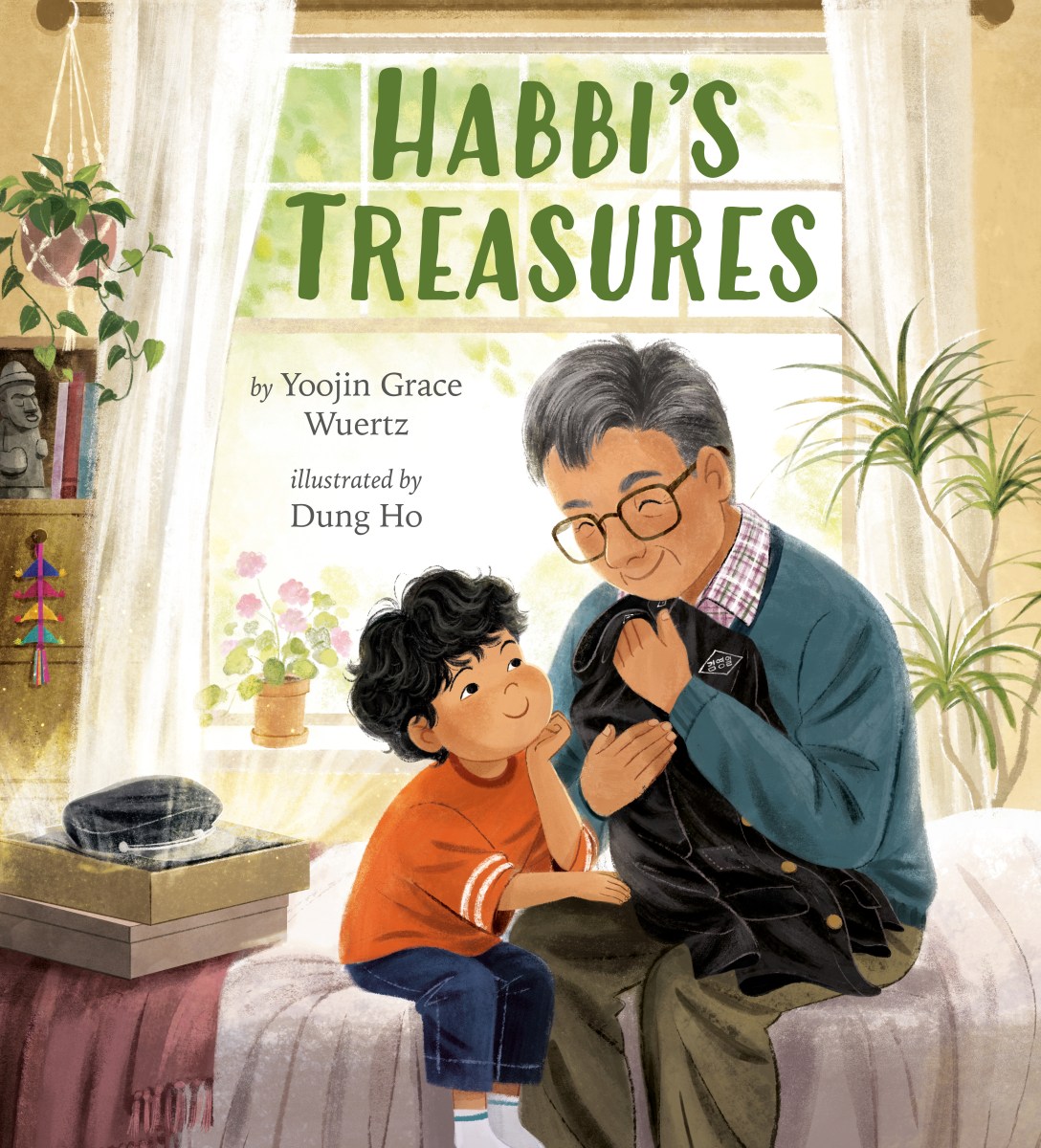

Can clothes be stories? Can stories be treasures?
I wrote HABBI’S TREASURES after a conversation I overheard between my dad and my son, and the answer is: YES and YES!
It was a week or two before the first day of school, and I had just done some back to school shopping for my son, Emmett, who was six at the time. I was excited to show him the clothes and have him try them on. At the time, Emmett was playing with my dad, known as Habbi (a shortened version of harabeoji, the Korean word for grandfather), and he was emphatically not interested in trying on the clothes. In fact, he pitched a bit of a tantrum.
My dad, who has always loved clothes, eyed what I’d bought and said, “Wow, Emmett, you’re so lucky. Look at all these new clothes you have. Look at these new pants. When I was a boy, I never had so many new clothes. In fact, I had one pair of pants– the pants from my school uniform. I wore those same pants proudly every day.”

Photo caption: My dad in his middle school uniform, 1968.
That stopped us in our tracks.
Emmett said, “Habbi, how come you only had one pair of pants?”
That’s when Emmett learned about how Habbi was born right after a big war in Korea, and it was a very challenging time, and people made do with very little.
Six years old is young to learn about the Korean War or about how poverty may have affected your loved ones. But in that moment it was an urgent, age-appropriate question and we were able to talk about it at a six-year-old level.
Very often, the grandparent/grandchild relationship circles around the child’s interest—and this makes sense. But in this instance, the focus shifted to my dad’s life story and the experiences he had when he was young, and it was up to Emmett to try to adjust to Habbi’s point of view. And he did, with curiosity and empathy. It was an important moment in our family, in which the first generation connected with the third generation in a way that was unexpected but so meaningful.

Photo caption: my son, age 6, around the time I overheard the conversation that inspired HABBI’S TREASURES.
We couldn’t have planned for this conversation. But because it came up organically, about an item of clothing that Emmett could see and understand, he could make that connection about what it was like for Habbi when he was young.
Habbi’s Treasures went through many drafts, but my editor and I decided to focus on the joy of connection and sharing memories rather than focusing on the hardships. While the challenges were real, I noticed that my dad shared stories from his past with fondness and pride. In his retelling, he didn’t dwell on the pain of what he didn’t have. Instead, he remembered the joy of what he did have and the distance he had traveled to overcome his difficulties.
In this book, which is dedicated to Emmett and my Abba, I wanted to preserve that sense of lightness and joy between a grandfather sharing his treasured memories with his young grandson. I hope that’s what you see on the page too, and I hope that invites other families to share their stories with each other as they read the book together.

Photo caption: My family, including my parents, at Gyeongbokgung Palace in Seoul this summer, July 2026.
Yoojin Grace Wuertz is the author of the adult novel EVERYTHING BELONGS TO US, which was selected as a New York Times Editors’ Choice, longlisted for the Center for Fiction’s First Novel Prize, and included on Kirkus Reviews’ Best Fiction of 2017. She is the author of two picture books, HABBI’S TREASURES (September 2026) and SOMI’S STAR DAY (September 2027), both from RISE x Penguin Workshop. Her debut young adult novel, WELCOME HOME, STRANGER, is forthcoming from FSG Books for Young Readers in May 2027. Grace was born in Seoul, South Korea, and immigrated to the United States at age six. She lives in Princeton, New Jersey, with her family. You can find her on social media @gracewuertz.