
The Prop Trading Drawdown Risk: How You Can Be Profitable and Still Fail



A prop trader can make money, give back the profit, and fail an evaluation without ever falling far below the starting account balance. The reason is a rule many traders overlook: relative drawdown.
Most traders begin a prop firm evaluation with two numbers in mind: the profit target and the maximum loss allowed. If they start with a $100,000 account and need to earn 10%, they know the target is $110,000. If the firm also advertises a 5% drawdown limit, they may assume they can keep trading as long as the account stays above $95,000.
That assumption can be costly.
Under the relative drawdown rule used in this article’s example, the loss limit is based on the account’s high-water mark, the highest account value recognized by the firm. When the account reaches a new high-water mark, the minimum permitted account value rises. If the trader later gives back the profit, that minimum does not move back down.
A trader can therefore return to the original $100,000 balance and have very little room left before failing the evaluation.
What Is Relative Drawdown in Prop Trading?
Drawdown is the decline in an account from a previous high. If an account reaches $104,000 and later falls to $100,000, it has experienced a $4,000 drawdown from that high.
In this article, relative drawdown refers to an evaluation rule that measures the permitted decline as a percentage of the high-water mark. With a 5% relative drawdown limit, the trader must keep the account above a floor calculated from that high-water mark.
The calculation is simple once you know which account value the firm uses:
High-water mark − permitted drawdown = drawdown floor
There is one detail to check before trading. Prop firms do not all establish the high-water mark in the same way.
- Some use the account balance after trades close.
- Some include gains and losses on open positions.
- Some update the data during the trading day
- Some use an end-of-day value.
The drawdown floor depends on the rules and which calculation applies for your specific evaluation
The key point is as the high-water mark rises, the drawdown floor may rise with it.
How the High-Water Mark Changes Your Loss Limit
Let’s use a $100,000 prop evaluation with a 10% profit target and a maximum relative drawdown of 5%. For this example, assume the firm measures the high-water mark using closed trades and raises the drawdown floor whenever the balance reaches a new high.
At the start:
- Account balance: $100,000
- Profit target: $110,000
- Initial high-water mark: $100,000
- Initial drawdown floor: $95,000
The trader initially has $5,000 between the account balance and the drawdown floor.
After several winning trades, the balance reaches $104,000. That becomes the new high-water mark. Five percent of $104,000 is $5,200, so the new drawdown floor is $98,800.
Now suppose the trader loses $4,000 over the next several trades. The balance returns to $100,000.
It may feel like a fresh start because the account is back to its opening balance. But the drawdown floor remains at $98,800. Only $1,200 separates the account from the limit.
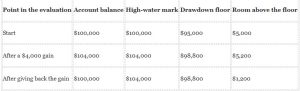
The trader still needs to reach the $110,000 profit target. From the current $100,000 balance, that means earning a minimum of $10,000 while staying above a drawdown Bottom line in this example is that ot 5% off the high waster mark the trader has much less room than at the start.
Why a Profitable Trader Can Still Fail
The danger is easier to see if the account climbs further.
Suppose the trader takes the account from $100,000 to a new high-water mark of $106,000. Under the same 5% relative drawdown rule, the floor becomes $100,700.
The trader is up $6,000 at that point. But if subsequent trades bring the account back to $100,000, it will cross the $100,700 floor. The evaluation can end even though the account has merely returned to its starting balance.
This result feels counterintuitive because traders often think of profit as extra protection. Profit does give the account more room above its loss floor while the balance remains high. But once it establishes a higher high-water mark, it can also raise the floor used to judge future losses.
However, some prop firms cap the drawdown floor at the starting balance after the account reaches a specified profit level. Others do not. Check the rules for the particular evaluation before assuming the floor will stop rising.
In any case, the mistake is to ask only, “Am I still above my starting balance?” In an evaluation with this rule, the more useful question is, “How far is my account from the current drawdown floor?”
TradingView and Eightcap Challenges: A unique duo
Relative Drawdown Versus a Fixed Loss Limit
A fixed loss limit works differently. Suppose a $100,000 evaluation has a floor fixed at $95,000. The trader makes $4,000 and reaches $104,000, then loses $4,000 and returns to $100,000. The floor remains $95,000, leaving $5,000 of room.
Under our relative drawdown example, the rise to $104,000 lifts the floor to $98,800. After returning to $100,000, the trader has only $1,200 of room.
That difference can change how a trader sizes positions and whether an evaluation suits their trading style. A strategy that regularly makes gains and then experiences sizable pullbacks may face particular difficulty when the floor follows the high-water mark.
I recall a term from my Consumer Economics course, Caveat Emptor, which means Let the Buyer Beware. In other words, don’t assume every prop firm uses the rule illustrated here. Read the rules carefully so you are aware of how drawdowns are calculated.
Why the Remaining Room Matters More Than the Account Size
The phrase “$100,000 account” can create a false sense of security. It describes the evaluation’s starting balance, but it does not tell you how much you can risk on the next trade.
In the first example, the trader returns to a $100,000 balance with only $1,200 above the drawdown floor. A $1,000 loss might look modest compared with a $100,000 account. Yet it would consume most of the remaining room. Another small loss, trading costs, or movement in an open position could end the evaluation.
That is why position size should be considered against both the trader’s personal risk plan and the available room under the firm’s rule. A trade can satisfy a normal risk guideline and still be too large for an account sitting close to its drawdown floor.
Winning trades also call for a fresh calculation. If a new win raises the high-water mark, the floor may change. The amount of room you had before the trade may no longer be the amount you have afterward.
Use the code PROP20 for a 20% discount

Watch Open Positions as Well as Closed Trades
A trader who watches only the account balance may miss an important risk. Balance generally reflects closed trades, while equity also includes the gain or loss on open positions.
If a firm monitors equity for rule breaches, an open trade can bring the account to its drawdown floor before the trader closes it. For example, an account may show a $100,000 balance, but an open loss of $1,300 would put equity near $98,700. If the applicable floor were $98,800, that could breach the rule even though the balance displayed for closed trades had not changed.
Imagine the market reverses and your position turns profitable. You look at your platform and you have flamed out as the prop firm closed out your challenge for breaching the rule based on breached the drawdown floor with an open position.
There may also be a separate maximum intra-day loss limit. Remaining above the overall drawdown floor does not guarantee compliance with the daily rule. Both limits need to be tracked.
How to Manage Relative Drawdown
The first step is to know your current high-water mark. Do not rely on memory, particularly after a series of gains and losses. Write down the value the firm is using and update it according to its rules.
Next, calculate the drawdown floor and the amount of room above it:
Current account value − current drawdown floor = remaining room
Use that figure when deciding how much to risk. The remaining room is a boundary set by the evaluation, not a suggested amount to lose on the next trade. Leaving a margin between your planned risk and the firm’s limit gives you more flexibility if a trade goes against you.
It can also help to set a personal stopping point before reaching the firm’s floor. If the remaining room becomes too small for your usual trading approach, reducing position size or pausing may make more sense than continuing to trade as though the account still had its original loss allowance.
Most of all, recalculate after a new high-water mark. A profitable day is good news, but it may change the level you must protect.
What to Check Before Paying for a Prop Evaluation
Before entering a challenge, make sure you can answer these questions from the firm’s written rules:
- Is the maximum loss floor fixed, or does it rise with the high-water mark?
- Does the firm establish the high-water mark using closing day balance or real-time equity?
- Are open-position profits included when setting a new high-water mark?
- When is the high-water mark updated?
- Does touching the drawdown floor count as a breach or does it have to move below it?
- Are commissions and other trading costs included?
- Is there a separate daily loss limit?
- What happens to the drawdown floor after a withdrawal or payout?
If the wording is unclear, ask the firm for a numerical example. Have it calculate the floor after a $100,000 account rises to $104,000 and then returns to $100,000. Its answer should reveal how much risk the trader would actually have left.
The Lesson for Prop Traders
A profitable trading strategy is not enough if a trader misunderstands the rules of the evaluation. With relative drawdown, yesterday’s account high can determine how close today’s account is to failure.
In our example, a trader who rises from $100,000 to $104,000 and then returns to $100,000 may feel back at square one. In reality, the $104,000 high-water mark has raised the drawdown floor to $98,800, leaving only $1,200 of room.
Know the firm’s calculation before you begin. Then track the high-water mark, drawdown floor, and remaining room alongside your profit target. Those numbers show whether the next trade fits within the rules you agreed to trade.
Use the code PROP20 for a 20% discount


