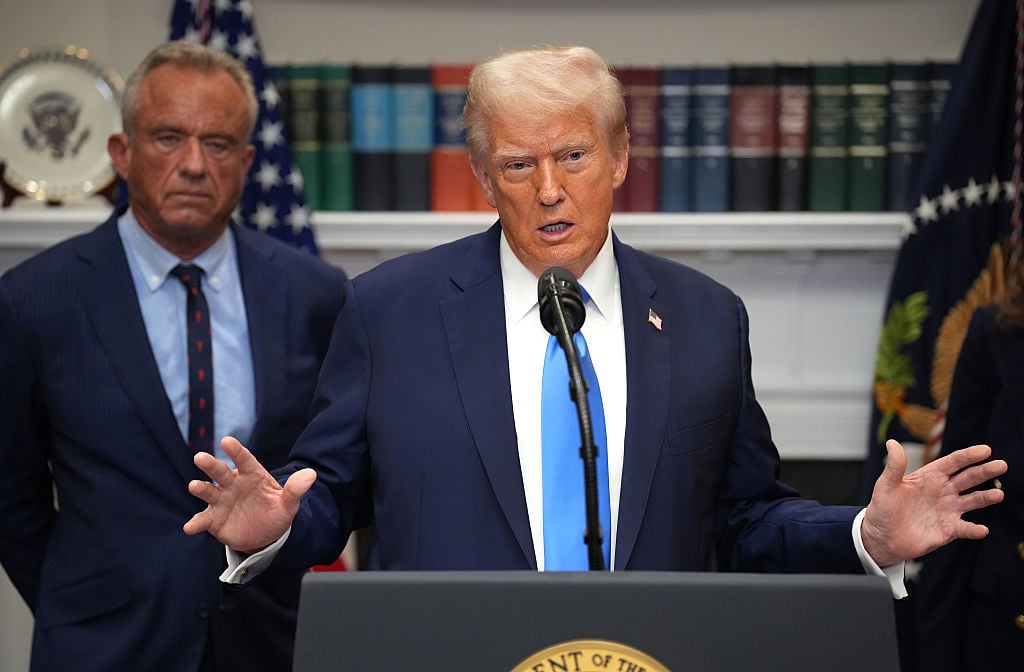
President Donald Trump signed an executive order Monday that calls for reducing the number of required vaccinations for children in a move that backs a revised immunization schedule pushed by the Department of Health and Human Services.
The executive order recommends immunizing children against 11 diseases, rather than the 17 that are currently recommended by the Centers for Disease Control and Prevention (CDC).
In the executive order, Trump said core childhood vaccine recommendations “should be aligned with scientific evidence and best practices from peer, developed countries while preserving access to vaccines currently available to Americans.”
In the executive order, the White House said HHS conducted a scientific assessment, identified a set of consensus vaccines consistently recommended across peer countries and found that the United States currently recommends more childhood vaccines than any peer nation. “The scientific assessment also found that, instead of implementing vaccination mandates, most peer nations maintain high childhood vaccination rates through public trust and education,” according to the executive order.
The policy, Trump said, also supports “maximal parental choice over childhood vaccines.”
The White House issued a directive May 29 as a broad statement of policy intent to align U.S. advice with peer nations, whereas the order issued Monday outlines explicit, actionable recommendations.
It’s unclear if the executive order has any legal power.
The order outlines three distinct categories of childhood immunization recommendations: vaccines recommended for all children, immunizations recommended for certain high-risk groups or populations and immunizations based on shared clinical decision-making.
The first category, recommended for all children, now includes 11 immunizations: measles, mumps, rubella, diphtheria, tetanus, pertussis, polio, Haemophilus influenzae type B, pneumococcal disease, human papillomavirus, and varicella.
Immunizations for respiratory syncytial virus monoclonal antibodies, hepatitis A, hepatitis B, meningococcal B, meningococcal ACWY, and dengue are recommended for high-risk groups. Vaccines subject to shared clinical decision-making include influenza and COVID-19 as well as hepatitis A, hepatitis B, rotavirus and meningococcal disease.
The order also directs HHS to explore offering single-antigen vaccines, beginning with separate measles, mumps and rubella shots in place of the combined MMR vaccine when such products become available domestically, and calls for childhood vaccines to be administered at separate medical visits “to the maximum extent feasible.”
Additionally, the administration ordered HHS to review vaccine timing and sequencing, study alternatives to aluminum-containing vaccine adjuvants, conduct ongoing risk-benefit assessments of childhood vaccines and expand vaccine safety monitoring and research.
Speaking in the Oval Office before signing the executive order, Trump linked the vaccine changes to concerns that vaccines are linked to autism despite dozens of studies that have not found a link between the two.
“Decades ago, children received only a small fraction of the vaccines required today. In those times, people were much healthier. And of course, the high rates of autism now observed did not exist. So there’s a reason for such epidemic rates of autism and we’re going to bring it back to much closer to where it was. While we do not know exactly what the cause is with respect to autism, it is essential to our research efforts that we have the very best vaccine recommendations in the entire world. So we’re reducing them,” Trump said during the press conference.
The Trump administration’s attempts to overhaul childhood vaccine recommendations have faced legal setbacks. In January, the CDC upended the immunization schedule for children in the U.S., eliminating six of the 17 vaccines that were previously recommended to protect them from disease. Major medical groups have pushed back on the administration’s high-profile changes to vaccine regulations and recommendations. The American Academy of Pediatrics (AAP) and other prominent medical organizations filed a lawsuit against HHS to reverse changes to the CDC’s childhood vaccine recommendations.
In March, a federal judge in Massachusetts blocked significant parts of the HHS’ vaccination agenda, finding that officials acted unlawfully in ushering in certain changes, Fierce Pharma reported.
As the administration’s prior directives regarding childhood vaccines have been delayed due to litigation over the composition of the Advisory Committee on Immunization Practices and separate updates to the federal vaccine schedule, the executive order is meant to “reaffirm” the policy, Trump wrote in the executive order.
The American Academy of Pediatrics swiftly condemned the executive order, noting that there is “no new evidence to justify significant changes to childhood immunization guidance.”
“As measles cases reach a 35-year high in the U.S. and with cold and flu season quickly approaching, today’s executive order on vaccines is not only disheartening but dangerous. Instead of ensuring every family can access life-saving vaccines for measles, influenza, RSV and more, federal leaders are once again spreading misleading claims,” Andrew Racine, M.D., Ph.D., president of the American Academy of Pediatrics, said in a statement.
“Today’s executive order is not based on ‘gold-standard science’,” Racine said.
Racine asserted that dozens of studies involving millions of people show there is no link between vaccines and autism, “yet federal leaders continue to promote this outdated, disproven idea to scare families.”
“Today’s executive order will do nothing to support families of children with autism or advance understanding of the condition. The only purpose of this announcement is to sow confusion so that more people doubt the importance of vaccines,” he said.
Vaccine recommendations from the American Academy of Pediatrics are tailored to the health of children living in the United States and are based on decades of research and systematic tracking of real-world experiences, Racine noted.
“Pediatricians recommend children receive certain vaccines at specific ages based on when children’s immune systems will respond best and when they are most vulnerable to certain diseases. Sometimes this means children will receive a single shot that protects against multiple diseases, or they may receive multiple vaccines at one visit,” he said.