
What Is Human-Centered Performance Management—and What Does It Look Like in Practice?

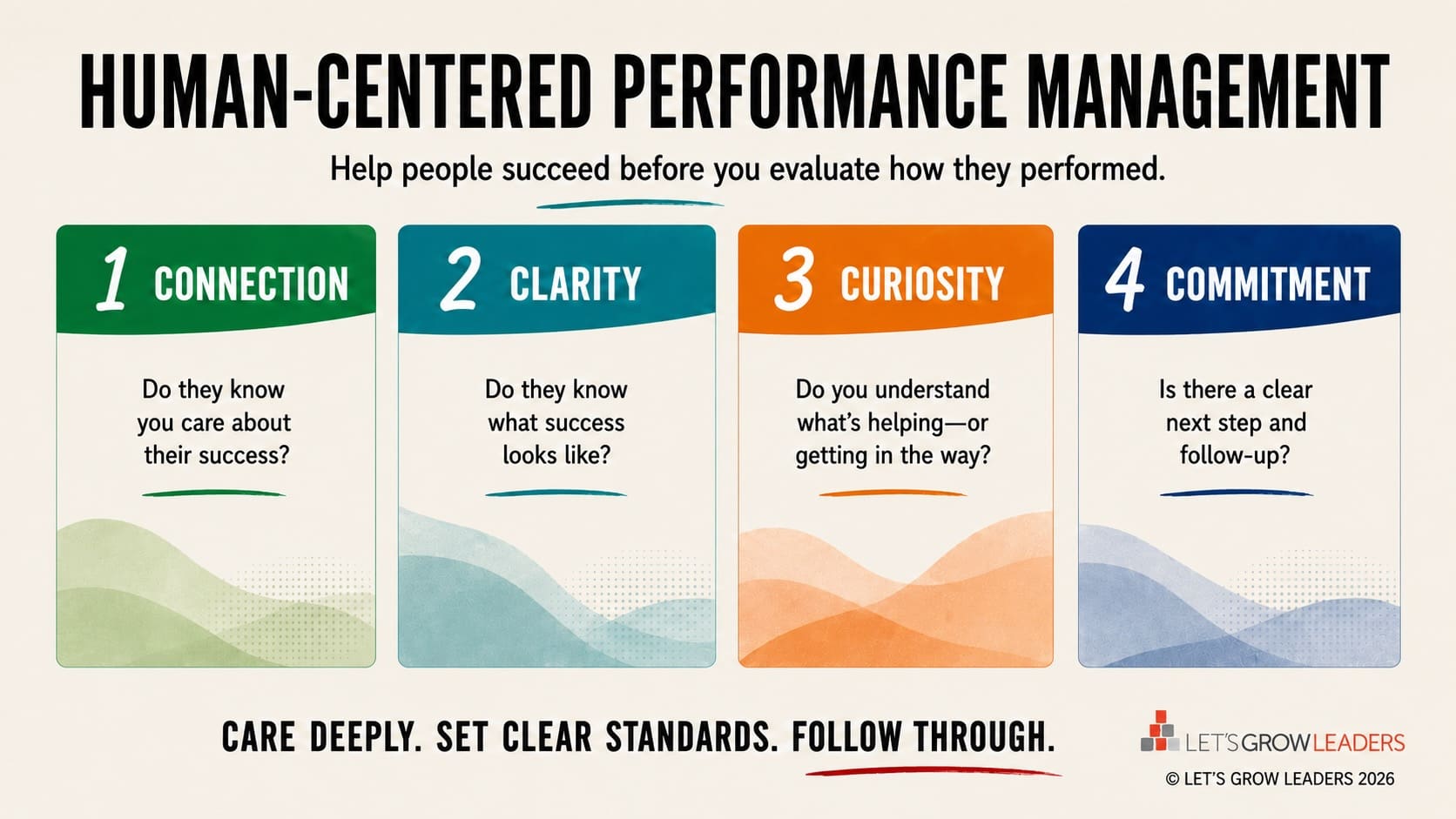
Help People Succeed Before You Evaluate How They Performed
You care about your people. You also need them to perform.
Most managers don’t struggle because they care too much about one and not enough about the other. They struggle because they aren’t always sure how to do both at the same time.
How do you address a missed commitment without damaging trust?
How much support is helpful—and when does helping turn into rescuing?
What do you say when an employee becomes defensive, shuts down, or agrees to improve but nothing changes?
And how do you keep performance management from becoming a once-a-year scramble involving a form, a rating, and several uncomfortable surprises?
That’s where human-centered performance management comes in.
Human-Centered Performance Management: A Quick Answer
Human-centered performance management is an ongoing approach to helping people succeed through clear expectations, meaningful coaching, honest feedback, and consistent accountability. It creates the conditions for people to do their best work—and addresses performance concerns with clarity, curiosity, and care when they don’t.
Human-centered performance management doesn’t lower standards or avoid difficult conversations. It helps managers establish clear expectations, offer appropriate support, address problems early, and follow through when commitments aren’t met.
What Human-Centered Performance Management Looks Like in Practice
Your employees should consistently know:
- What success looks like
- Why their work matters
- How they’re doing
- Where they need to improve
- What support is available
- What they’ve committed to doing next
When those conversations happen consistently, the annual performance review becomes a meaningful reflection and planning conversation—not an archaeological dig for examples from eleven months ago.
Human-Centered Doesn’t Mean “Soft”
Sometimes managers worry that a human-centered approach will make accountability harder.
They think, “If I ask too many questions, will it sound as if the expectation is optional?”
Or, “If I show empathy, will they assume the poor performance is okay?”
But empathy and accountability aren’t opposites.
You can care deeply about an employee and tell them that their work isn’t meeting expectations. You can listen carefully to what they’re experiencing and still ask for a specific commitment. You can offer support and hold a firm boundary.
In fact, avoiding an important performance conversation or stuffing it in the “diaper genie” isn’t kind.
When you let an employee continue to struggle without clear feedback, they lose the opportunity to improve. Their coworkers often carry extra work. Customers feel the consequences. Resentment grows, and eventually the conversation becomes far more serious than it needed to be.
A human-centered manager addresses the issue early because they care about the employee, the team, and the results.
The Human-Centered Performance Management Loop
In our work with leaders around the world, we’ve found that effective performance management depends on four dimensions: Connection, Clarity, Curiosity, and Commitment.

We call this the Performance Loop because performance management isn’t a one-time event. You move through these dimensions continuously as priorities change, people grow, and new challenges emerge.
1. Connection: Build Trust Before You Need It
Human-centered performance management begins with connection.
Do your employees know that you care about them and want them to succeed? Do you understand what motivates them, what they’re proud of, and where they want to grow? Do they believe they can bring you a problem before it becomes a disaster?
Connection doesn’t mean becoming your employees’ best friend or avoiding uncomfortable subjects. It means building a relationship in which honest conversations are normal.
That trust is built in small moments:
- Asking thoughtful questions and listening to the answers
- Recognizing meaningful contributions
- Keeping your commitments
- Showing interest in an employee’s development
- Responding constructively when someone brings you a concern
- Giving feedback throughout the year, not only when something goes wrong
When you’ve invested in the relationship, a performance conversation is less likely to feel like a sudden attack.
You can begin with a clear statement of positive intent:
“I care about you and your success, and I have an observation that I think will help. Is this a good time to talk?”
Or:
“My intent for this conversation is to make sure you have the clarity and support you need to succeed.”
Of course, a strong opening won’t eliminate every uncomfortable emotion. Performance feedback can be hard to hear. But genuine connection helps the employee understand why you’re having the conversation.
2. Clarity: Show People What Success Looks Like
 Many performance problems begin long before an employee misses a deadline or disappoints a customer.
They begin when expectations are vague.
You think you’ve asked for one thing. Your employee leaves believing you asked for something slightly different. Or you communicate the task but not its priority, purpose, quality standard, or deadline.
Weeks later, you’re both frustrated.
Before assuming you have a performance problem, ask yourself:
Did I…
- Clearly explain the desired outcome?
- Identify what matters most?
- Schedule the finish, including and aligning on a deadline?
- Explain how the work will be evaluated?
- Clarify what decisions they can make independently?
- Check for understanding?
That last question is essential. Telling isn’t the same as communicating.
A practical check for understanding might sound like:
“I want to make sure I communicated this clearly. What are you hearing as the most important outcome?”
Or:
“What’s the first step you’ll take, and when should we check in on progress?”
This isn’t a quiz. You’re not asking employees to repeat your exact words to prove they were paying attention. You’re discovering whether you created a shared understanding.
If their answer isn’t what you intended, you’ve uncovered the confusion while it’s still easy to fix.
And if you realize you haven’t been clear in the past, own it.
“I realize I haven’t been as clear as I needed to be about this expectation. That’s on me. I’d like to reset our expectations going forward.”
Taking responsibility for unclear expectations doesn’t weaken your authority. It strengthens your credibility—and gives you a fair foundation for future accountability.
3. Curiosity: Diagnose Before You Prescribe
 When an employee’s performance slips, it’s tempting to jump straight to a solution.
Give more instructions. Monitor them more closely. Send them to training. Remind them to “be more proactive.”
Sometimes those responses help. Other times, they solve the wrong problem.
Poor performance can have many causes:
- The expectation wasn’t clear.
- The employee lacks a necessary skill.
- They know what to do but lack confidence.
- They’re overwhelmed by competing priorities.
- A broken process is making success unnecessarily difficult.
- They don’t have the information, authority, or resources they need.
- They’ve lost motivation.
- They understand the expectation but aren’t committed to meeting it.
- The role is no longer a good fit.
These situations require different leadership responses.
More encouragement won’t solve a skill gap. Training won’t fix a lack of commitment. Accountability won’t repair an impossible process. And rescuing an employee who is capable but uncertain can make them even more dependent on you.
Before deciding what an employee needs, stay curious.
You might ask:
“What’s making this more difficult than you expected?”
“Where do you feel confident, and where could you use more support?”
“What competing priorities are getting in the way?”
“If you were going to improve this result, where would you begin?”
“What’s one thing I could do that would make it easier for you to succeed?”
Curiosity doesn’t mean accepting every explanation as an excuse. It means gathering enough information to respond wisely.
You’re trying to understand whether the employee needs clarity, coaching, resources, encouragement, accountability, or a more serious conversation.
4. Commitment: Turn the Conversation Into Action
 A thoughtful performance conversation can feel productive in the moment and still change nothing.
You both talk. The employee nods. Everyone leaves feeling relieved.
Then two weeks later, the same problem happens again.
Human-centered performance management turns insight into a specific commitment.
Before ending the conversation, clarify:
- What will the employee do?
- What will you do?
- What does improvement look like?
- When will the action happen?
- How will you both know it worked?
- When will you discuss progress again?
A commitment might sound like:
“What specific action are you willing to take before our next meeting?”
Then check for shared understanding:
“What I hear you committing to is updating the project tracker by 3 p.m. every Friday. Is that right?”
Finally, schedule the follow-up:
“Let’s put twenty minutes on the calendar for the end of the month. We can look at what’s improving, address any obstacles, and recognize the progress you’re making.”
Follow-up isn’t only for catching continued problems. It also gives you an opportunity to notice growth.
When an employee makes a meaningful change, tell them.
“I noticed you raised the concern two weeks earlier this time. That gave us room to solve the problem before it affected the customer. Thank you.”
Specific recognition reinforces the behavior you want to see and shows that the performance conversation was truly about helping them succeed.
What Human-Centered Performance Management Looks Like in Practice
Imagine that one of your employees, Jordan, has missed three project deadlines in the past six weeks.
You’re frustrated. Other team members have had to adjust their work, and your manager has begun asking what’s happening.
An unhelpful response would be to wait until Jordan’s performance review and reduce their rating. Another would be to take over their work because explaining it again feels exhausting. You could also send a vague message asking Jordan to “improve time management.”
None of those responses gives Jordan a fair opportunity to understand and address the problem.
A human-centered performance conversation might unfold this way.
Start with connection and intent
In our human-centered performance management training programs, leaders learn how to use the Let’s Grow Leaders I.N.S.P.I.R.E. method for accountability conversations which looks like this.
Initiate the Conversation
“Jordan, I’d like to talk about the recent project deadlines. My intent is to understand what’s happening and make sure we have a clear plan going forward.”
Notice the specific behavior and explain the impact
“The customer analysis was due on May 10 and arrived on May 13. The implementation plan was two days late, and yesterday’s update wasn’t completed by our agreed-upon deadline.”
This is much more useful than saying, “You seem disorganized” or “Your attitude toward deadlines is becoming a problem.”
You can observe behavior. You can’t observe attitude.
“When those updates arrive late, the implementation team has less time to complete its work, and we risk missing the customer commitment.”
Probe with curiosity
“What’s happening from your perspective?”
Perhaps Jordan is struggling with a new reporting system. Perhaps three senior leaders are assigning conflicting priorities. Perhaps Jordan underestimated the work and waited too long to ask for help.
Or perhaps Jordan understood the expectations and simply didn’t prioritize the commitments.
Your next response depends on what you learn.
Invite a solution
“What do you think would help you meet the next deadline?”
Let Jordan think. You don’t need to solve the entire problem immediately.
If their solution is incomplete, you can coach:
“That sounds like a useful start. What will you do if you realize you’re at risk of missing the deadline?”
Review the commitment
“So, you’ll break the project into three milestones, send me a brief update each Tuesday, and raise any risk at least forty-eight hours before the deadline. Is that a commitment you can make?”
Establish follow-up
“Let’s check in after the next two milestones and see how this approach is working.”
The standard hasn’t changed. The deadlines still matter. But Jordan now understands the pattern, the impact, the expected change, and the support available.
That’s human-centered accountability.
Address Performance Throughout the Year
Human-centered performance management works best when feedback is frequent, specific, and proportionate.
Not every issue needs a formal meeting.
Sometimes a thirty-second conversation is enough:
“Quick observation: when you summarized the decision at the end of that meeting, everyone left knowing exactly what to do. Please keep doing that.”
Or:
“I noticed the report didn’t include the customer-impact analysis we discussed. Please add that before you send the final version.”
Short conversations help employees adjust in real time. They also prevent managers from saving 12 months’ worth of feedback for one overwhelming conversation.
By the time you reach the annual performance review, there should be very few surprises.
You can use that conversation to step back and consider:
- What accomplishments matter most?
- What strengths should the employee continue using?
- What patterns would help them become more effective?
- What have they learned?
- Where do they want to grow?
- What support, experience, or coaching would help?
- What commitments will you both make for the coming year?
That’s a far more valuable conversation than debating whether someone is a 3.4 or a 3.6 on a five-point scale.
Don’t Forget Your Strong Performers
Performance management isn’t only about addressing problems.
Your consistently strong performers also need thoughtful feedback, recognition, coaching, and meaningful opportunities to grow.
“You’re doing great” might feel positive, but it doesn’t tell them:
- Which contributions are having the greatest impact
- What strengths they should continue using
- How others experience their leadership
- What might prepare them for greater responsibility
- Where they could stretch without burning out
- How their work connects to the organization’s future
Ask your high performers what they’re proud of, what they’re learning, and where they feel underchallenged.
And be specific when you recognize their contribution:
“The way you involved operations early helped us identify the implementation risk before it became a customer problem. That combination of curiosity and collaboration made a real difference.”
Strong performers deserve more than gratitude. They deserve leadership that helps them continue growing.
Human-Centered Performance Management Is a Shared Responsibility
Managers play a central role, but sustainable performance requires shared accountability.
Employees need to ask for clarity, surface concerns early, seek feedback, and honor their commitments.
Managers need to establish expectations, provide support, address problems, and recognize progress.
Senior leaders need to align priorities, model accountability, and ensure managers aren’t punished for raising legitimate performance concerns.
HR professionals need to equip managers with practical tools, coach them through complex situations, and create fair and consistent processes.
When all four groups understand their role, performance management becomes part of how work gets done—not a process everyone tries to survive.
A More Human—and More Effective—Way to Lead Performance
Human-centered performance management begins with a simple belief: most people want to succeed, and they deserve to know what success requires.
That means creating clarity before criticizing the outcome. Staying curious before assuming you know what’s wrong. Coaching people to think and grow. Addressing problems while they’re still small. Recognizing meaningful progress. And following through when commitments aren’t met.
You don’t have to choose between caring about people and expecting results.
Your team needs both.
And when you consistently lead with connection, clarity, curiosity, and commitment, performance management becomes less about managing a process—and more about helping people do work they’re proud of.
Are you looking to build a culture of human-centered accountability, where leaders at every level have the confidence and skills to set clear expectations and coach employees to high performance? We can help. Contact us to learn more about our custom performance management for human-centered leaders programs, or learn more about our open-enrolment performance management accelerator here.


