
When the City Books a Mega-Event on Top of Yours

Next weekend Washington DC will play host to two major events at once.
On the National Mall and across city streets, INDYCAR will stage the Freedom 250 Grand Prix, the first street race in the capital’s history.
On Saturday, Aug 22, about a mile north, the Library of Congress will host their 26th National Book Festival at the Walter E. Washington Convention Center.
Our team works the Festival.
Decibel Events has been the Operations and Logistics vendor for the Library of Congress National Book Festival since 2009. We are not producing the race, we’re just sharing a city with it, along with every other event production team putting on an event in DC this month.
So when I tell you that sooner or later your host-city will book a mega-event on top of your established event, I’m not guessing. It is the situation we are working right now. Our load in starts Tuesday. This isn’t the first time a city has changed the ground rules around an event we produce, and it won’t be the last. Not one time has our answer to a client been to give up the date.
The race outside our window
INDYCAR takes over the Mall on August 22 and 23. A 1.7-mile, seven-turn street circuit, broadcast live on FOX, with the main race on Sunday. That part you’ve probably read about.
 The part that matters to every other event producer, client or host in town is longer and more nuanced. The District has posted Emergency No Parking along the affected streets from July 12 through September 15. Construction crews have been closing parking lanes, curb lanes, and partial travel lanes from July 22 through August 14 for the buildout, then they will again from August 24 through September 3 for the breakdown. This makes it a nine-week street footprint for a two-day race, and every team producing an event in this city sits somewhere inside this footprint this month. Including us.
Here’s what race weekend looks like from the festival side, all of it straight from the Library of Congress’ public information team. The convention center sits at Mt. Vernon Square, with a Metro station on the Green and Yellow lines at our door and well clear of the circuit. The Library requires tickets this year (totally free, get them here), encourages advance registration, and will have same-day tickets available. Can’t make it in person? The Library will livestream a selection of programs and post video of everything shortly after. The full guide lives at loc.gov/bookfest, and if you’re coming, read it before you leave the house. Getting anywhere on a race weekend goes a lot better if you checked the map the night before.
Fair warning: this section will be ancient history by October. The rest of the post won’t be.
I was there for year one in Las Vegas
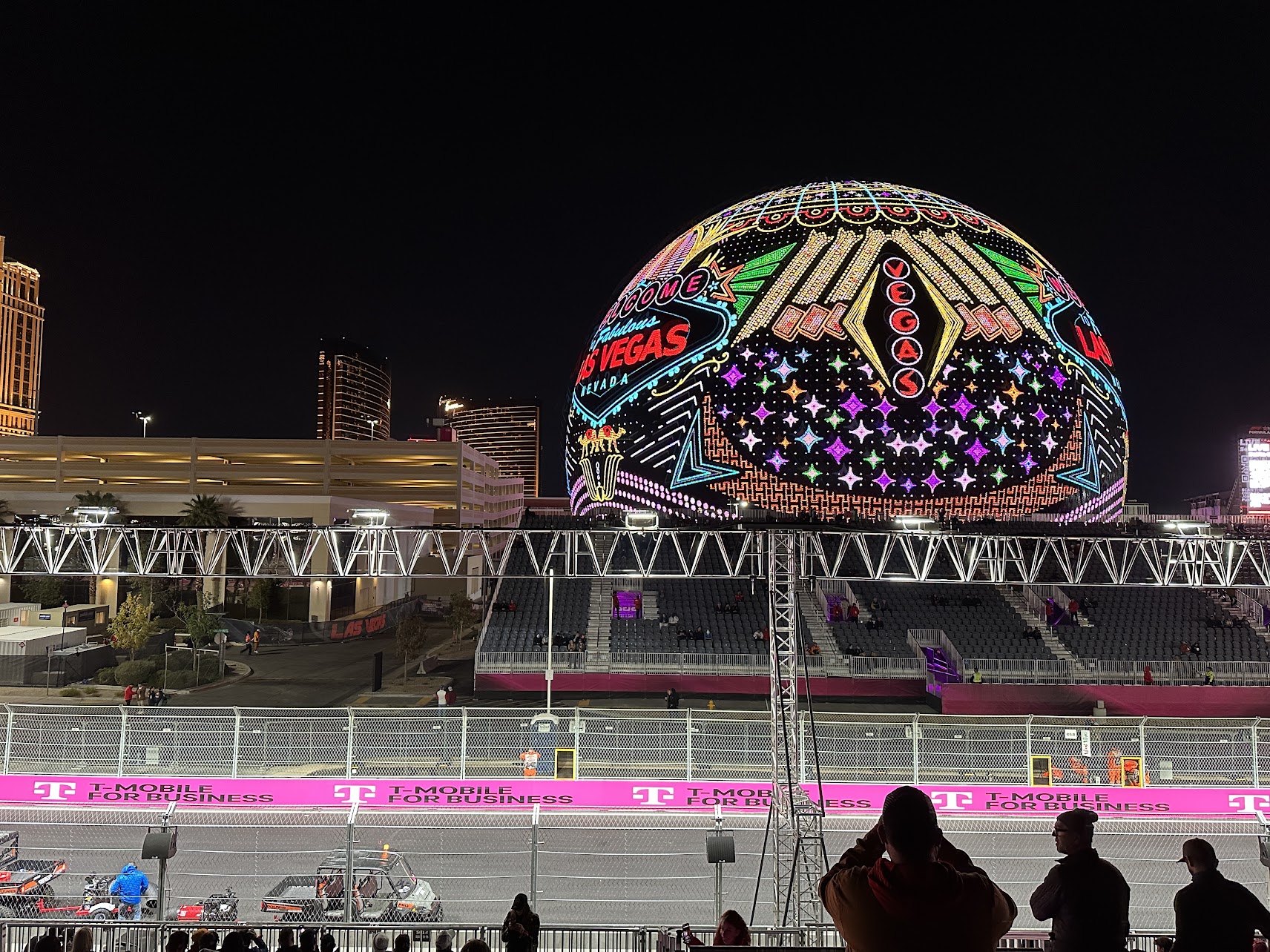
In November 2023 I flew to Las Vegas for the inaugural Formula 1 Las Vegas Grand Prix. Most of you know I’m a fan. But I made it a priority to go because when a city attempts something at that scale for the first time, it’s professional development for anyone who does this for a living. The photos in this post are mine from that weekend.
 Nine minutes into the first practice session, the downforce from a car pulled a water valve cover loose and it destroyed the underside of the Ferrari. Crews spent hours pulling and inspecting covers across the 3.8-mile circuit, and race officials didn’t get the second session started until 2:30 in the morning, in front of grandstands that security had cleared out hours earlier. We only knew it was happening because you could hear it from our room at the Venetian. The logistics and decision matrix around clearing the stands is enough for an entire post itself. Local businesses had already sat through months of construction by then. Ticket holders filed a class action, and the organizers settled it for just over three million dollars.
I don’t say any of that as a knock on Vegas. That’s just what year one looks like up close. Monaco has hosted a Grand Prix on its streets since 1929. Disney has spent seventy years working out how people move through a park. When those operations look effortless, it’s because somebody solved the hard parts decades ago. Vegas earned year two the hard way, and in years two and three the organizers had shorter build windows, better merchant coordination, and contingency plans they’d actually rehearsed.
DC is in its inaugural year right now, producing an event on some of the most jurisdictionally complicated ground in the country. NPS, Secret Service, Metro PD, US Park Police, DDOT, and a federal schedule that doesn’t get changed for a race. The team producing it has its work cut out, and whoever produces the next first-year event in this town will be grateful for the playbook they’re writing.
The people covering a race like this write for the fans going to it. Almost nobody writes for the teams working a different event in the same city that month. That’s the seat we’re in. This one’s for you.
The Library of Congress National Book Festival team has been through a citywide shakeup before
There’s a piece of this weekend’s story most coverage will skip, and honestly it’s my favorite part. The reason the National Book Festival and an IndyCar race can coexist in this city at all goes back to a disruption the National Book Festival took on the chin twelve years ago.
For over a decade the Library held the National Book Festival outdoors on the National Mall, with crowds that topped 200,000 across a weekend. Then in 2013, right as that year’s Festival was about to open, National Park Service rolled out their new rules for the National Mall. The Park Service had just finished a major turf and irrigation restoration, and it now required major changes. This included protective decking over the grass for pedestrians, no more staking tents (the turf has a rubber barrier 36″ under the surface), a marble surround for each of the panels, and large structures contained to the gravel paths. They also rolled out one hell of a bond that has to be put up for turf damage. While this isn’t the three comma club, it’s certainly a Powerball winning amount. All of this combined made a seven block outdoor event far more expensive and complicated to build. The Library spent months looking for a compromise with the Park Service. Nobody found one. In 2014, after twelve years outdoors, the Library moved the festival indoors to the Walter E. Washington Convention Center. Our team at Decibel Events handled operations and logistics through that transition, same as we had for the five years before it.
People who loved the Festival on the Mall were sore about the move, and I understood. I loved it out there too. If you have not visited Washington, D.C. in September you should. If you plan outdoor events also know it’s the best temp and lowest rainfall stats you can find. But look at what the Library of Congress gained in the trade. Climate control, after years of heat advisories and rained-out afternoons. Evening programming the Park Service never allowed on the Mall. A Metro station at the front door instead of a long walk across grass. Accessibility and accommodations that were impossible outdoors. Massive gains in customer satisfaction. And now, twelve years later, the Library isn’t competing with a race track on the same grounds. The 2014 move is a big part of why this weekend is workable at all.
A few things that experience taught us, and they apply whenever your city schedules a city-wide on top of your annual meeting:
Being established doesn’t protect you. Twelve years and 200,000 people didn’t matter once the White House changed its priorities. Your annual conference isn’t exempt because it’s always been on that date, in that hall, or on that street.
Work with the agency(s), not against it. The Park Service had a turf restoration project it was required to complete, and they weren’t going to un-have it. Once you treat the requirement as a design input, you can plan to it. Fight it and you just lose slower.
A forced change can leave you better off. The Library didn’t choose the move. Twelve years later the Festival is stronger for it, and this month is the proof.
What actually changes for your event
When a city takes on a city-wide or mega-event, the headlines cover road closures. The real changes for every other event are quieter.
Curb access, not just road access. Roads staying open isn’t the same as your truck having a place to stop and you being able to unload. The city restricts the curb lanes and parking lanes first, and those closures last for weeks on either side of the event. Confirm where your trucks stage, where your crew can park, and where your speakers get dropped off. Then confirm it again, in writing. Get a map. Don’t stop confirming.
Crew and vendor availability. The teams building a hundred-thousand-person event book the stagehands, riggers, barricade, generators, trucking, and security before anyone else can. The vendors you’d normally call on have already committed. Lock your crew earlier than you would in a normal month. Our event books staff for a week load-in for a one day event. The race is booking crew for 3-4 weeks. We support crew and know that they will always select the longer, higher paying gig. We are fortunate to have a solid crew that we treat right, and they treat us right every year.
Hotel availability. Hotels sell out and raise rates across the whole market, not just near the main venue. If your attendees book their own travel, tell them now rather than in the reminder email. As soon as the date was announced, our outstanding TD called our crew hotel and signed the contract. Another reason a solid TD is worth their weight in gold.
How your attendees actually arrive. Organizers steer their crowds to public transit, and your attendees ride the same system on the same days. A venue five blocks from the perimeter is either an easy walk or a bad morning, depending on which station your attendees plan for. Give guidance with named stations, not general advice.
Security posture. When federal agencies own the perimeter, they make the access decisions for your venue, not you. Agencies can apply screening, bag policies, and vehicle restrictions to buildings that are nowhere near the footprint on a map. Find out early which decisions belong to whom.
The playbook: eight moves, in order
- Get the official closure map and overlay it with your venue, your load-in rollup door, and the path your attendees walk from public transit.
- Confirm curb and dock access with the venue in writing, with specific dates and hours. A verbal yes from the dock manager means nothing to the police detail out front.
- Re-confirm every vendor, and ask each one what else their crew and warehouse are working that weekend.
- If your venue allows, move load-in earlier than the schedule calls for. Buy yourself a day.
- Write attendee travel guidance with named Metro stations, and send it twice.
- Ask out-of-town speakers and talent to arrive a day early.
- Assume you can’t change truck movements or rigging plans on short notice.
- Ask whoever handles logistics which agencies have a say in your event and what each one requires. If they can’t answer that, you’ve learned something useful.
Should you move or cancel?
Usually no. A city hosting something large is also a city full of people, energy, and press. Teams put on events in Washington, D.C. during inaugurations, state funerals, and the Fourth of July every year, and they are a success when the planners work with the conditions instead of against them. This city is about to host The Library of Congress National Book Festival and the Freedom 250 on the same weekend, and the people behind both intend to have a good one.
There are cases where moving is right. If your event depends on motorcoach movement through a closure zone, if your guests include officials whose security details will be committed elsewhere, or if your venue sits inside the secure perimeter, the honest answer may be to host a different weekend. A partner who tells you that is worth more than one who tells you it’ll all be fine.
Your city is probably next
This isn’t really a Washington story. FIFA just took the World Cup through eleven American host cities. Los Angeles is building toward the 2028 Olympics. Cities keep saying yes to first-year mega-events, and the same things happen every time. Builds take longer than planned because nobody has done one there before. The new event’s crews hire up the local labor market. Contingency plans stay theoretical because nobody has rehearsed them. Year two is calmer because somebody wrote down what broke in year one.
If your city is hosting something new, the questions are the ones above. Ask them early, while your team still has options.
Frequently asked questions
When is the 2026 Library of Congress National Book Festival?
Saturday, August 22, 2026, at the Walter E. Washington Convention Center in Washington DC, from 9 a.m. to 8 p.m., with doors at 8:30 a.m. The Festival is free and open to the public, and the Library requires free tickets for entry. INDYCAR stages the Freedom 250 Grand Prix on the National Mall the same weekend, about a mile south. The Library posts official festival information at loc.gov/bookfest.
Who produces the Library of Congress National Book Festival?
The Library of Congress produces the National Book Festival. Decibel Events has served as the Festival’s Operations and Logistics Vendor since 2009, through its years on the National Mall, its 2014 move to the Walter E. Washington Convention Center, and its virtual and hybrid formats.
Has a major Washington DC event ever been forced to relocate?
Yes. The Library of Congress moved the National Book Festival off the National Mall after 2013, when the National Park Service adopted new rules protecting the Mall’s restored turf that made large-scale outdoor production unworkable there. The Library has held the festival indoors at the Walter E. Washington Convention Center since 2014.
How far in advance should I book crew and vendors during a city-wide or mega-event window?
Earlier than normal. In a typical cycle you have flexibility a few months out. In a window like this, the crews, trucking, and barricade companies you need have already committed to the larger event. Lock your vendors the moment organizers announce the city-wide or mega-event’s dates, not when the city publishes the closure maps.
When is the Freedom 250 Grand Prix, and how long do its closures last?
August 22 and 23, 2026, on a temporary 1.7-mile, seven-turn street circuit around the National Mall, with the main race broadcast live on FOX on Sunday, August 23. The street footprint is much longer than the race: the District has posted Emergency No Parking from July 12 through September 15, and crews close lanes for buildout and breakdown for weeks on either side of race weekend.
Does Decibel Events work events during periods like this?
Yes. We’ve supported corporate, federal, and association events in Washington DC since 2007, so road closures, security perimeters, and the federal schedule are part of most jobs we take here.
Does Decibel Events work outside Washington DC?
Yes. We’re headquartered in DC, and our team works events across the country and internationally. The same senior people who handle the federal environment here handle your show wherever it is.
Have an event inside a window like this?
If something is on your calendar in a city that’s about to host its first city-wide or mega-event, and you’d like a second set of eyes on your plan, we’ll spend an hour with you on a call. No cost. Bring your site map, your load-in schedule, and your worries. We like talking about events.
And if we’re not the right firm for what you’re doing, we’ll tell you and point you toward who is.


