


“Where do you get your ideas?” is a question you get
asked a lot on school visits. I suspect AF Harrold has also often been asked
this question, because in The Book of Not Entirely Useful Advice there is an
Ideas Shop, where you can buy reasonably priced ideas.

Now the idea of buying a couple of bags of ideas really
appeals to me. I’ve trawled the backstreets of Oxford and haven’t found the
Oxford one yet. I’m still looking.
But how do stories get started? When and how did the first whiff of a
thing that became a book come into being? So my mission in this post is to be a Starting Point Detective, and track down those elusive beginnings.
JK Rowling, when describing
her creative process, talks about a Lake and a Shed. There’s a Thing in the
Lake that hands you stuff that you take to your shed and work on, hammering
away at it.
“I feel as though the inspiration is the
thing that lives in the lake that’s very mysterious, that I never see. But it hands
me stuff. And then I have to take this unformed stuff – sometimes it can be
reasonably formed, sometimes it’s very blobby like molten glass or something,
and then I have to take it into the shed and there I have to work on it.”

JK Rowling is working with
ideas and words, but when you’re a picture-book-maker, you’ve got all the
visual ideas to play with too. My sketchbook is my shed and my collecting place:
in the back pages are my shelves and drawers for any scrappy ideas to be stored.
In the middle pages is the workshop: when the time is right, a poor blinking
squinting idea can be brought from the back out into the middle zone and I see
if there’s anything it can become.
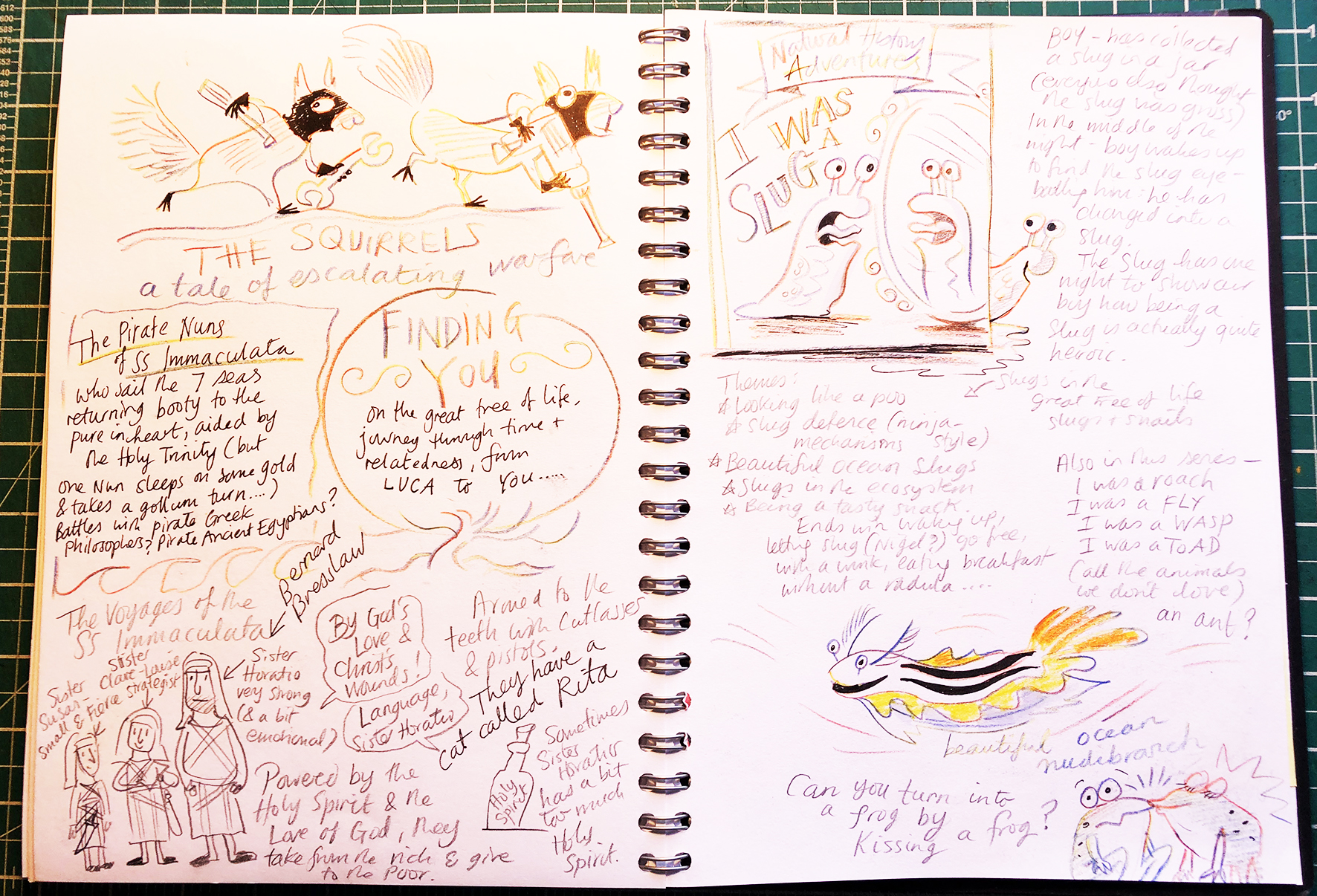 |
| Sketchbook back pages in which I scribble down my brilliant idea for some Pirate Nuns… |
Some treasures from the back of sketchbooks can be
thing you found or cut out of newspapers.
 |
|
| A news story about a mysterious smell. Could I do something with this forgotten lunch? |
 |
| Starting place? Mice vs cats at the British Museum |
Ideas have a habit of evaporating and being lost. The trick is to make sure the ideas don’t fly away – to be a butterfly collector and pin them down, and keep them safely captive until you can bring them into the workshop.

Sometimes catching a starting point means being a
Story-Sniffer: following a trail to a story: a scent, a place, a mood. This
might mean starting with making pictures, with a colour palette, a fox in a
moonlight night, someone running through green forest.

But sometimes starting might be a train of thought, a voice-over. Here’s a sketchbook page:

I was on a train, I had this idea about magic show bunnies that I was stuck with. Then I started just performing the show, being
the Announcer, and that gave me just about all the story of the Bad Bunnies’
Magic Show.
Asking WHAT IF? (or WHAT COULD?) can be a good starting place. The Adventures of the Dish and the Spoon started with thinking about all the things that a Dish and a Spoon could do together:

…and in those things were the seeds of a love story
and the danger of being broken.
Here’s the first idea for The Last Wolf on an always-useful post-it note:

Sometimes why not just steal a story? Sometimes you’ve started with a stolen story without realising it. My book Hermelin, I realised after I’d made it, was really an attempt to remake a favourite childhood book about a cheese-loving proud mouse with a typewriter: Anatole, by Eve Titus and Paul Galdone.

Starting with a badly
remembered story can lead you to new and wonderful places. Jon Klassen’s book The Skull began with a folktale in a library in Alaska that Jon read while waiting to do a presentation. He put the book back on the shelf, but afterwards thought about the story, remembered the story, reimagined the story. Eventually he’d remade the story. He contacted the Alaskan Library and tracked down the original tale, and it was wildly and disappointingly different to the story of Otilla and the Skull that he’d made. So a badly remembered thing can lead to a good thing.
A Start can be with an escaped
story; and an ending can become a beginning. The Bad Bunnies that I was pondering about earlier on the train, had actually escaped from a book of poems I’d illustrated by June Crebbin, specifically this poem about a magic show crime scene:

Starting can be with a thing that
happened. Sometimes it’s a lost thing: here are a couple of lost things that inspired stories:
 |
| Our missing Cat Bonzo for a starting point for Hermelin. |
 |
| You wouldn’t think it was possible to lose a whale… |
So you have a starting point to think about – now you need ingredients for your story, you need to collect things that might happen. One way to collect ideas is to draw. Draw to explore: to go ideas-fishing. Drawing pulls out more ideas like pulling out fish from a dark bottomless lake. Ideas happen while you are drawing, the act of drawing makes ideas happen. I always use the scrappiest paper possible no nothing matters, this does not have to be a good drawing.
I thought I’d try and map out all the things I’m interested
in and like drawing and like thinking about, so if I ever need a starting point
I can pick one from my Starting Points Mind Map, and take it to the workshop and see what happens.
So here it is:
 |
| My Starting Points Directory Mind Map |
It’s on my wall for whenever I might need a starting
point. Maybe I could randomly choose two things off it and see what happens
when I put them together – I actually put a Combination Machine in the bottom
right corner for just this purpose…
So now it’s definitely time to end this post about starting points. I wish you much happy ideas-fishing in your own personal lake – or whatever or wherever your ideas come from.


