This post may contain affiliate links to things like tours, hotels, Amazon associates and products. These help me earn a small commission at no additional charge to you.
I recently had a fantastic, memorable trip in Northern Uzbekistan, one that was quite spontaneous. Although I had heard positive things about visiting the Aral Sea & Moynaq Ships, I wasn’t sure if I would. I’d heard LOTS of driving is required, and that tours are expensive because they charge per 4×4 vehicle, so you need to fill all the seats (not super convenient for solo travellers in Uzbekistan).
I wasn’t in a rush since I had three months to visit Central Asia, so I kept my mind open to visiting but decided to see if I met other travellers in Khiva who wanted to split the trip. I also wanted to hear from travellers who had visited to find out whether it was worth a trip to the region.
In the end, I had no problems meeting people to explore with, and I felt the experience was well worth my time and money. Here’s everything you need to know…
Where is the Aral Sea?
It’s in Northern Uzbekistan, close to the border with Kazakhstan’s Mangystau region.
Side note: this region looks insanely stunning, but I don’t think I’ll have time to visit while in Kazakhstan. Luckily, I now feel like I have been, thanks to the comparable scenery in Northern Uzbekistan during the tour.
Karakalpakstan
The Aral Sea and Moynaq are located in Karakalpakstan, an autonomous region of Uzbekistan with centuries of history. They even have their own flag and language.
Historically, the region was home to the ancient Khorezm civilisation, based around the banks of the Amu Darya River. To this day, you can see the remains of their fortresses (we were lucky enough to stop at one between Khiva and Nukus for sunset), some of which date back 2,500 years.
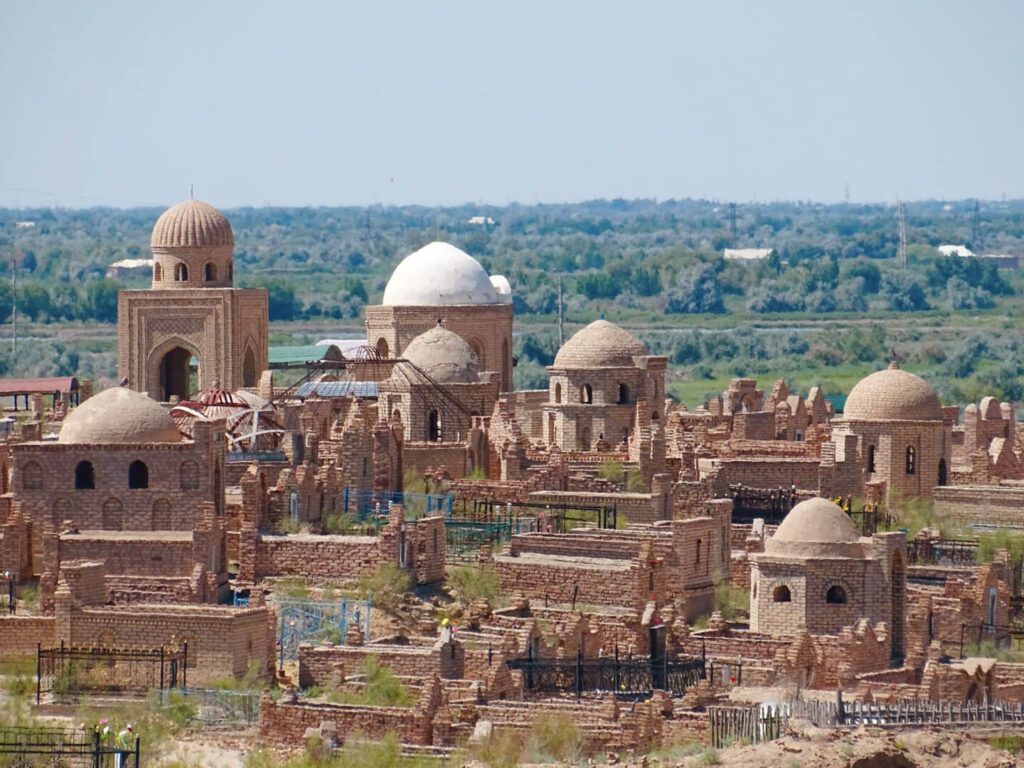
Here you can see evidence of Buddhism and Zoroastrianism, practised before Central Asia became Islamic. We saw evidence of this at a cemetery where bodies were historically placed in high places so birds could return them to nature.
Nowadays, Karakalpakstan is largely comprised of the Aral-Qum: the new, man-made desert created by the retreat of the Aral Sea.
What’s the story of the Aral Sea?
During the Soviet Union’s occupation of Uzbekistan in the 1960s, feeding rivers that supported the Aral Sea were diverted to power factories producing cotton (the most important export of the era).
What was once the world’s fourth-largest lake (despite the name, the Aral Sea is actually a lake, not a sea) shrank by 90% within 40 years.
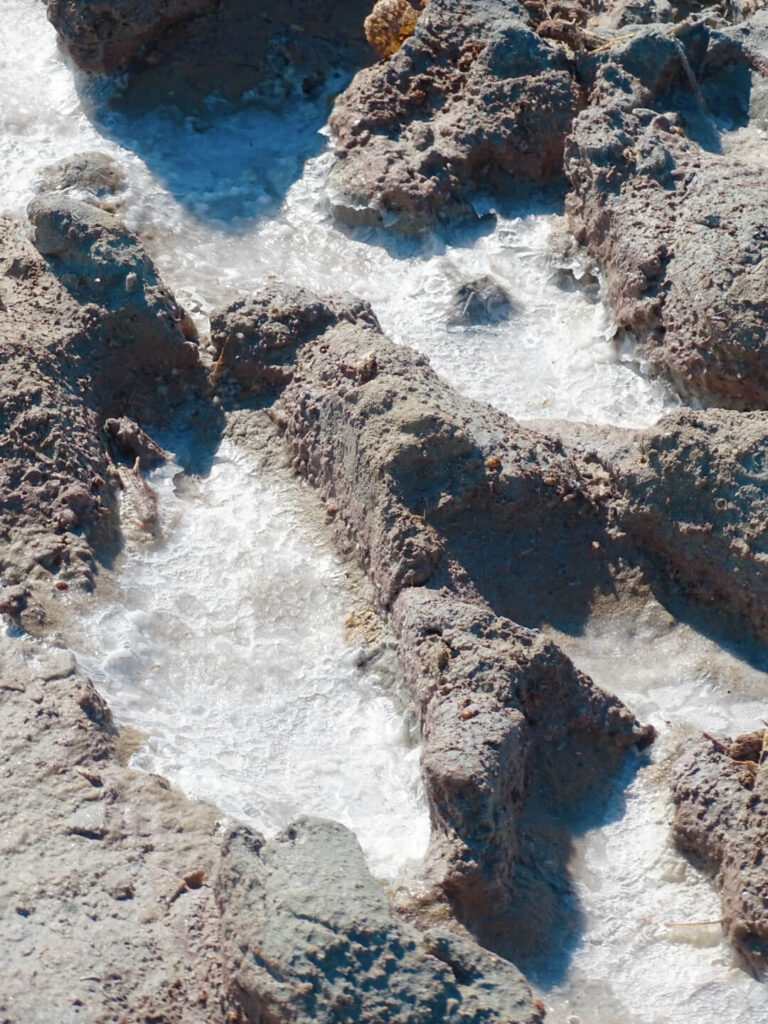
Worse yet, a toxic lakebed was revealed, rich with chemicals and salt residue. Wind blows this into populated areas, creating respiratory problems and other health issues for local populations.
Can the Aral Sea ever recover?
Jury’s out, but a complete recovery of the Aral Sea is deemed near impossible. In particular, the southern part of the lake in Uzbekistan is in a dire situation compared to the northern section in Kazakhstan, which has benefited from the Kokaral Dam funded by the World Bank.
A partial recovery is underway, but it’s a tricky job without completely pausing agricultural processes that the country’s economy relies on. I hear that thousands of trees are being planted in an effort to tackle the toxic soil (however, I didn’t see evidence of this during my trip – the land seemed very bare).
Sadly, a modern barrier is global warming: shrinking glaciers in mountain regions further reduce the volume of water reaching the Aral Sea.
So, why visit (and is it safe?)
Some people would think you were mad for wanting to visit a toxic lakebed, and they may have a point!
However, I found the Aral Sea a fascinating and mind-boggling place that was well worth visiting. Not only is it a living (ish) piece of history, but it’s a sobering tale of man’s involvement with nature. And, since it may not be here forever, it’s somewhere to visit now rather than potentially never.
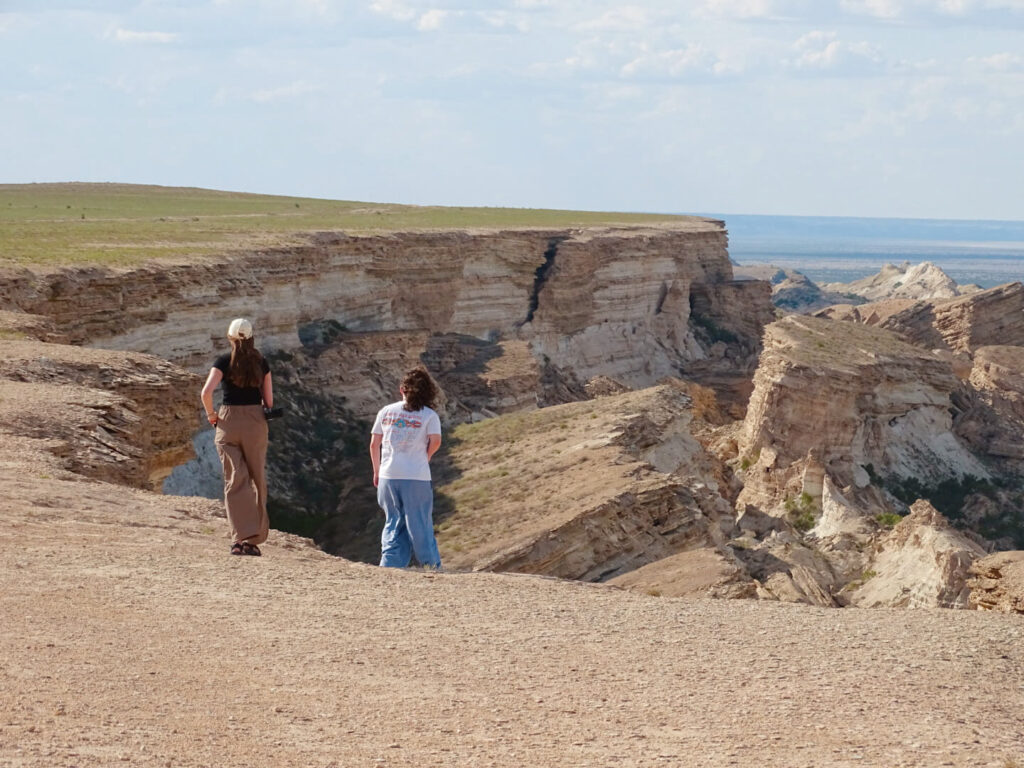
Also, you see spectacular scenery on the drive there, unlike anything else I saw in Uzbekistan. If your trip mainly encompasses cities like Bukhara and Khiva, it’s a way to get off the beaten path and see rural Uzbekistan.
When to visit?
Your bet is the ‘shoulder season’ of spring (April-June) and autumn (September-October) when it’s not too hot.
We visited in early June, and it was hot but not scorching. With the environment getting hotter these days, I think even late June could be excruciating if there’s a heat wave, which there was a few weeks after I visited in 2026.
Winter (November-March) can be freezing, plus infrastructure is limited with many accommodations and restaurants closed. Check with local tour operators if they’re still running.
Can you visit by public transport?
Yes and no.
You CAN visit the Moynak ships by public transport (from Nukus).
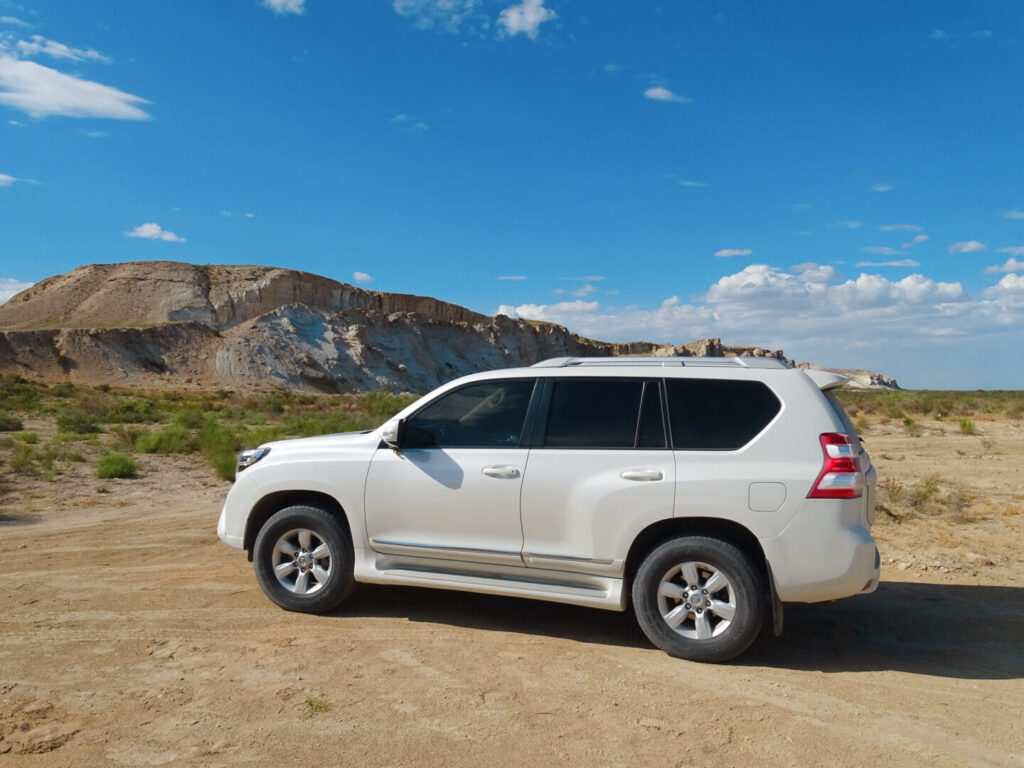
You CAN’T visit the Aral Sea by public transport because there is none. You need a 4×4, so taking a tour is your best bet. There’s no official road (our driver was clearly following a mental map), so I wouldn’t recommend self-driving, even if you have your own vehicle.
Is a tour worth it?
The tour price is a bit expensive ($170 pp with a minimum of three required), so it depends on whether you’re set on seeing the lake AND the ships. Moynaq is a long way from Khiva, so I was happy to see more of the region, even if it meant more driving!
The $170 pp includes all transport (Nukus to Moynaq then switching to a 4×4 for the off-road section to the lake, and back again), accommodation in a yurt (shared with the members of a group), and four meals (lunch and dinner on day 1 and breakfast and lunch on day 2).
The meals were always very generous. Dinner and breakfast were cooked at the yurt camp, while lunch on both days was at the same restaurant in Moynak. We had kebabs, dumplings, noodles, meat, veg… It was a feast!
We also had a driver and an English-speaking guide.
Given local costs in Uzbekistan, it’s a little expensive. But given that it’s the only way to experience the region, I felt it was worth it, and had a fun and memorable few days.
It helped that I had a great group of other like-minded solo female travellers. Obviously, if you’re travelling alone, you can’t guarantee great company OR even finding enough people who want to go on the same dates as you (however, I think it’s likely if you contact a local tour company a few days in advance).
Other things seen on the tour
As well as the mesmerising colourful rock formations that I’ll share photos of soon (which aren’t accessible without a tour as they’re in remote desert locations), another highlight of our tour was stopping at the Mizdakhan Necropolis in Karakalpakstan.
Yes, visiting a cemetery may sound odd, but it’s been a poignant part of many of my trips now. The architecture and traditions tell you a lot about a country’s culture. Ultimately, death is an inevitable part of life and not universally seen as sombre and sanitised, like it is in the West.
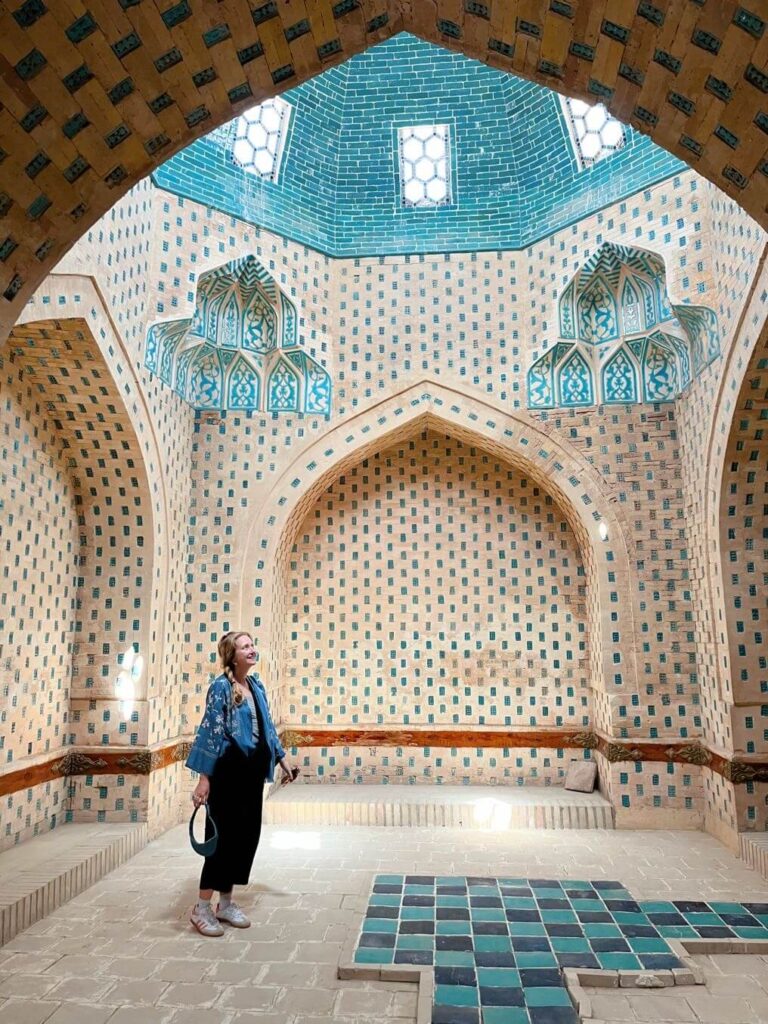
We saw stunning underground tombs decorated with intricate tiles, and learnt about the myths and legends of those resting here.
Getting from Khiva to Nukus (a necessary stop-over)
Although there are trains (usually requiring a change in Urgench) and a public bus, the easiest way to travel – especially if you can get a group together – is by taxi.
I paid 120,000 ($10) in a taxi when splitting the ride with three others. If you book the ride via your accommodation, they may be able to co-ordinate with local drivers so you can join some other travellers. I booked through Central Park Hostel who arranged for us to make a sunset stop at a fort along the way. The total journey time is just under 3 hours.
Where to stay in Nukus
There are plenty of budget homestays and hotels. We opted for the one our hostel in Khiva recommended, Danexan Apa. The location is a bit random, however you can easily call an affordable Yandex via the app, so it’s easy to get around.
Danexan Apa has dorm beds from $7, and the rate includes a decent breakfast. For other meals, there’s a restaurant offering local food. It took forever to come but it seemed decent in quality.
Getting from to Nukus to Moynaq (if you don’t do a tour)
Although there isn’t loads of information online, there ARE buses that run between Nukus and Moynaq.
Buses depart from Sarancha Bus Station in the west of Nukus, departing at 9am. A return service from Moynaq departs daily at 3pm. Be sure to arrive slightly early as buses may depart once full regardless of scheduled times.
You may even be able to get a Yandex from Nukus to Moynaq if a driver accepts. You could ask him to wait for an agreed price, or take the bus back.
The driving time is 3-4 hours.
What else to do in Nukus?
Savitsky Museum of Art – expecting to find the world’s second-largest collection of Russian Avant-Garde art in this nondescript city? Well, me neither. Yet it’s well worth visiting; some travellers visit Nukus especially for it, even if they’re not visiting the Aral Sea. The curator risked his life to protect the collection during Stalin’s rule, and revealed it after 1991 when Uzbekistan gained independence.
The bazaar – it’s no different from other Uzbek bazaars in other cities but it’s still a great place to visit if you have spare time. We wiled away time here before our transfer back to Khiva. Buy fruit, cakes, and premade salads and noodle dishes.
Visiting the Moynaq ships
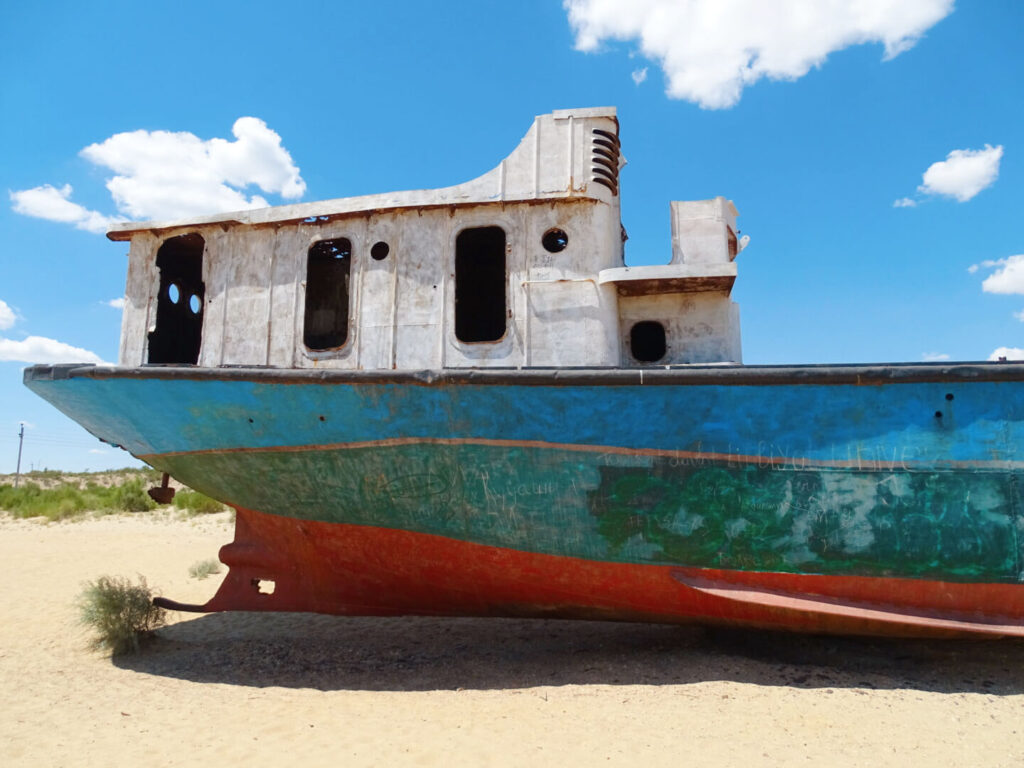
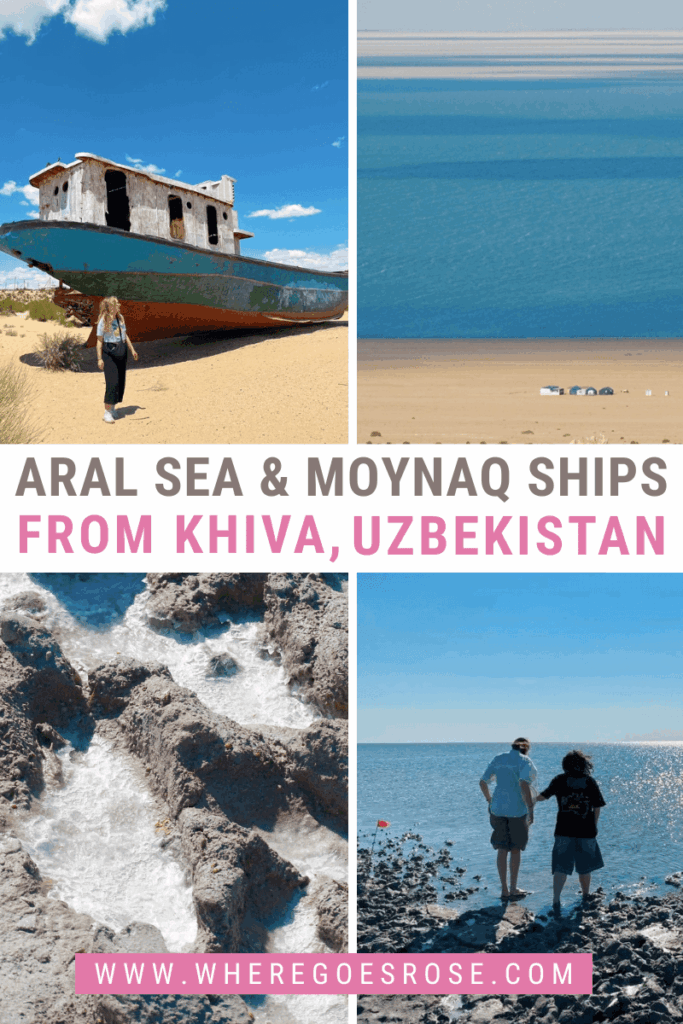
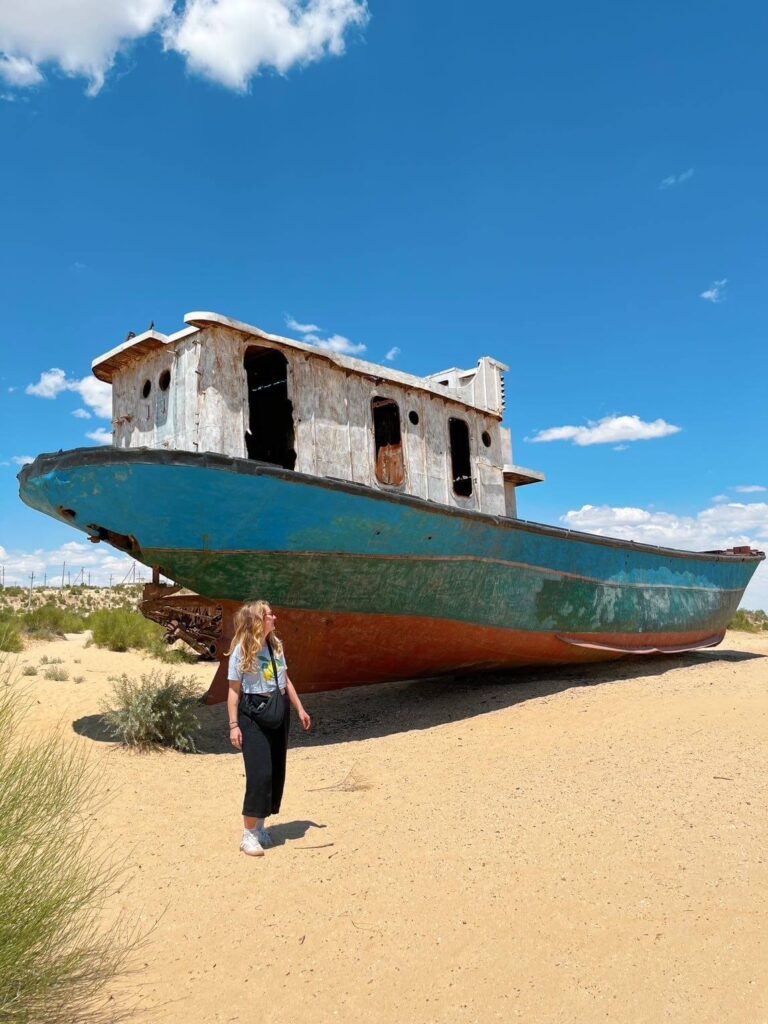
After a long drive from Khiva to Nukus then Nukus to Moynaq (around 7 hours in total), we finally laid eyes on the famous ships.
If part of me felt like it was a LOT of travel time for a site that doesn’t need more than a 30-minute stop, the eerie feel of the place made up for it.
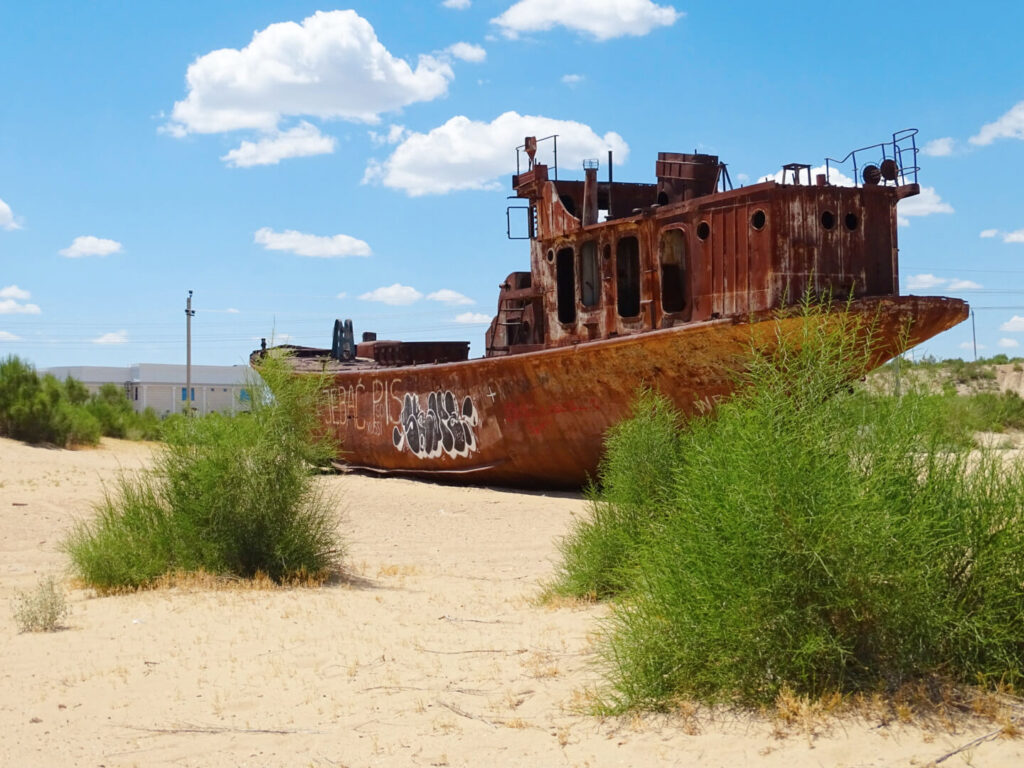
There is a large collection of ships here, from those retaining their original colours and paintwork to rusty old tankers, splattered with newer graffiti.
The site is exposed, so be sure to pack sun protection, especially if you’re visiting in the summer months like I was.
Lunch and beginning our off-road adventure
The Moynaq ships are where the adventure ends for those exploring the region with public transport. Since we were taking a tour, we switched to a 4×4 off-road car in Nukus during our lunch stop.
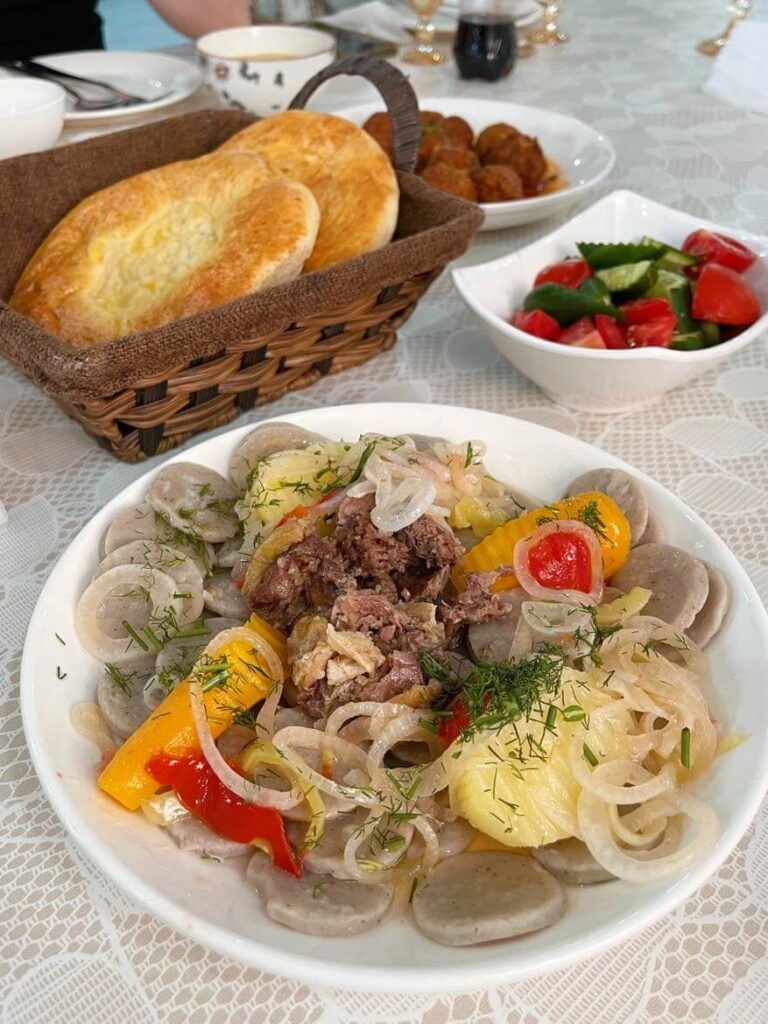
FYI, if you’re considering taking a tour and wondering about the food, I’ll say it was great. We stopped at the same restaurant for lunch both days. We had a feast, including dishes I’d not tried elsewhere in Uzbekistan. Since visiting Kazakhstan, I realise these are more Kazakh than Uzbek, likely influenced by how close we were to the border.
We had manti (dumplings), shashlik (meat kebabs), and even fish (luckily NOT from the toxic lake: we checked even though we were fairly certain no fish can live there now). I enjoyed the dish pictured below; although the grey-ish cubes don’t look amazing, they were made of corn and pretty tasty – apparently a Kazakh favourite.
A change of scenery
After getting in our 4×4 for the next 24 hours, we watched as the scenery – and the roads – changed. When I say roads, I really mean the lack of roads in this inhospitable place. I could immediately see how hard it would be to visit independently because there’s no clear road, only tyre tracks in the sand.
We learnt we were travelling through Aralkum, the ‘new’ desert region revealed by the retreat of the Aral Sea. Forty years prior, it would have been underwater.
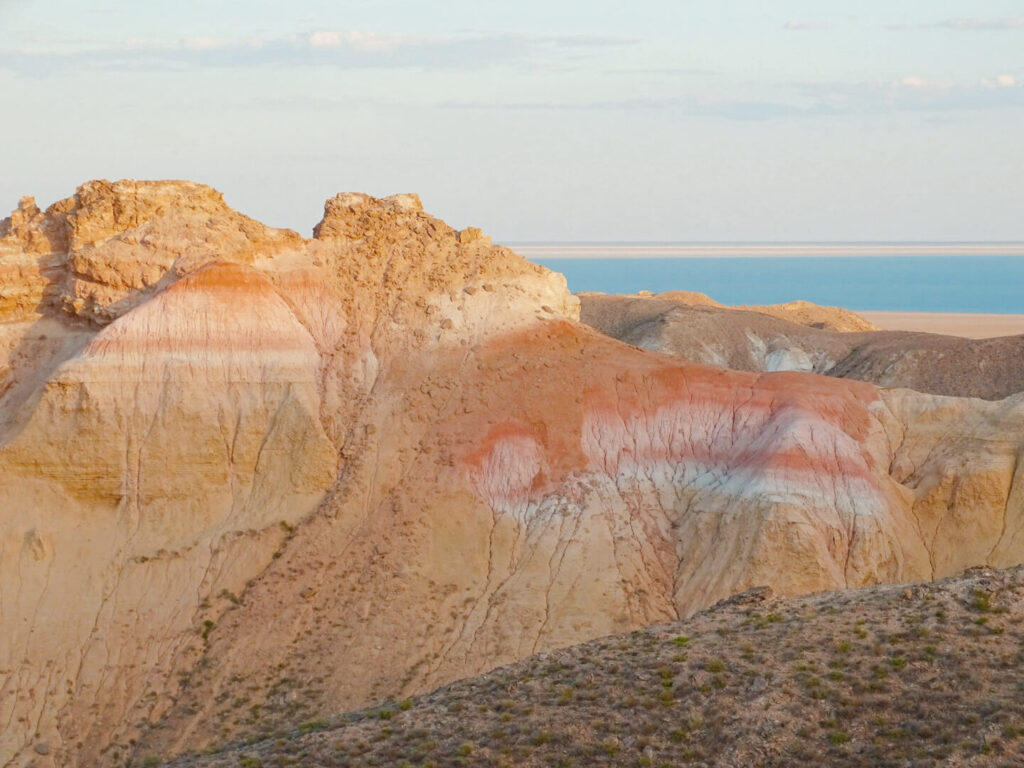
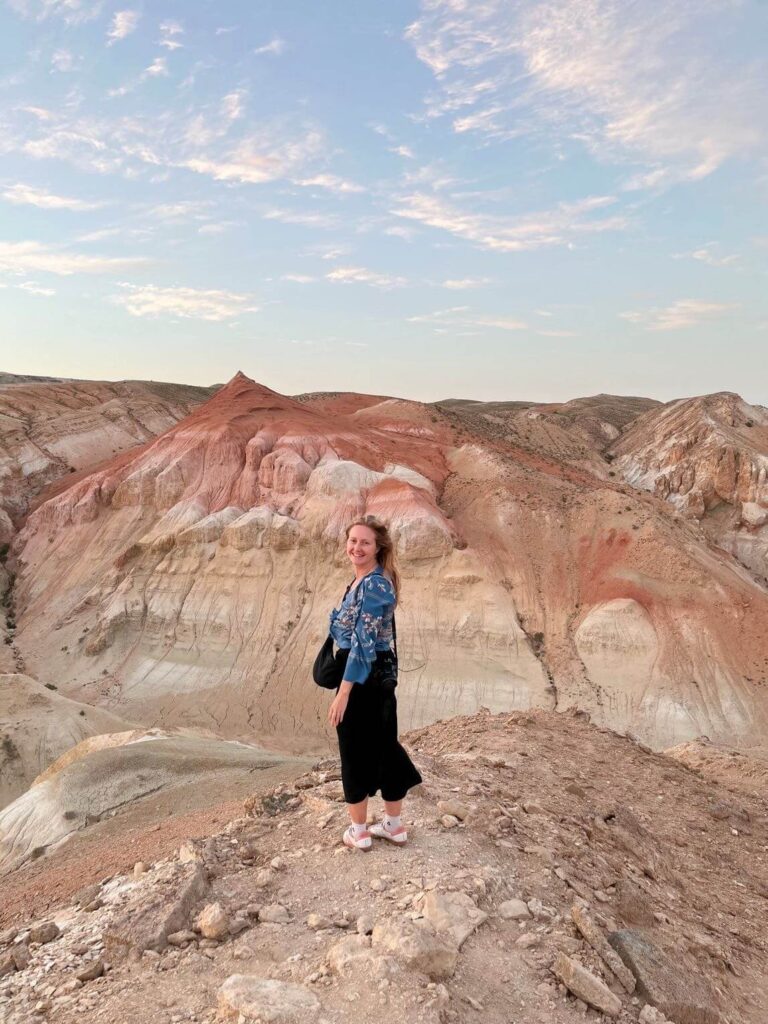
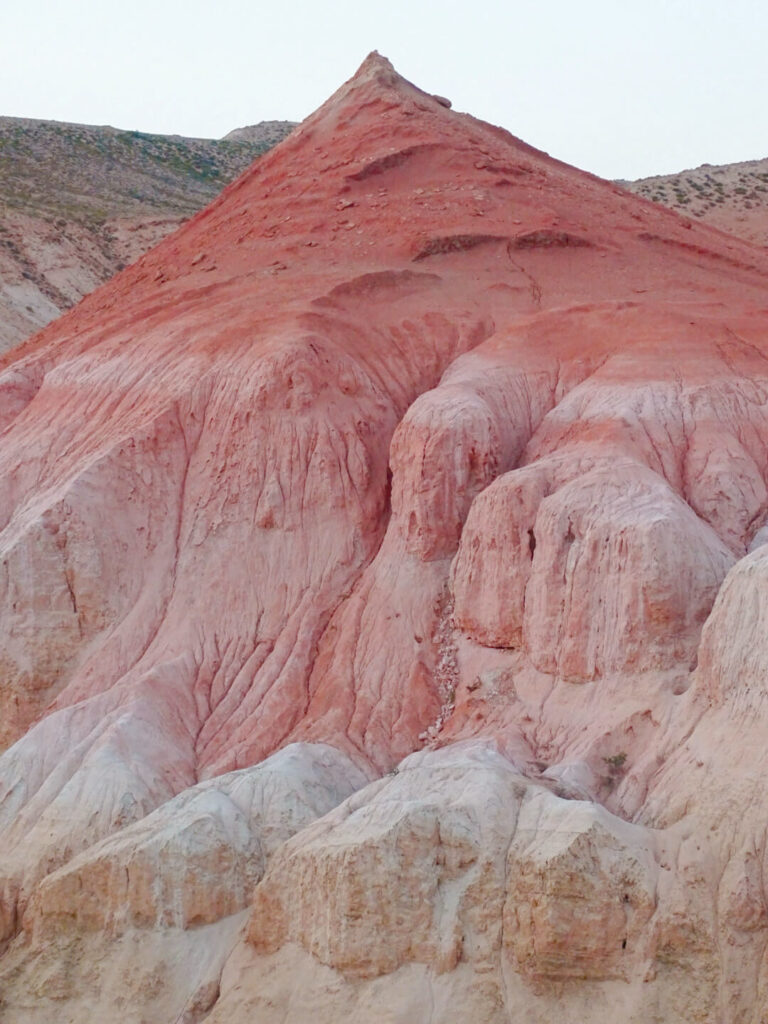
I expected the arid, desert-like scenery, but I didn’t anticipate quite how stunning the region would be. We stopped to take photos at colourful rock formations that reminded me of photos I’d seen of the Mangystau region of Kazakhstan; not surprising since we were so close to the border.
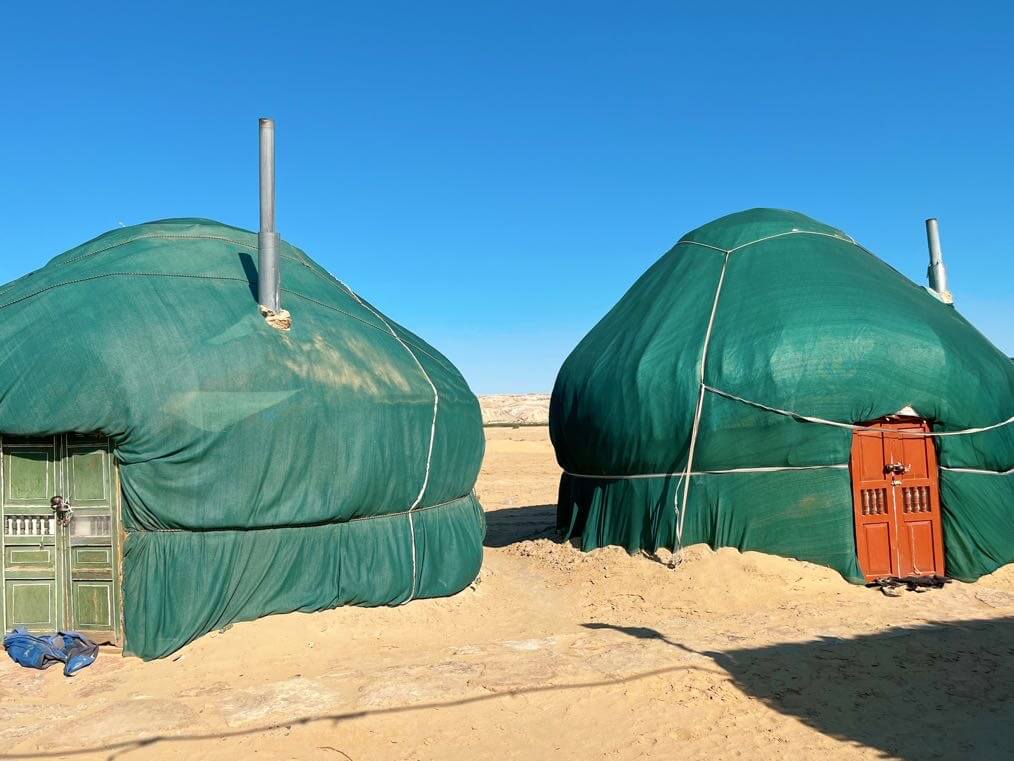
Finally, we arrived at camp. The four of us passengers shared a ‘yurt’ (not exactly like the ones I’ve since stayed at in Kyrgyzstan, as this had a steel structure, which made it rather hot).
Dinner was chicken, potatoes, salad… and the offer of copious amounts of vodka! When booking, our guide hadn’t asked us any questions about our dietary preferences but had confirmed multiple times how many people wanted vodka. We said none, so naturally they provided four bottles. The Soviet era may have ended, but the fondness for vodka has apparently not.
Visiting the Aral Sea
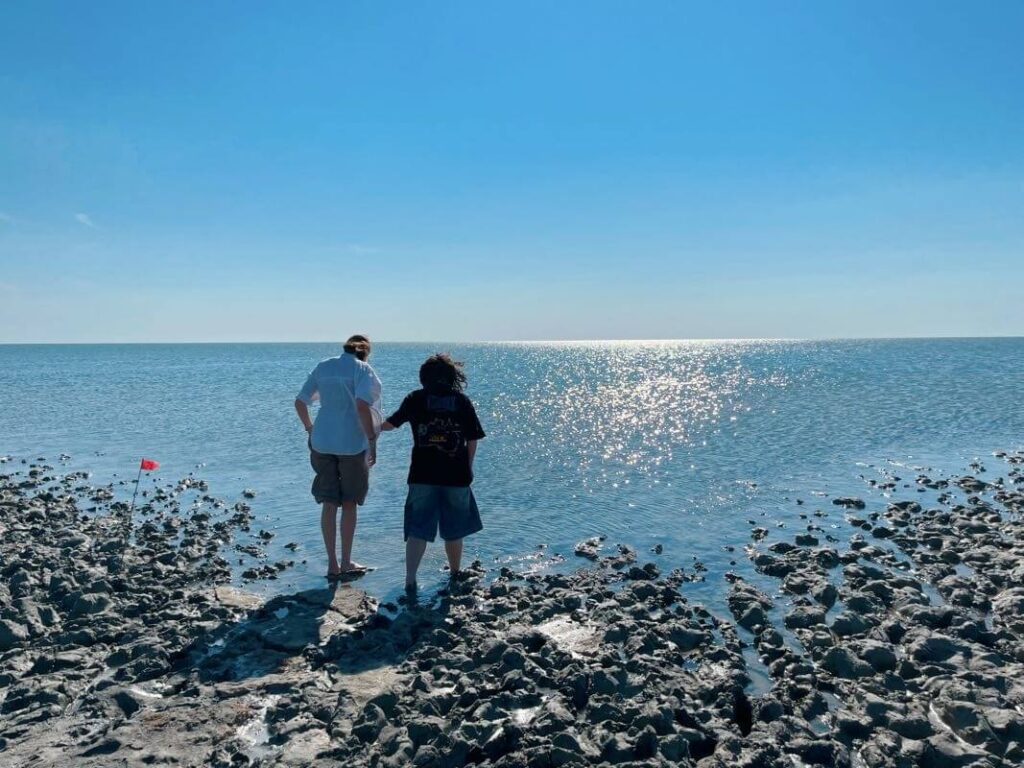
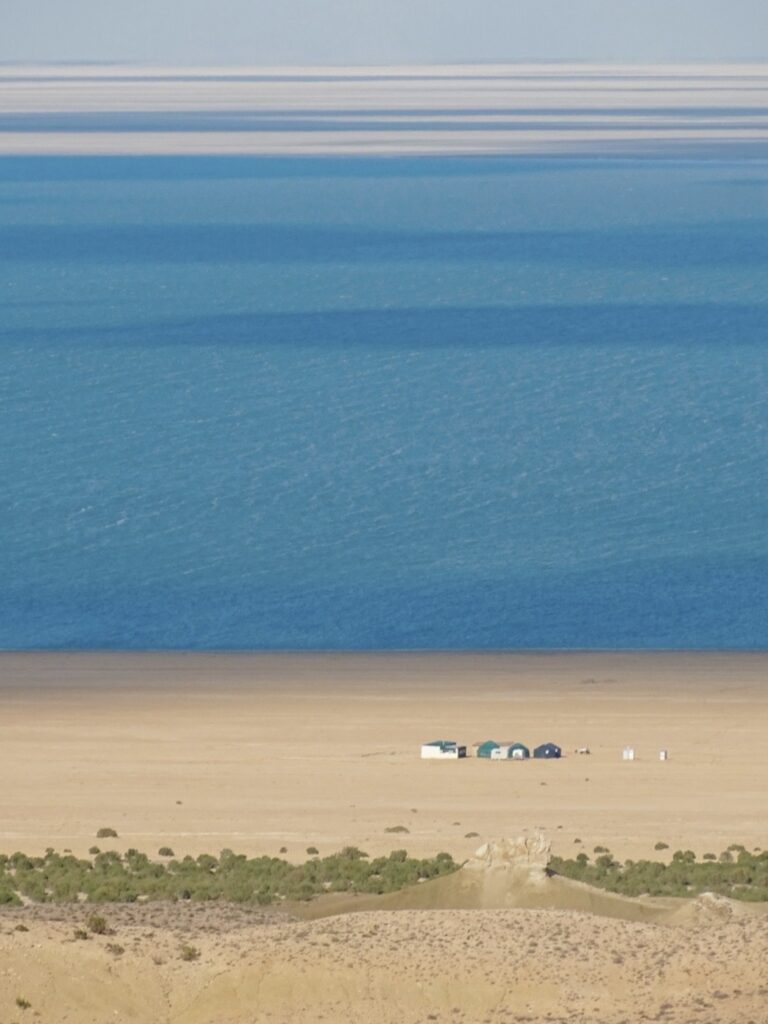
The following morning, after breakfast, we had the chance to visit our long-awaited final stop of the remaining Aral Sea. Presumably, our camp had been constructed on the banks of the lake, but given how the water is continually receding, it’s now a few hundred metres away. Our driver motioned for us to hop in the car to visit.
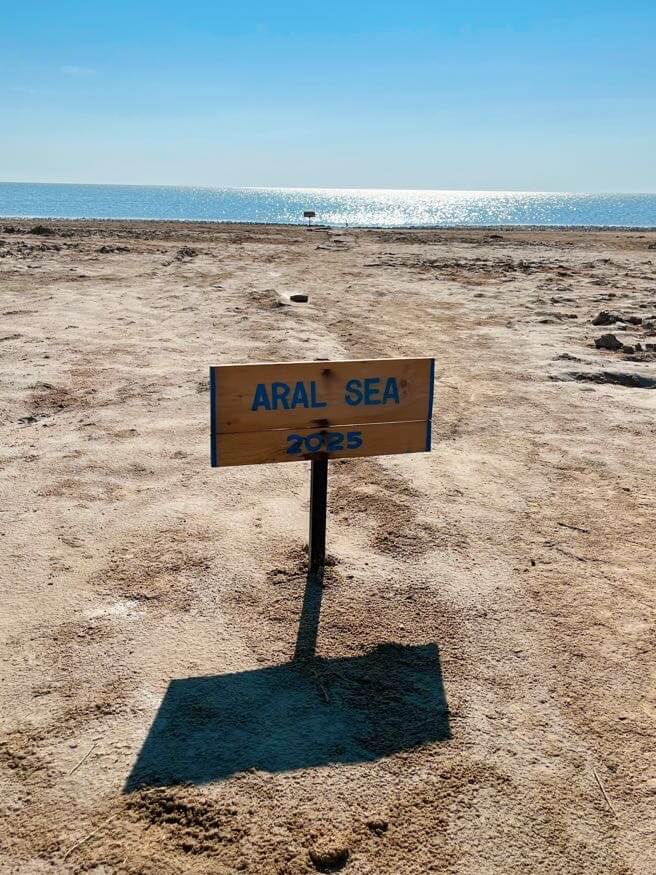
Once we reached the shore, we could see how fast the water is receding. Each year a post is added to the sand, stating the current year. We could see that the 2025 post was at least 10m from the water’s edge, while even the 2026 post was a few metres back (I visited in June 2026).
We went for a – potentially toxic – paddle in the very muddy waters where we kept sinking. Not the most enjoyable, and certainly not the cleanest, but it felt wrong to come all this way without feeling the Aral Sea on our toes. It felt like our long journey was complete.
Speaking of very long journeys, our upcoming day included driving back to Moynaq, changing from our 4×4 to a regular car after lunch, then driving back to Nukus. I wish we’d stayed overnight rather than transferring back to Khiva the same day as we didn’t arrive until almost midnight. Such a long day!
Final thoughts on visiting the Aral Sea
This trip was such a memorable part of my time in Uzbekistan, breaking up a trip that would otherwise have been predominantly about architecture and cities. I’ve loved delving into the history and seeing all the beautiful buildings in Khiva, Bukhara and Samarkand, but sometimes found it a bit ‘samey’.
The Aral Sea excursion couldn’t have been more different. It was a glimpse into the darker and more contemporary post-Soviet history, plus a change of scene thanks to the mind-bending colourful rock formations that leave you thinking ‘is this Planet Earth?’.
If you have the time and budget to visit the Moynaq Ships and Aral Sea from Khiva, I highly recommend it.
Thanks for reading!