Jaylen Brown says NBA agents steer players from community

The Celtics star turned 76er said representatives prioritize deals over local reinvestment and that players who resist face media pushback
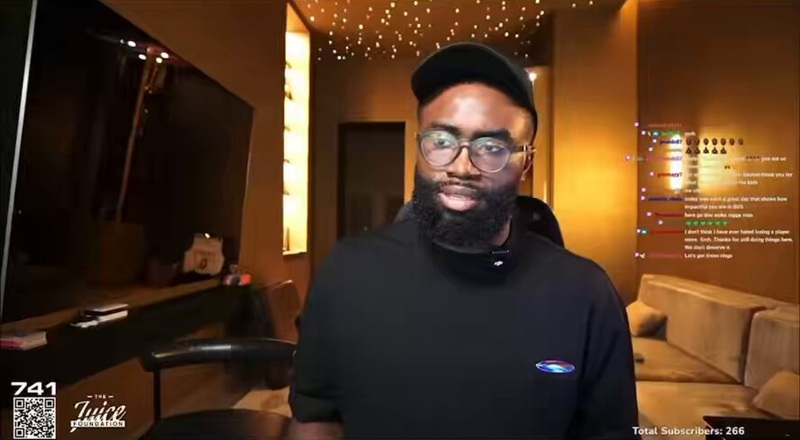
Jaylen Brown used a Twitch livestream to say agents and handlers steer NBA stars away from community investment because “there’s no benefit for these people that are representing.” He recalled his own experience after signing his $304 million extension — the community work, the media backlash, and the labels that followed. Kyle Kuzma later responded with a counter-argument. Shared by @thechat101 on X, the clip has more than 5.2 million views.
Brown said the people around many of the league’s most influential players push them away from being present in their communities. He said it requires a real strong mind and some real courage to resist that pressure. As a result, he feels that those who do resist are labeled. He cited the specific characterization that “they said I had a disease.”
Commitment to Building the Next “Black Wall Street”
Jaylen Brown recalled the period when he signed his five-year, $304 million extension with the Boston Celtics in 2023. Children from his programs stood behind him at the announcement. Brown publicly committed to building something akin to “Black Wall Street” in Boston and to investing in the city. He said that is what he and his organizations proceeded to do and that the work continues beyond Boston, with plans to expand.
“Black Wall Street” refers historically to the Greenwood District in Tulsa, Oklahoma. This district was a prosperous early-20th-century African American business community destroyed in the 1921 Tulsa Race Massacre. Brown used the phrase as shorthand for concentrated, locally rooted economic development intended to address racial wealth gaps. That commitment developed into Boston XChange, a nonprofit aimed at generating substantial wealth for communities of color in the city, with backing that included Jrue Holiday’s family foundation and partnerships involving MIT and Harvard Business School.
The organization has been described as targeting a multi-billion-dollar scale of impact over time through entrepreneurship support and accelerators rather than one-off donations. Boston later designated October 24, Brown’s birthday, as Jaylen Brown Day.
The Label That Followed the Work
When a player resists the pressure and pursues community, Brown says they get labeled. He cited the specific characterization that “they said I had a disease” and that he is called “the smartest person in the room and all this type stuff.” Brown framed those labels as a response to his efforts “for just trying to uplift my community and showing respect to the places that I came from.”
Shortly after the Celtics traded him to Philadelphia in July, Fox Sports’ Colin Cowherd cited two anonymous league sources — an executive and a scout — who described Brown as having a “disease:” As Brown quoted, the “disease” was believing he is the smartest person in every room. Furthermore, Cowherd’s sources elaborated that this led to tuning out coaches, bosses, and eventually teammates once compensation grew large. Cowherd also criticized athlete livestreaming. Brown responded on Twitch that “the bar is low” in sports media and that he was tired of anonymous sources. With that, he named Cowherd along with other media figures.
JB has long described community work as a priority dating to age 18. He entered the league without a traditional agent at one point. Back then, he cites calculations about fees and the players’ union. His critique of the agency model predates this clip. It also forms part of his longer argument about how money and advice flow around young athletes.
No Financial Incentive to Build Communities
Brown broadened the point to corporations and the entities that represent them. He said the people who represent those corporations “do not want you to be like that.” They “do not care about your community. They care about dollars.” He added, “Everybody only cares about dollars. I feel like that’s the problem with the world, chat.”
The core claim is that agents and managers typically earn percentages on playing contracts and certain deals. Place-based community development — real estate, local business ecosystems, education pipelines, lending access — often does not produce the same immediate, commissionable upside as a shoe deal or a standard endorsement. Brown’s argument is that this misalignment of incentives systematically pulls talent and capital away from the neighborhoods players left.
He has separately discussed the agency model, citing high rates of former players losing wealth and arguing that representatives who cannot help an 18- or 19-year-old maintain and grow wealth should not be in that role.
A Fellow Player Offers a Different View
Kyle Kuzma of the Milwaukee Bucks posted a multi-part response on X that acknowledged Brown’s frustration while disagreeing with parts of the framing. Kuzma argued that many handlers lack business-building expertise, that players share responsibility for whom they empower, and that “invest in your community” can mean unsustainable personal subsidies rather than sound investments. He cited commercial real estate as more viable than, for example, buying a relative a shop.
Kuzma also argued that rebuilding something on the scale of Black Wall Street should not rest primarily on athletes and that players should first stack capital and then pursue larger projects with institutional partners. His response generated its own cycle of coverage and became a central counter-narrative to Brown’s argument.
The exchange between the two players highlighted a divide in how athletes view their role in community development — one emphasizing structural barriers, the other emphasizing personal responsibility and practical investment vehicles.
X Split on JB’s Claims
Commentary was supportive among users who already viewed Jaylen Brown as community-oriented or who interpret sports media as hostile to independent Black athletes. Many treated the remarks as confirmation of a known but rarely named dynamic.
One user wrote, “Wasn’t Kanye saying the same thing?” linking Brown’s handler narrative to earlier public claims by Kanye West. Another said, “Hell @stephenasmith will definitely be the first to sign up to help destroy any Black Athletes career or perception.” A third wrote, “This is why he’s not in Boston and why I’ll forever be a Jaylen Brown stan — it’s deeper than basketball.”
A smaller but visible set rejected the premise as an excuse. Some argued that wealthy athletes can act regardless of advisors. One user wrote that Brown is “mad his advisors won’t let him spend billions he doesn’t have on a ‘black Wall Street.’” Conspiracy-adjacent posts appeared, with one user claiming, “They’re going to find a way to silence him.” Kyle Kuzma’s subsequent thread became a central argument against Brown’s sentiments.
From Boston to Philadelphia, the Work Continues
The Celtics traded Brown to the Philadelphia 76ers in July. The franchise cited financial and luxury-tax considerations under the collective bargaining agreement. The move surprised many observers given Brown’s production — he averaged 28.7 points, 6.9 rebounds, and 5.1 assists in his final season in Boston — and his tenure with the franchise. He had been a Celtic for a decade, drafted third overall in 2016, and had grown from a raw prospect into a five-time All-Star and Finals MVP.
Brown later said he felt disrespected by people he thought valued him and that he was more motivated to win in Philadelphia. He has already held community events in his new city, including at the Francis J. Myers Recreation Center. The Juice Foundation work continues, with the Bridge program and Boston XChange still operating. On August 30, he hosted “741 Frequency Fest” on Boston Common. Approximately 10,000 people attended, according to estimates from his stream. He received a key to the city and a commemorative street sign referencing his impact on Boston.
The Twitch clip about handlers and Black Wall Street came from livestream activity during this period — after the trade, after the farewell event, and as he begins his next chapter in Philadelphia. The work he started in Boston continues. The work in Philadelphia is just beginning.