Grimanesa Amorós Turns a Site of Passage into Light

Following “RADIANCE,” we turn to “PASSAGE” and “MARITIME,” two works shaped by place.
Created in Istanbul, the installations draw from the city’s history of movement, migration, and exchange. Amorós works with what already exists, and builds from architecture, water, and memory.

Istanbul, Turkey, 2025.
Courtesy Grimanesa Amorós Studio.

The Peninsula Hotel, Istanbul, Turkey.
Courtesy Grimanesa Amorós Studio.
The Pulse of Istanbul
These projects involve much research and intense travel. What helps you stay grounded when moving between places?
Grimanesa Amorós: Experience, my routines, and a belief in being romanced by the unknown.
I do not fight the unknown; I let it inspire me instead.
My routines keep me centered, like waking up and having my morning coffee while getting ready for the day. Simple things help me stay grounded, especially when traveling from place to place. Sometimes I have to remind myself where I am, and these seconds of normalcy help me be present.
I do not fight the unknown; I let it inspire me instead.
“PASSAGE” and “MARITIME” were created as a pair. How did you decide what belonged outside on the tower, and what belonged inside in the lobby?
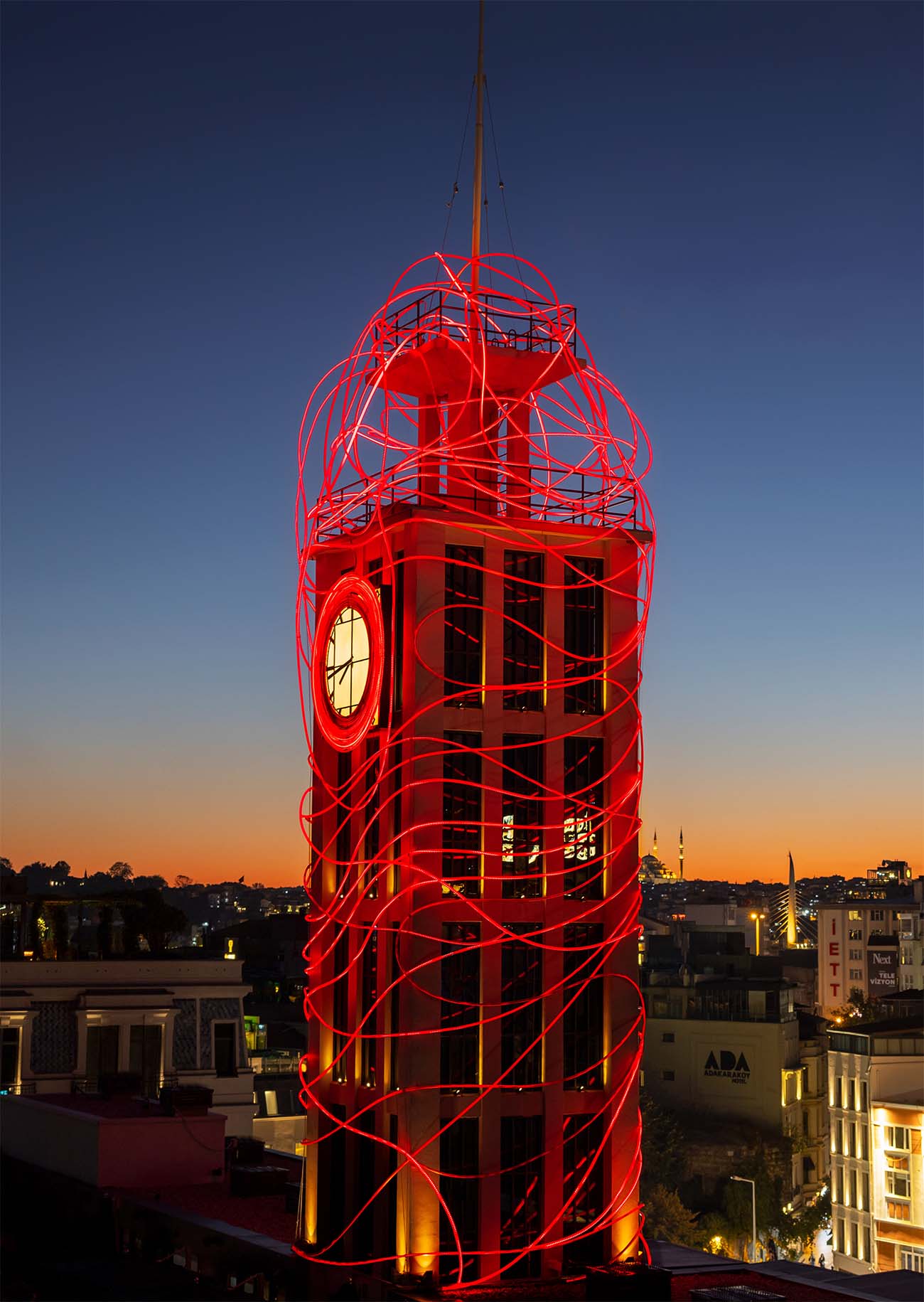
Amorós: “PASSAGE” was surrounding the clock tower, it was the “beacon,” the first thing people saw when The Peninsula was a port stop. It could be seen from the outside, so it was a public work, accessible to all.
“PASSAGE” becomes a part of The Peninsula Hotel’s clock tower. The building was once home to Çinili Han; the former passenger hall where travelers awaited transit. This space was deeply embedded in the rhythms of migration, serving as a site that regulated human flow. By reactivating this location through light, I highlight how built environments retain collective histories, even as their functions evolve.
I am always fascinated by how people move through a space, what is seen, and what essence already exists there.
The 1910s clock tower that used to be a practical anchor for those in transit has become symbolic.
The work extends from the uppermost point of the building, the first terrace, where travelers once stood to wave goodbye or hello to loved ones. Walking through the lobby of The Peninsula echoes the physical paths and trajectories of those who passed through. The work speaks to the dualities of passage: inside and outside, departure and arrival, memory and presence.
“MARITIME” is the waves and water from the Bosphorus, but to access it you enter a private space.
Inside was the flow of history, outside was the signal of optimism.

Istanbul, Turkey, 2025.
Courtesy Grimanesa Amorós Studio.
Grimanesa Amorós on the Color of Istanbul
In “PASSAGE,” red is the main color. Why did you choose red for Istanbul?
Amorós: Red is drawn from Turkey’s cultural and historical glossary and becomes a bridge across time. It speaks of the city’s imperial legacy, revolutionary fervor, and contemporary dynamism.
My experience has taught me that I have the tools to tackle any obstacle.
Red is the pulse of Istanbul, from the Turkish flag to the tiled interiors of mosques and the vibrant markets that continue to welcome newcomers.
In “PASSAGE,” red becomes a visual carrier of remembrance, transformation, and continuity. It is a beacon for those who have moved through this place and for the cultural heritage they carry with them.
The clock tower sits in a place shaped by movement and waiting. When you begin researching a site, what do you look for first?
Amorós: I first look at its history; even new spaces have history, although short.
I am always fascinated by how people move through a space, what is seen, and what essence already exists there. To progress, one must look to the past to improve the future.
“MARITIME” feels dreamlike, but it also points to the real state of the sea. How do you keep that balance?
Amorós: Growing up by the Pacific, I have studied the waters of different states, its strength, its calm, its power. It is both beautiful and dangerous. The “dreamlike” nature reels people in, but it is the reality that keeps them looking, pondering the work’s intention.

The Peninsula Hotel, Istanbul, Turkey.
Courtesy Grimanesa Amorós Studio.
“MARITIME’s” formation becomes a vessel, one that carries memory, movement, and light across expanded geographies. Referencing nautical history and ancient modes of navigation, the piece invites viewers to consider journeys; physical, historical, and emotional. It is charted across both water and time, along with the untold and spoken stories of the waves of adventure, while also commenting on the unbalanced state of our seas.
The light sculpture’s form suggests a globe yet resists fixed borders, alluding instead to the fluidity of identity. The piece twists and turns internally, exploring the delicate ecosystem of the sea. This ever-shifting artwork holds not only the stories of waters and waves, but the pressing responsibility to protect them. The light component of the sculpture explores its surface like waves or constellations, echoing the way early travelers once relied on stars and tides to cross unknown distances. “MARITIME” reminds us all of the rise of tides and the regression of coastlines, often accelerated by our trade, travel, and neglect.
Installing “PASSAGE”
There is a video showing a large crew and crane installing the work. What part of install day still makes you nervous?
Amorós: My experience has taught me that I have the tools to tackle any obstacle. My father always said, “When we are kaput, is when we can’t do anything; there is always a way.”
I trust myself and my abilities to navigate anything that comes my way; romance with the unknown.
You’ve said there is never any waste, and that materials are reused after an installation comes down. What is one reuse you are especially proud of?
Amorós: I am very lucky; many of my works are kept, but the very few are reused in the studio as a library and reference for my upcoming projects.