Global Citizens Club for Kids: Virtual Trip to China: Homeschooling China: Chinese Crafts for Kids & Activities

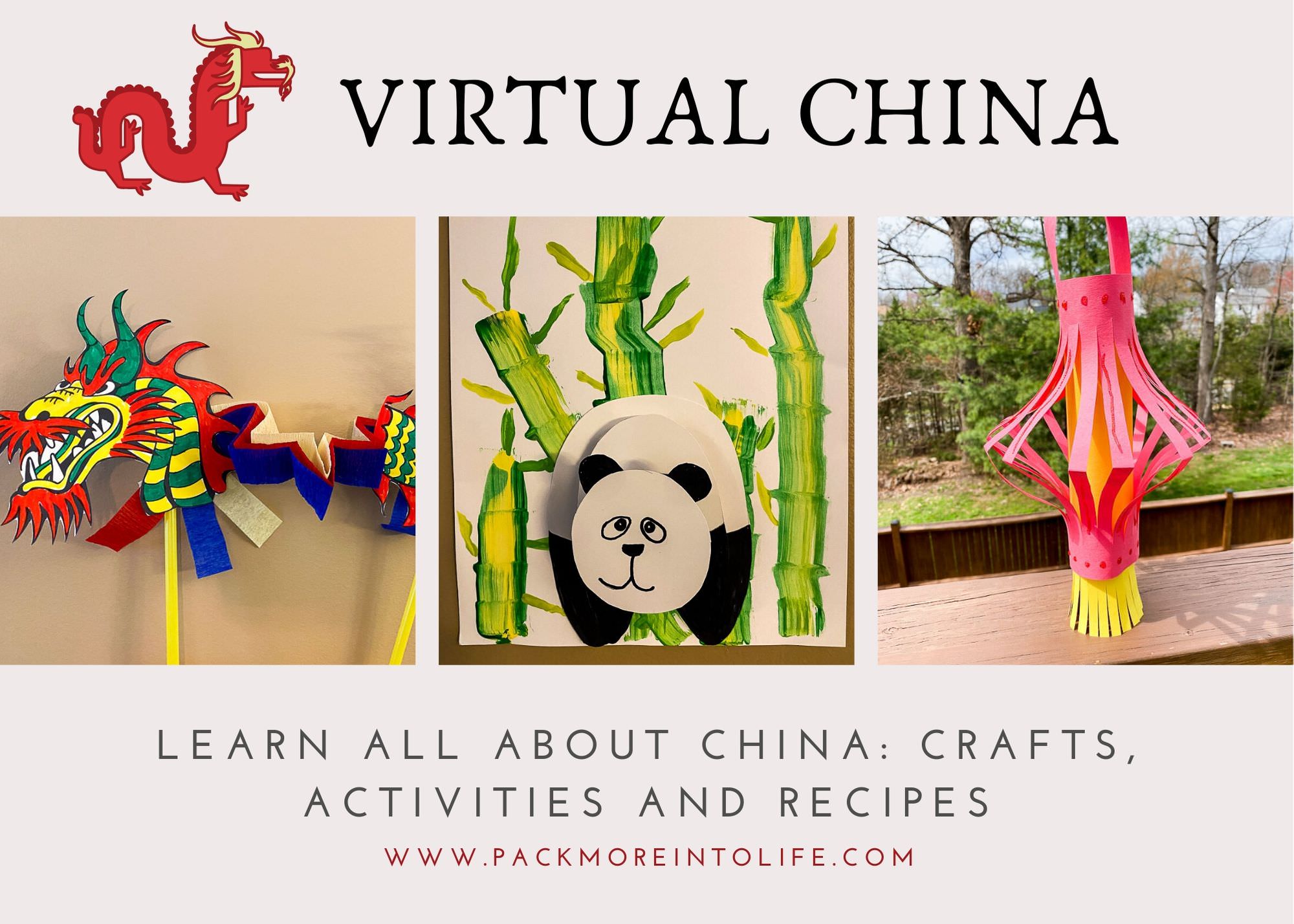
Join us for a trip around the world as we “virtually” learn about different countries, cultures, foods, music and famous landmarks with Chinese crafts and activities. Each week we will post about a different country with tons of great activities to engage with children of all ages. This week we will be learning about China. Join us on an adventure around the world with Chinese New Year crafts for kids and lots of fun activities! This unit is perfect for homeschool families, travel-loving families, and teachers with our sample Chinese lesson plan.

Grab this fun passport kit as an add-on to our global adventures. The kit includes a “passport”, stamps, stickers and other items to get kids excited about their adventure. You’ll see our passport used throughout the lessons. It’s perfect for our homeschooling China unit.
Each unit we locate the country of study on the map and complete our passport as we progress through the different activities. It makes it seem like we are really traveling the globe together!
Save this China Lesson Plan for the future.

Want to travel to more countries? Check out all of my previous travel units by clicking on the name of the country.
Be sure to read through all the chinese craft ideas & activities, gather or purchase any needed supplies (most are what you have around the house) and then decide which activities you’d like to cover each day. Each activity has suggestions on how to modify it for younger and older children, but feel free to get creative and share your experience with us.
The following activities works great as a Chinese New Year lesson plans for preschool aged children, toddlers or elementary students.
If you like a schedule, here is a suggested 3-day “schedule” to complete all the Chinese New Year classroom activities. It makes a great schedule for a China homeschool unit.
Day One
- Read Books About China
- Locate China on the map and do the map activity
- Create a Chinese flag
- Listen to Chinese music
- Learn some Chinese phrases
- Pick some Chinese Crafts for Kids from the list
Day Two
- Make your own Chinese egg rolls for lunch
- Learn about famous landmarks and make your own model of the Great Wall of China
- Have fun with Chinese New Year activities and Crafts
- Learn some Chinese acrobatics
Day Three
- Watch Moulan on Disney +
- Read some Chinese Folktales
- Enjoy a Chinese dinner complete with Soup, and Chow Mein
- Plan a Field Trip or your future trip
All About China for Kids
- Mandarin is the official language of China, but there are many different languages spoken in China, including Mandarin, Yue, Wu, Minbei, Minnan, Xiang, Gan and Hakka.
- China is officially known as the People’s Republic of China and is located in the continent of Asia.
- The Great Wall of China is the largest man-made structure in the world, stretching an incredible 8,850 kilometers (5,500 miles).
- China has the largest population in the world with more than 1.3 billion people.
- Ancient China was a land of inventions. The Chinese invented paper, the magnetic compass, printing, tea porcelain, silk, and gunpowder.
- Chinese New Year is celebrated each year between January and February with parades, feasts with family, fireworks and time off work (15 days).
Books About China for Kids
We found quite a few great books for kids about China. We’ve included a few options that you can either purchase on Amazon via the links or you can reserve them at the library for a low-cost option. Grab a few options, even if the reading level is too high for your child, they can still look at the pictures and maps or have an adult read the book to younger children.
Do your kids enjoy watching YouTube? I know my son is always finding fun little videos. Here is a great video with beautiful scenes from all around China.
China Map Activity
China is a country located in Asia. It is the third-largest country in the world. China has the maximum number of neighbors touching its border. The 14 countries touching its border are India, Pakistan, Afghanistan, Tajikistan, Kyrgyzstan, Kazakhstan, Mongolia, Russia, North Korea, Vietnam, Laos, Myanmar, Bhutan, and Nepal. Beijing is the capital city of China.

If you have a globe, help your child(ren) locate China on the map. If you have the passport kit from Amazon, it comes with a fun colorful map that you can hang up.
- Ask your child what they know about China
- Write down any questions your child has about China
Print the map below (right-click on the image, save it and then print).
Color China GREEN on the map. Then use different colors to show the various countries.
You can use watercolors (like we did), crayons, markers or colored pencils. I’ve linked to our favorites if you need more supplies.

Preschool Kids: Color the map
Elementary Ages: Talk about the various regions. Ask questions about the map:
- What is the Capital City of China? Mark the capital on the map with a star and write Beijing.
- The highest point in China is Mount Everest, which stands at 8,848 m (29,028 feet), find it’s location and highlight it on the map with a mountain shape. Add the name “Mount Everest”.
- The Great Wall of China is the longest man-made structure. Draw your own wall between China and Mongolia.
China Flag Activity
The Chinese flag is a red flag with one large star in the upper left corner with four smaller stars surrounding the larger star. The red of the Chinese flag symbolizes the communist revolution, and it’s also the traditional color of the people. The large gold star represents communism, while the four smaller stars represent the social classes of the people
The flag of China was officially adopted on October 1, 1949.

Make a flag of China.
For preschoolers, practice cutting and gluing with the instructions below.
Older kids can choose to paint or hand draw and color.
For this craft, all you need are: (if you need supplies, click on the links)

Step 1. Practice how to draw a star on the yellow piece of paper, parents might need to help with this part. You need one large and four smaller stars.

Step 2. Cut out the stars (parents might need to demonstrate).

Step 3. Glue the stars on the red background according to the Chinese flag photo.

Voila! Your child has created the flag for China. Hang it up somewhere or find a stick/dowel and attach it. We’ve been adding our flags on a string hanging down the stairs.

Chinese Recipes
Grab the kids and make your very own egg rolls! Your kids can choose which fillings they prefer in this fun hands-on recipe.
Egg Roll Making Supplies
- Egg Roll Wrappers
- Soy Sauce
- Ground Ginger
- Rice Vinegar
- Vegetable Oil
- Cornstarch
- Egg
Filling Ideas
- Cooked Chicken
- Cabbage
- Carrots
- Pork
- Mozzarella and Meatball (non-traditional)
- Bacon and Cheese (non-traditional)
Kids will love helping to make their own egg rolls. Get creative with different items to put inside the egg rolls. Here are some ideas for non-traditional egg roll recipes. Here is the recipe we used to make the egg rolls.

Step 1: Lay out all the ingredients.

Step 2: Saute the cabbage, chicken, shredded carrots and other veggies in some vegetable oil for 5 minutes.

Step 3: Mix together your sauce according to the recipe and pour it over the mixture, cooking another 3 minutes.
Step 4: Scoop the filling onto a single sheet of egg roll wrapper.

Step 5: Fold the sides in, then the back flap and finally the front flap. Add some egg white to seal the front flap.
Step 6: Put the egg rolls onto a cookie sheet, spray with vegetable oil and then cook on each side for 6 minutes.

It took me a bit of practice to get the folding technique right, but eventually, my son and I were a pro! We even tried a meatball, marinara, and mozzarella egg roll. They were both delicious.

Not quite sure you are ready to tackle making your own egg rolls? Visit a Chinese Restaurant to try new foods (or order take out). Some of our favorite Chinese foods include:
- Dumplings (dough with filling)
- Chow Mein (stir-fried noodles)
- Peking Duck
- Sweet and Sour Pork
- Spring Rolls
Ready to cook a delicious traditional Chinese family-friendly dinner? Here are a few of our favorite recipes.
- Chinese Corn Soup – crunchy corn kernels and chicken broth make up this easy Chinese Corn Soup. Add chicken for a heartier meal.
- Chow Mein – a Chinese dish of stir-fried noodles with vegetables and sometimes shredded meat like chicken, beef, pork or seafood.
- Chinese chicken and broccoli – a popular Chinese takeout dish.
Chinese Folktales
Chinese Folktales are a major part of the countries history and proud traditions. Stories are loved by both the young and the old. Folktales and are used to teach important values such as moderation, the value of promises, respect for one’s elders, why you should follow the ways of the culture, justice, and injustice, and the power of wisdom.
Chinese folklore is influenced by the country’s religions and beliefs. The animals in Chinese folk tales often have human characteristics and can speak and perform tasks in the same manner as humans.
Here are some of our favorite stories for children that you can read online:
Looking to add to your library collection? Here are some other books below.
Chinese Music
Listen to traditional French music while you complete the activities. Ask Alexa to play “Traditional Chinese Music“, or check out this youtube video with scenes from China with six hours of music to enjoy while you do crafts and learn about China.
Make your own music with this Chinese pellet drum. Pellet drums are popular with street vendors in China who use them as noisemakers to attract customers. In China, this drum is called taogu, or “rattle drum.”

Here is the instruction to make your own DIY pellet drum. Click on the links to purchase supplies or head to Michaels Craft Store (US-based).
Supplies Needed:
Step 1: Paint the bottom (outside) of the two paper plates red (or another color if you’d like).
Step 2: While the paint dries, cut two 8″ pieces of string and tie on a bead to the end. Make sure you double knot it.

Step 3: Paint a design on the outside of your drum. We choose two Chinese characters.
Step 4: Once the paint is dry, tape the dowel to the inside of one plate. Make sure the handle is long enough for kids.

Step 5: Put glue around the outside edge of the plates and glue the two together. Wait for the glue to dry.
Step 6: Punch a hole on either side of the paper plates and tie the string with the beads. You want the bead to hit the center of the drum (paper plate).
Congrats! You’ve made your first Chinese Pellet drum. Was this Chinese drum craft easy? Find me on Facebook and show me yours!
Animals Native to China
China has a vast area of landscape and is home to a great variety of wildlife. China has the third-largest number of mammals in the world. The most well-known animal is the Giant Panda. Other animals that are native to China are the Asian elephant, North China leopard, the golden snub-nosed monkey, and the Pallas cat.

The Asian elephant is slightly smaller than the African elephant. The elephant uses its trunk for drinking, grabbing, breathing, and smelling. The Pallas cat is almost the size of a domestic cat, but it has a long dense fur coat. Their fur changes color depending on the season.
The North Chinese Leopard is one of the world’s Big Cats, but there are only 100 leopards left in the wild, causing the North Chinese Leopard to be on the endangered animal list. The golden snubbed nose monkey is very rare and can only be found in Southwest and central China.
The giant panda is part of the bear family and its body is covered by a thick black and white coat. The majority of their diet composed of bamboo, which they spend 12 hours of the day eating. If you like Panda’s, check out our Panda craft below.
Want to learn even more about animals that call China their home? Check out this fun video to learn about eleven animals that live in China.
Panda Craft
Supplies Needed:
- Yellow and Green Paint
- Paintbrush
- Scrap piece of cardboard (1″ x 1″)
- Piece of white paper/cardstock
- Panda Template (see below)
- Black Sharpie
- Scissors
- Glue
Step 1: Put one dot of yellow and then two dots of green next to the yellow.

Step 2: Use the construction paper to slide the paint down the paper. Stop every 1-2″ and slide left or right by 1cm and then return to the center. The slide will make it look like segments of bamboo.
Step 3: Fill the paper with bamboo and then paint leaves using two different colors of green paint.

Step 4: While your bamboo dries, print the image below or freehand the image on a piece of white paper.

Step 5: Using the black sharpie. Color the bottom of the legs, ears and facial features. Mine looks a bit different because I did a freehand of the image. Lucky for you, I gave you the printable version above.

Step 6: Cut out the body parts and make two loops out of extra construction paper.

Step 7: Glue the largest part of the body to the bamboo background.

Step 8: Glue the two loops to the back of the panda’s smaller body part. Glue that to the center of the large body piece.
Step 9: Make an accordion shape out of a piece of construction paper and glue it to the back of the panda’s head. Then glue it to the body of the Panda. Don’t forget to glue on the ears too.
Now you’ve got an adorable bobble head panda. We hung ours on the wall and my son likes to jiggle his head as he walks by.

Famous Landmarks
China has so many iconic walls, cities, palaces, temples, gardens, and UNESCO sites.
The Great Wall of China is one of the most recognized. It was built over thousands of years as a defense system against invading soldiers from other countries. It is currently the longest man-made structure in the world, with over 13,170 miles of wall.
The Great Wall is about 2,700 years old and was built by over 1 million laborers. It receives over 50 million visitors every year who come to admire its construction.

In order to understand the amount of time it took to build such a large structure, kids should attempt to build their own Great Wall of China. You can use legos, keva planks, playdoh, Melissa and Doug giant brinks or brick-sized rice Krispie treats.
We decided to use a combination of play-doh and LEGO Minifigures. We used this brick maker from our kinetic sand kit to make bricks out of the playdoh and then our son made them into his wall. We stacked higher towers and added fire signals.

Once his tower was complete, he added ladders and LEGO Minifigures to complete the scene. It was a fun way to show how much thought and effort went into making the Great Wall of China over thousands of years.
China has many other notable sites including the Forbidden City. It is an area of Beijing, China, that contains the former imperial palaces, to which entry was forbidden to all except the members of the imperial family and their servants. Zhangjiajie National Forest Park is the inspiration for the movie Avatar and is well known for its giant sandstone pinnacles rise skyward from the valley floor.
The Shaolin Monastery is a Chan Buddhist temple in the Henan Province of China. It is believed to have been founded in the fifth century, the Shaolin Temple played a historical role in spreading Zen Buddhism and martial arts to Japan, Korea, and other countries.

West Lake in Hangzhou is a place that Chinese people call “paradise on earth”. It is a beautiful landscape with mountains and Chinese-style arched bridges near the lake. There are tree-lined walkways, islands, and hill to bike around or cruise along the lake.

Chinese Crafts for Kids & Activities
There are so many fun crafts that you can do to learn more about China. Many crafts pair well with Chinese New Year crafts for kids which takes place between January and February. I’ll share some of our favorite Chinese crafts for kids below. If you find more activities that you love, please share them with me and I’ll add them to this list.
1. Coloring Pages – Click the link for tons of great coloring pages
2. Chinese Dragon Craft
Dragons in China are very important and seen as a symbol of window, power, and luck. Unlike scary dragons in the US, Chinese dragons are seen as kind and benevolent. We will make a fun dragon puppet craft for kids to enjoy. The paper dragon puppet is great for kids because they can play with it and make it dance around when they are finished.

Supplies Needed:
Step 1: Print out the image below.

Step 2: Color the head and tail of the dragon.
Step 3: Cut out the head and the tail. You can either cut around the design or leave a bit of white.
Step 4: Cut three colors of crepe paper to 12″ long (30cm).

Step 5: Fold the paper in half and then in half again. Cut the paper in half to form 6 pieces of crepe paper.
Step 6: Take 3 layers and stack them on top of each other. Fold them into an accordion style.
Step 7: Tape the three-piece of accordion-style paper to both the head and the tail of your dragon.
Step 8: Tape one plastic straw to the head and one plastic straw to the tail (cut off the bendy part if you have a bendy straw).

Step 9: Cut 3″ strips of crepe paper using the three strips that you have left. Fray the bottom of the crepe paper pieces.
Step 10: Tape the 3″ strips of crepe paper to the bottom of the dragons head and tail.

Voila.. you have a beautiful Chinese New Year dragon craft to enjoy. Children can dance around the room with their DIY Chinese dragon.

3. Chinese New Year Lantern Craft
Chinese lanterns are one of the most easily recognized features of Chinese culture. They are used not only as a source of light and simple paper decoration, but they also symbolize good luck, social status, and vitality. Historians believe that the Chinese first began making the now traditional lanterns during the Eastern Han Dynasty (25–220).

There are three types of lanterns in Chinese culture: the hanging lanterns (most common), the floating lantern (used during lantern celebrations) and the flying lanterns (released into the night skies).
If you are looking for easy Chinese new year craft ideas, start this with this project. In this craft, we will make homemade paper lanterns. They are very easy to make and perfect as a Chinese new year craft for preschool students.
Supplies Needed:
Step 1: Take one sheet of red paper and fold it in half. You can either go lengthwise or widthwise.

Step 2: Mark a line every 1″ and cut (leaving 1″ at the top). We used fun scissors. Grab some HERE.
Step 3: Open up the paper and wrap the two ends around to meet each other, forming the lantern.
Step 4: Glue or tape the two ends together.

Step 5: Cut a 2″ strip of paper on the short side of a piece of construction paper to use for the handle.
Step 6: Glue or tape the handle to the lantern.

Step 7: If you’d like to add “light” inside your lantern, roll up a piece of yellow construction paper. Make sure you find the right size to fit into your lantern. Tape the roll together and then slide it into your lantern.

Step 8: Glue or tape the yellow tube inside your lantern. You can insert it in fully or let the bottom hang out and then cut frills into the paper as beams of light.
Step 9: Decorate your lantern. We used glitter paint and ribbon.
Did you have fun experimenting with different shapes and styles of lanterns? Did you know lanterns were really created to keep the wind from blowing out the candle in Ancient China? Pretty smart, right?

Chinese Inventions
China has been credited with many inventions over its thousand-year history. Some of those inventions include papermaking, the compass, gunpowder (fireworks) and printing. In addition, kites were first used as a way for the army to signal warnings (as well as signal fires) and umbrellas were invented to protect against the sun as well as the rain.
We are going to explore two Chinese inventions. Chinese papermaking and terraced farming.

1. Paper Making Ancient China
Among the many Chinese inventions, paper and printing were among the most important Chinese inventions and changed the world. Paper was invented around 100 CE, during the Han dynasty. The first paper was made from rags, but later plant materials were used, such as bark, hemp, and bamboo.

Supplies Needed:
- Paper Scraps (newspaper, construction paper)
- Dye (food coloring)
- Plastic containers (Tupperware)
- Paper Making Screen (or make your own below)
- Paper Towels/Dish Towels
Looking for an easy solution? Buy a kit HERE.
If you want to make your own papermaking screen, here are the instructions. Grab an old photo frame (the larger it is, the bigger the paper). Take out the insides and just leave the frame. Glue in some window screening or mesh around the edges. Use the insert to measure the size of the screening/mesh. Let it dry and you’ve got a paper screen.
Step 1: Cut or rip up scrap pieces of newspaper or construction paper. We used newspaper and just cut out the white parts.

Step 2: Place the pieces into a container and add water to cover the paper. Add food coloring if you’d like. Let the paper sit overnight for 12 hours.
Step 3: Transfer the paper into a blender. Make sure you have enough water to make the blender work. Pulp the paper.
Step 4: Lay your screen over a larger dish (to catch the water).

Step 5: Scoop the paper onto your screening. You can use cookie cutters to make shapes. You want a thin layer.
Step 6: Use a paper towel or kitchen towel to push the paper into the screening and push out the water.
Step 7: Once the paper is dry enough, flip over the paper from the screen onto a towel to dry.
Step 8: Let the homemade paper dry overnight.
Homemade paper works great as teacher gifts, for mother’s day or a fun gift for friends. They are easy to make a cost-effective. You can also write your name in Chinese characters and frame it.
2. Terraced Farming
Supplies Needed:
Step 1: Take a ball of Play-Doh and place it in the center of the tray. Explain to your child that China has many hills and mountains, which is good usable land, but difficult to farm.

Step 2: Have your child pour a bit of water over the mound of play-doh. What happens? Why did all the water run off the play-doh onto the tray?

Step 3: Farmers in Ancient China designed terraces in the hills to make a flat surface to farm on. This also allowed the water to stay on the crop and not wash them down the side of the hill. Have your child make a terraced hillside.
Step 4: Pour the water on the new design and see what happens. Did the water stay in the flat areas? How is this better for farming?
In order to grow more food, the ancient Chinese built terraced fields for water conservation which made it possible to grow rice in hilly areas. They figured out how to use land that was at first unusable into terraced fields.
Chinese Acrobats: Get Moving!
Chinese acrobatics is a wide range of acrobatic acts, balancing acts, coordination, demonstrations of physical skill and Chinese stories and is traditionally performed by a troupe in China. There are two styles of performances: Martial Arts or Circus.

Grab all the members in your family, invite some friends or if you have a small family like ours, mom and dad get to play too! There are four elements of Chinese acrobatics, try an activity or two from each.
1. Flexibility and balance: See how flexible each member of the family is.
Can you touch your toes? Do the splits? Lay on your belly and touch your toes to your head?
Test your balance by standing on one leg, then try to touch the ground in front of you, to the left, to the right and behind you without falling over. Find a rock and see if you can stand on it with only one foot. Time each other to see how long each person can last before falling over.

2. Group coordination: Pick a favorite dance and see if you can all stay together or create your own moves to your favorite song. Here are some favorites that are family-friendly.

3. Chinese music and theater: Use your pellet drums to create your own music show or use one of the Chinese folktales to create a theater performance.

4. Martial arts: The Chinese are known for their Kung Fu. Practice your moves with kicks and punches in this ancient Chinese art. You can also play Just Dance Kids Kung Fu Fighting.

Family-Friendly Chinese Movies
There are so many great family-friendly movies set in the country of China. The hardest part is picking which option to watch! We watched Mulan to go along with our China unit, but we’ve seen the majority of these.
Mulan(rated G)- The movie about a young Chinese woman who disguises herself as a man to enter battle in her ill father’s place delivers a positive message of staying true to yourself.
Kung Fu Panda 1, 2, & 3 (rated PG)- Jack Black as Po the chubby panda and extremely unlikely martial arts hero is funny and memorable.
Mickey Mouse Clubhouse: Around the Clubhouse World (Rated G)- Along with countries like France and Egypt, Mickey and the gang visit China and have to figure out a hack for getting over the Great Wall. Perfect for the 5 and under crowd.
Disneynature Born In China (Rated G)- “Born In China” follows the adventures of three animal families — the majestic panda, the savvy golden monkey, and the elusive snow leopard. It is a documentary and not a movie, but great for animal lovers. You can download an activity packet from the Disney website to use with the documentary.
You should be able to find the movies on Amazon, Netflix or Hulu. If you’d like to buy the DVD, click the photos below.
Learn Mandarin Phrases/Words
Learn more about China by practicing a few Mandarin words. Mandarin is a language made up of characters and they represent words or phrases rather than sounds. Chinese writing has over 50,000 characters, but only 20,000 are used today. Chinese is considered one of the hardest languages to learn. The video below will teach you some basic greetings such as Hello, Thank you and You’re Welcome.
Want to learn more Mandarin? Download the Duolingo app for daily practice.
My 5-year-old is a huge fan of Little Passports, a monthly subscription service for kids focused on global learning. They have two versions, Early Explorers is meant for ages 3-5 years of age and it focuses on various themes such as music, oceans, and dinosaurs.


World Edition is meant for children 6-10 years of age and it focuses on a different country each month. One of the countries that is included in the series is China, which is a perfect pairing with this week’s lessons.


After the
first month (when kids receive their world map and suitcase), your child will
receive souvenirs, activity sheets, photos, stickers for their map and
suitcase, and access to more activities online.
Field Trip: Chinese Style
Expand your learning with a visit to a Chinese Garden.
- The New York Chinese Scholar’s Garden in Staten Island, New York, USA
- Lan Su Chinese Garden in Portland, Oregon, USA
- Liu Fang Yuan or the Garden of Flowing Fragrance, Chinese Garden at the Huntington Library in San Marino, California
- Seattle Chinese Garden in Seattle, Washington, USA
- The Astor Court in the Metropolitan Museum of Art in New York, USA
- The Margaret Grigg Nanjing Friendship Garden in the Missouri Botanical Garden in St. Louis, Missouri, USA
- Robert D. Ray Asian Gardens in Des Moines, Iowa, USA

Attend a Chinese festival in your area or visit a local Chinese restaurant to immerse yourself in the culinary delights. Chinese New Year is a great time to visit Chinatown and see if they have a parade scheduled.

Plan your trip!
If you loved learning about China and are looking to plan a trip, check out these great resources from our family travel blogger friends. They’ve got all the best insider tips and tricks.
Have your sights set on Beijing? Check out these tips for planning a trip with the kids to Beijing.
Looking to visit the Great Wall of China? Don’t miss these tips for visiting the Great Wall from our travel blogger friend Kyla.
Visit Shanghai like a pro with these top family activities.
I hope you’ve enjoyed taking a virtual trip to China with your kids. Learning about new countries and cultures can be a fun experience for both children and adults. I created this travel blog for families to inspire others to travel and create memories with their families.
Don’t miss our first Virtual trip to Greece, Virtual trip to Japan, Virtual trip to England, Virtual trip to Switzerland, Virtual trip to Brazil and Virtual trip to France. Click the link to head to that post.
Please share your fun activities with me on Facebook or Instagram. Looking to plan an adventure with kids, but not sure where to start? Check out my top posts on my homepage to discover more of our favorite places to travel with kids around the globe.
Like this post? Save it and help spread the word!
Disclaimer: Pack More Into Life is a participant in the Amazon Services LLC Associates Program, an affiliate advertising program designed to provide a means for sites to earn advertising fees by advertising and linking to amazon.com and its partners. Amazon and the Amazon logo are trademarks of Amazon.com, Inc. or its affiliates.